The purpose of this assignment is to gain experience in constructing a parser. The parser will parse input typed by the user at a prompt at the keyboard. (Bonus credit is available for creating an applet -- see below.)
Like writers of natural-language parsers, your goal is to parse input from a user in order to determine its meaning -- and, from there, to judge whether or not what the computer is being told is true. Unlike writers of natural-language parsers, your task is simplified in that you will only have to parse input statements which are syntactically correct logical statements. Such statements are usually easier to prove or disprove than general, free-form assertions. In this assignment you will write a program that converts sentences into syntax trees. Assignment 8 will address the question of whether or not those sentences are true.
On execution your parser should present the user with a prompt
Type a logical statement >at which the user can input arbitrary logical expressions. Logical expresions consist of the symbols described in the chart below (in the section The grammar to parse) strung together according to a natural grammar (specified precisely below).
For example, the user might input
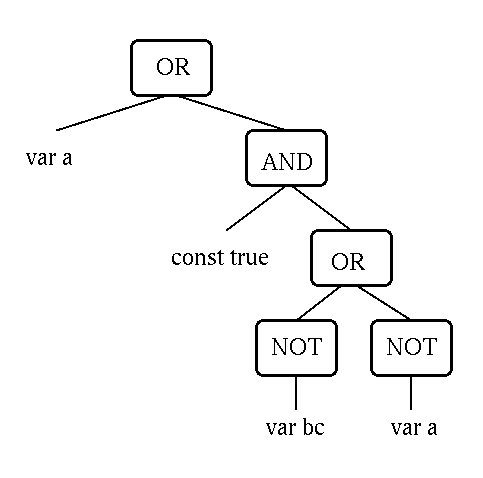
Type a logical statement > a + 1 * (bc' + a')As a logical statement, this input would mean "a OR ( true AND ( NOT bc OR NOT a ) )". Note that variables can consist of more than one character (though only lower-case, alphabetic characters with no whitespace are allowed). The parser must create a syntax tree in the form of a Polylist and then print out that tree in prefix form as an S expression. The correct output in this case is
(OR (var a) (AND (const true) (OR (NOT (var bc)) (NOT (var a)))))which represents the syntax tree
In a file named LogicalParser.java, include the following classes and functions:
Your code should include a LogicalParser class that extends (is a subclass of) ParseFromString. You can use the AddMult2 class in the file
/cs/cs60/examples/java/parse/addMult2/AddMult2.javaas a starting point.
LogicalParser should have functions named
The grammar specified below uses the following meta-symbols:
|   the vertical bar separates alternatives

{ } curly braces denote "0 or more repetitions of" what they contain

[ ] square brackets denote "0 or 1 repetitions of" what they contain,
       that is, an "option"
| Symbol | Meaning |
| 0 | FALSE |
| 1 | TRUE |
| any group of letters | a proposition variable |
| postfix ' | NOT |
| infix * | AND |
| infix + | OR |
| infix > | IMPLIES |
| infix = | IFF |
The full grammar is the following:
    E -> I [ = I ]            Expression (or Equality expression)
    I -> S [ > I ]            Implication
    S -> P { + P }            Sum ("OR")
    P -> L { * L }            Product ("AND")
    L -> U { ' }              Literal (the ' is a single quote)
    U -> V | C | ( E )        Unit
    V -> A { A }              Variable name
    C -> 0|1                  Constant
    A -> a|b|c|d|e|f|g|h|i|j  Alphabetic character
        |k|l|m|n|o|p|q|r|s|t
        |u|v|w|x|y|z
Whitespace is allowed between any tokens, but not between letters in a variable name.
In addition to the file AddMult2.java, you may want to examine the other arithmetic-expression parsers discussed in class and available from the Java examples page and in the directory
/cs/cs60/examples/java/parse
In the /cs/cs60/assignments/a7 directory there are six test files you can use to check that your application is working properly. They are named Test1.in, Test2.in, ..., Test6.in -- and each tests more of the grammar than the previous ones.
To use these files, run
java LogicalParser < /cs/cs60/assignments/a7/Test1.in(or which ever number you would like to test) and you will see the results of your parser on each of the input lines in that file.
To be sure your output is correct, you can run
java LogicalParser < /cs/cs60/assignments/a7/Test1.in | diff - /cs/cs60/assignments/a7/Test1.out(for whichever number you're testing). If you see NO output, your parser is producing idential output to the ".out" file. If you do see output, it is a list of the differences between your parser's results and the solutions file.
Note: If you think you find any errors in the output files, please let me know at dodds@cs.hmc.edu . There shouldn't be, but one never knows... .
For optional bonus credit (10%, or 5 points), turn your parser into an applet with functionality similar to the one linked here . However, instead of outputing whether or not the input statement is a tautology, output the syntax tree that results from parsing it. For an additional 10%, output the syntax tree in the form of a tree. (A possible example is available here from the Java examples page.
Grammars and parsing are covered in Chapter 8 of the text.
You should submit your LogicParser.java source file in the usual way, i.e., by running
% cs60submit LogicParser.javaYou will be asked to input the assignment number (7).