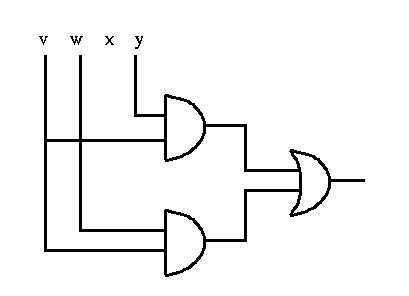
| Wire | Represents |
| v | more significant bit of # of pieces of toast |
| w | less significant bit of # of pieces of toast |
| x | 1 if at mushy setting; 0 if at melba setting |
| y | 0 if at mushy setting; 1 if at melba setting |
3. (Switching functions) [50 points]
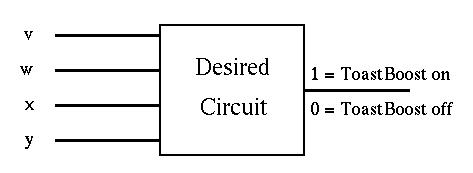
The ToastRWealth company has approached you to help design a circuit that their latest "Toastmaster" product will use. The Toastmaster can handle from 1 to 3 slices of bread at two settings: "mushy" or "melba." To ensure toastal correctness, the Toastmaster incorporates breakthrough ToastBoost® technology. Your goal is to design a circuit that will indicate when to turn on or turn off ToastBoost®.
Your plan is to build the circuit within the box shown below. The top two inputs (v and w) hold the number of pieces of toast in binary (from 01 to 11 -- you don't care what happens with zero pieces of toast). The more significant bit is v; the less significant bit is w, so that two pieces of toast are encoded by 10, i.e. v=1, w=0. The last two inputs are a one-hot encoding of the setting: input x indicates "mushy" when 1 and input y indicates "melba" when 1. It is always the case that exactly one of x and y is 1.
|
|
The edibility experts at the company have provided the following guidelines for ToastBoost® use:
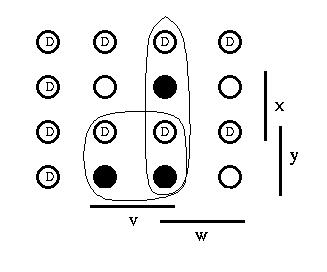
(A) (15 points) Indicate with the above Karnaugh map (the extra is for scratch work) those minterms included in the desired switching function by filling in the "on" vertices. Indicate "don't cares" by placing a D in the "don't care" vertices. Additional diagrams usable for scratch work are placed at the end of this exam.
Solution:

  The Toastboost is ON in three situations:
    * when there are two pieces of toast at "melba"
    * when there are three pieces of toast at "melba"
    * when there are three pieces of toast at "mushy"

  These correspond to the following minterms:
    * vw'x'y
    * vwx'y
    * vwxy'

  Don't cares occur in the situations when
    * both setting bits are 0
    * both setting bits are 1
    * there are no slices of toast

  These correspond to the following terms (they're not minterms)
    * x'y'
    * xy
    * v'w'

  Hence, the Karnaugh map looks like the diagram below.
(B) (25 points) Write a simplified sum-of-products description of the desired switching function. Try to make your description as simple as possible.
  From the above Karnaugh map, the simplified SOP is

       vw + vy
(C) (10 points) Draw a circuit which implements the description you arrived at in Part B using NOT "bubbles" and multiple-input AND and OR gates.