Purpose:
In this phase we transform the calculator language into a mini Lisp-like language by adding structured data in the form of s-expressions.
Background:
S-expres- sions As Data
Before I can specify the details of the project I must
first tell you about how s-expressions are used as data in
Lisp. So far we have only simple data types: numbers and
strings. In Lisp s-expressions are provided as the principal
way of building up compound data structures out of the base
types which include not only numbers and strings but also
symbols, which so far we have used just for
variable names. Lists are constructed using the
cons operator (which just stands for
construct). For instance, we could build a list of
3 integers with the expression: (cons 2 (cons 6 (cons
-3 ()))) which evaluates to the value (2 6
-3). Remember that in Lisp the second item in a
cons does not have to be a list itself, though
in this case it was for each of the calls to
cons.
In general, a cons pair is written by writing
the two items of the pair inside parentheses, separated by a
".". Thus the result of evaluating (cons
2 3) is (2 . 3). However, in order to
cut the nesting of parentheses, the representation is
simplified according to the rule that whenever a dot
immediately precedes a left parenthesis, the dot, the left
parenthesis, and its matching right parenthesis, are not
shown. That is why the result of (cons 2 (cons 6 (cons
-3 ()))) is printed as (2 6 -3) rather
than (2 . (6 . (-3 . ())))
The empty list can be written either as (),
or as nil. You do not have to worry about which
form the user types: the parser is already set to return
Atom Nil for either representation.
CAR and CDR
To get the first thing in a cons pair the function
car is used, while the function
cdr is used to return the second thing in a
pair (usually the tail of a list). These functions take
their names from the first implementation of Lisp on an
early IBM mainframe. A pair was always represented as a pair
of pointers that were loaded respectively into the address
and decrement registers of the cpu. Thus car is
``Contents of Address Register'' and cdr is
``Contents of Decrement Register''.
We use these functions as follows:
> (define a (cons 2 (cons 6 (cons -3 ()))))
a <- (2 6 -3)
> (car a)
2
> (cdr a)
(6 ~3)
> (car (cdr a))
6
The operations car and cdr
apply only to cons pairs. It is an error to apply either to
nil or to a symbol, string, or number (that is, to
atoms).
Quote
Now, obviously, it would be nice if we could just type
(2 6 -3) instead of typing (cons 2 (cons
6 (cons -3 ()))), but there is a problem:
> (define a (2 6 -3))
>>Error: Unknown operator 2 in (FUNCTION 2)
Since we are also using the s-expression syntax for our
program syntax, the interpreter sees a list of things in
parentheses as a request to treat the first item as a
function and send the rest of the items to it as arguments.
Of course, 2 is not a function. (This last
error was from a real Lisp interpreter, the sample solution
just prints "Illegal Expression".)
The way around this is the quote operator
which simply says "Don't evaluate my argument!":
> (define a (quote (2 6 -3)))
a <- (2 6 -3)
> (+ 2 3)
5
>(quote (+ 2 3))
(+ 2 3)
>(car (+ 2 3))
Runtime Error -- Illegal argument to car.
>(car (quote (+ 2 3)))
+
For any expression exp, the expression
(quote exp) can also be abbreviated
'exp, as in '(2 6 -3). However,
you do not have to worry about this, as it is handled by the
parser. You will always see it as though it had been typed
(quote exp).
Notice quote is not idempotent (that is,
applying it more than once is not the same as applying it
once):
> '(2 6 -3)
(2 6 -3)
> ' '(2 6 -3)
(quote (2 6 -3))
Symbols as Data
Now, with quote, it becomes meaningful to have symbols as
data. Suppose a and b are defined
to be 3 and 4 respectively. Well,
there is a difference between the variable a
and the symbol a. For instance:
> (define a 3)
a <- 3
> (define b 4)
b <- 4
> a
3
> 'a
a
> (+ a b)
7
> (+ 'a b)
Runtime Error -- Illegal operands to math function +
> (car '(a b))
a
> (+ (car '(a b)) b)
Runtime Error -- Illegal operands to math function +
So, once they've been quoted, symbols are just symbols. They become pretty much like the elements of an enumerated type.
Note, this is not true of numbers or ()
which are called self-quoting. (That is, you didn't
know it, but they were really quoted all along, you just
didn't see the quote!):
> 3
3
> '3
3
> (+ 3 4)
7
> (+ '3 4)
7
>'(3 4)
(3 4)
> (car '(3 4))
3
> (+ (car '(3 4)) 4)
7
Note that explicite use of quote is still
not idempotent on the self-quoting items:
> '3
3
> ''3
(quote 3)
That's because your not quoting the three (vaculously) and then quoting it again. Rather, you are quoting the act of quoting the three.
As a more complete example, if we wish to search a list for a value, we can use the following code:
(define (memb val list)
   (cond ((null list) ())
         ((= val (car list)) 'T)
         (memb val (cdr list))))
Here null is a predicate that tests whether
its argument is the empty list.
Boolean Values
The standard treatment of boolean values in Lisp is
somewhat analagous to that used in C and C++. The empty list
(nil or ()) is used to represent
false, and any non-nil value (including any other
atom, or any other compound s-expression) is true.
(Thus, 0 is now true, since it is not
nil.)
Remember that when (quote exp) is evaluated,
it's value is exp. So the value returned in the
second case is the symbol T which is the result
of evaluating the expression (quote T). That
is, if we look at the ML value returned, it is just
(Atom (Symbol "T")), not ((Atom (Symbol quote))
$ (Atom (Symbol "T"))). If we had left off the quote,
then it would have appeared we were trying to return the
value of some variable named T. Note that there
is nothing special about 'T. It is just an
arbitrary non-nil value that has become a
standard value to use for "true".
Richer Data Structures
Because s-expressions don't have to be homogeneous like ML lists, they can be used to build arbitrary data structures. For instance, we can represent a binary search tree as a three element list, the first element of which is the root, the second of which is the left sub-tree, and the third of which is the right sub-tree. As in:
'(4
  (2
   (1 () ())
   (3 () ()))
  (8
   (6
    (5 () ())
    (7 () ()))
   (9 () ())))
which can be seen as representing the binary search tree:
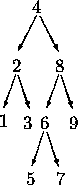
To make this clearer, imagine it formatted as:
'(4
(2
(1 () ())
(3 () ()))
(8
(6
(5 () ())
(7 () ()))
(9 () ())))
Using this representation, the function to determine if a tree contains a given value would be:
(defun (tree_memb val tree)
   (cond ((null tree) ())
         ((= val (car tree)) 'T)
         ((< val (car tree)) (tree_memb val (car (cdr tree))))
         ('T                 (tree_memb val (car (cdr (cdr tree)))))))
Of course, it would be better to impose some level of data abstaction by first defining some methods and using them, as in:
(defun (empty tree) (null tree))
(defun (root tree) (car tree))
(defun (left-subtree tree) (car (cdr tree)))
(defun (right-subtree tree) (car (cdr (cdr tree))))

(defun (tree_memb val tree)
   (cond ((empty tree) ())
         ((= val (root tree)) 'T)
         ((< val (root tree)) (tree_memb val (left-subtree tree)))
         ('T                  (tree_memb val (right-subtree tree)))))
What I Have Provided:
In order to support the use of s-expressions as data, the
type AbstractSyntax.datavalue must be changed
from ConcreteSyntax.literal to
ConcreteSyntax.sexp.
The code for SyntaxConverterFun must be
modified to deal with the use of quote. Any
time you see a quoted expression, the body of the expression
should be wrapped with a Cdata rather than
being further evaluated. The only other changes to be made
to SyntaxConverterFun are those necessary to
recognize and check the arity of the new built-in operators
described below.
As stated above, the parser is already set up so that if
the user types 'exp you will recieve an
sexp as though they had typed (quote
exp). You do not have to deal with that conversion
yourself.
I have created a version of the SML-NJ interpreter with
the parser structure SexpParser, the two syntax
structures ConcreteSyntax and
AbstractSyntax, and the
SyntaxConverter structure, as well as the
UserInterface functor, and the signature for the
evaluator functors already loaded. The executable (or a link
to it) is in /cs/cs131/bin/sml-sexp. The file
/cs/cs131/bin/sml-cs131 (which is the version
loaded by emacs) has also been re-linked to
this version.
You may find it useful to diff the new version of syntaxconverter.sml against the one from the last project to get a sense of the changes.
(I have also loaded a sample solution to the evaluator functor and built a structure called testEvaluator as well. You can use the functions in this structure from the SML command line to see what the results of evaluation should be.)
I have also provided an executable sample solution at
/cs/cs131/bin/sml-soln-proj7. You can use this
to test how your solution should behave (from the standpoint
of user interaction). This launches directly into my
solution's interpreter.
Finally, the file /cs/cs131/proj_7/tests.lisp
contains a variety of test functions that your
solution should be able to handle.
What You Need To Do:
- You should define the built-in functions
cons,car, andcdr. You should also define the built-in functionsnullwhich tests its argument and returns'Tif it is nil and nil otherwise, andatomwhich returns nil if its argument is a cons-pair and'Totherwise.Note that while
carandcdrare not defined for atoms,atom, andnullare defined for all value types. This is exactly so that you can useatomto check whether or not it is safe to applycarorcdr. - The built-in functions write and
makestring must be extended to deal with
arbitrary s-expressions.
Note, however, that the provided function sexpToString can be used to do most of the work.
- The relational operators should be redefined to
return nil for false and
'Tfor true. The evaluation of conditional expressions should also be changed to use these values (i.e. nil for false, non-nil for true) rather than zero and non-zero.Equality (=) and inequality (<>) defined for and among all the types of the language (numbers, strings, s-expressions). Any cross-type comparison should return nil. (Note that comparing a real and an integer is not cross-type, since both are subsumed in the general notion of number in this language.) Recall that the implementation of s-expressions is not an ML equality type (since it includes reals at the leaves) so you will need to implement equality checking in your own recursive function.
The remaining relational operators are defined only on numbers and, separately, on strings.
- Suppose we want to create a list out of the values
stored in the variables
aandb. We can't write'(a b)since the quote blocks the evaluation of the variable names to their respective values. Instead we have to write(cons a (cons b ()))which is pretty cumbersome. Therefore, Lisp defines the functionlistwhich takes an arbtrary number of arguments, evaluates them, and then builds a list out of the results. I.e.:> (define a 3) a <- 3 > (define b 4) b <- 4 > '(a b) (a b) > (list a b) (3 4)Add the definition of
listto your interpreter. - Suppose we wish to extract the
3from the s-expression((0 1) (2 3))which is stored in the variablea. This requires typing the incredibly horrible expression(car (cdr (car (cdr a)))). Because Lisp does not have pattern matching it is often necessary to write such expressions for extracting parts of a structure.To simplify such expressions, most Lisp implementations allow you to abbreviate any combination of
carandcdrexpressions by simply typing the corresponding combination ofas andds, surrounded by acand anr. So, for instance, the example expression becomes(cadadr a)which, while still hard to figure out, is at least easy to type.In the binary search tree example above, we could now define the tree accessor functions as:
(defun (left-subtree tree) (cadr tree))
(defun (right-subtree tree) (caddr tree))Add an implementation of this shorthand to your interpreter. That is, make the interpreter able to understand any such abbreviation of
carandcdrexpressions. Note that the syntax converter has already been modified to recognize these as unary built-in operators.
What to Submit:
As with the last project, only the evaluator and the
syntax converter get appreciable changes in this phase. And,
as before, the changes to the syntax converter and user
interface have already been made for you. Therefore, you
should submit just the new implementation of
EvaluatorFun.
The make file in the /cs/cs131/proj_7
directory can be used to test-build your solution. A file of
test lisp expressions is also available in that
directory.
