- In a rex comment, describe how one could use lists to represent strictly positive integers as products of prime numbers. Be sure to explain how one can reconstruct the natural number from the list representation. Your encoding of an integer should have a size roughly proportional to the number of distinct prime factors.
- Define the variable
thirtyto be the result of representing the number 30 using this representation. [It is very important that in all assignments you use exactly the names specified for variables and functions! Some assignments will use an automated grading process that will give you no credit if you fail to follow directions.]
Consider a computer application that colors 2-dimensional maps for publication purposes. A map consists of a set of countries (or other political regions). Assume that each country is a contiguous region. Any two countries either touch or do not. When the application colors a map, it cannot color two touching countries with the same color. The application always uses the smallest number of colors possible to color a map.
- As a rex comment, describe a representation of the input for this problem, which would be a description of which countries touch which other countries. (Assume that every country touches at least one other country; we then know that every country is mentioned in the description of adjacent countries.)
- As a rex comment, describe a representation of the output for this problem, an assignment of a color number to each country, starting with numbers 1, 2, ... up to whatever number of colors is necessary.
- Define the rex variables
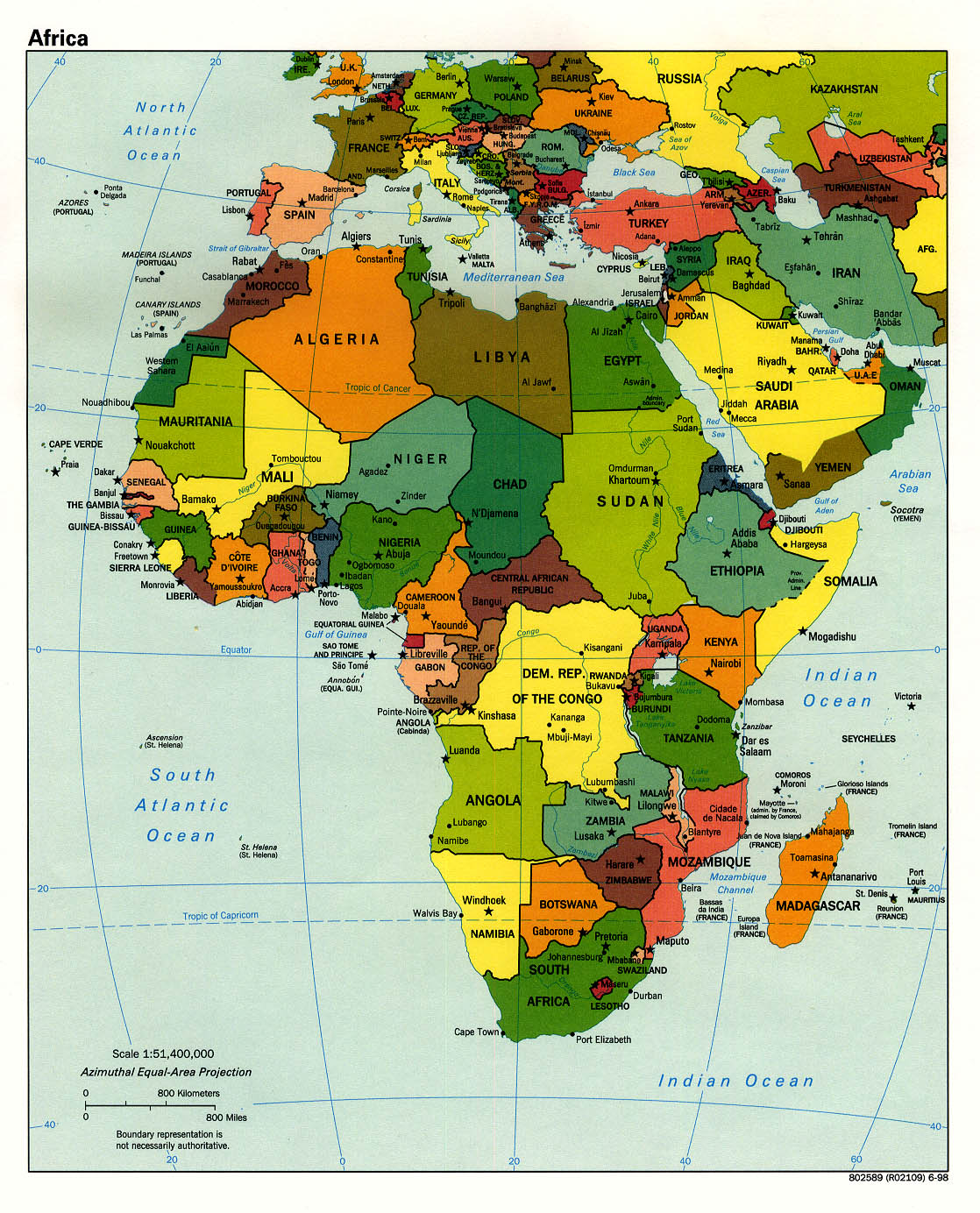
map_inputandmap_outputto be the corresponding list representations for the following example (selected North African countries, from http://www.sas.upenn.edu/African_Studies/CIA_Maps/Africa_19850.gif)Input:
- Algeria touches Libya, Mali, Mauritania, Morocco, Niger, Tunisia, and Western Sahara.
- Chad touches Libya, Niger, Sudan.
- Egypt touches Libya, Sudan.
- Libya touches Algeria, Chad, Egypt, Niger, Sudan, Tunisia.
- Mali touches Algeria, Mauritania, Niger.
- Mauritania touches Algeria, Mali, Western Sahara.
- Morocco touches Algeria, Western Sahara.
- Niger touches Algeria, Chad, Libya, Mali.
- Sudan touches Chad, Egypt, Libya.
- Tunisia touches Algeria, Libya.
- Western Sahara touches Algeria, Mauritania, and Morocco.
Output:
- Algeria is color number 1.
- Chad is color number 1.
- Egypt is color number 1.
- Libya is color number 2.
- Mali is color number 2.
- Mauritania is color number 3.
- Morocco is color number 3.
- Niger is color number 3.
- Sudan is color number 3.
- Tunisia is color number 3.
- Western Sahara is color 2.
The text explains that binary relations can be identified with sets of
ordered pairs; two elements x and y are said to be related
by this relation if the pair (x,y) is in the set. A relation
is reflexive if every element in the domain of interest is related
to itself; that is, if the pair (x,x) is in the relation for
every relevant x. A relation is symmetric if whenever (x,y)
is in the relation so is (y,x). Finally, a relation is said
to be transitive if whenever (x,y) and (y,z) are in
the relation, so is (x,z).
An equivalence relation is a binary relation that is reflexive, symmetric
and transitive. For example, given the finite set S = {1,2,3,4,5,6,7},
the relation on this set that relates two numbers in this set if they have
the same remainder when divided by three (also known as equivalence mod
3) is an equivalence relation. As discussed in the text, we can represent
relations on a finite set as a list of all the pairs that are related:
        [[1,1], [1,4], [1,7],
         [2,2], [2,5],
         [3,3], [3,6],
         [4,1], [4,4], [4,7],
         [5,2], [5,5],
         [6,3], [6,6],
         [7,1], [7,4], [7,7]]
However, the properties of equivalence relations permit a more compact encoding.- In a rex comment describe how, given a finite set, one could efficiently encode any equivalence relation on this set. Ideally your encoding should mention each element of the set only once.
- Define the variable
mod3to be the result of representing the above relation using your encoding.
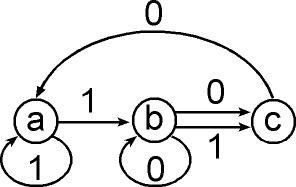
The text describes ways to represent directed graphs; a labeled directed graph is a directed graph where every arrow has a corresponding label. In such graphs we permit more than one arrow between two nodes (or from a node to itself) as long as the arrows have different labels. The same label may appear on several different arrows (as long as the arrows do not have both the same source node and target node).
- In rex comments, describe at least 3 different representations of labeled directed graphs using lists.
- Define the variables
graph1,graph2, etc. to be implementations of the following labeled graph for each of your representations. (Remember that you will need to represent the nodes using strings such as"a"in your rex code.)