Name _________________________
Karnaugh Map and Circuit Design Problem
Due Th., Apr. 4 in class (30 pts.)
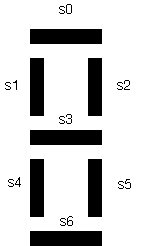
Consider the 7-segment display (now nearly extinct):
Seven segment LED display

Display of 0 through 9 with a seven segment display
In the following, assume that a 7-segment display is to display one of the digits from 0 to 9. The goal is to design a circuit whose input is the binary representation of that digit (0-9) and whose output is the state of the segments of the seven-segment display. Represent an "ON" segment (the filled pieces in the image above) with a logical true or "1" . Represent an "OFF" segment with a false or "0" .
Create a truth table for this switching function that maps four bits to seven bits. The four bits of input represent the binary encoding of a single decimal digit (for example, 0 = "0000" and 9 = "1001"). The seven bits of output indicate which if the seven segments of the display are switched on. Note that of the 16 possible 4-bit inputs, you only care about the outputs for 10 of them (0-9).
Decimal Input         Binary Input                      OUTPUT
-------------         ------------          --------------------------------
                        w x y z             S0   S1   S2   S3   S4   S5   S6

      0                 0 0 0 0              1    1    1    0    1    1    1

      1

      2

      3

      4

      5

      6

      7

      8

      9

     10

     11

     12

     13

     14

     15
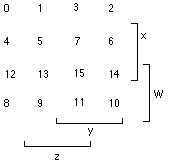
Give a Karnaugh map (with don't cares) for each of the switching functions. To help determine which vertices are "on", the decimal value of each vertex in the Karnaugh map is provided. In this case "on" is literal -- the goal is to mark those vertices that correspond to inputs for which turn on each segment. Also mark the "don't care" vertices in some fashion -- but differently than the "on" vertices.
When you have completed each Karnaugh map, write the simplified sum-of-products form for that circuit. You do not need to actually draw all of the circuits with AND gates, OR gates, and NOT bubbles. Instead, just draw the final segment's circuit (S6).
Segment S0 will be done as an example in class.
s0: s1:
 s2: s3:
s4: s5:
s6:
Construct the logic circuit that outputs the state of the last segment (s6) in the seven-segment display. Label the input bits w, x, y, and z.