
If this page looks abnormally plain, you should consider upgrading to a standards-compliant browser.
Links to other sections of this site appear at the bottom of the page.
Administrivia
CS 70 Quick Facts
Most of the important information you should know related to policies and procedures for CS 70 is available in the CS 70 Quick Facts handout, which will be available soon.
The handout covers the following topics:
- Course mailing lists
- Computer accounts
- Using
ssh - Attendance (and illness)
- Getting help
- Late Policy, Extenuating Circumstances, and The Honor Code,
Class Meeting Times and Location
There is just one section of CS 70 in the fall 2006 semester. We meet on Mondays and Wednesdays at 2:45 in Thomas-Garrett Hall, room 103.
Contact Information and Office Hours
Professor O'Neill
In most cases, you should send e-mail to the general CS 70 help list. If you need to contact me directly, please use e-mail for short, easily answered questions or statements, and office hours for questions which require longer answers.
If you require help debugging your code, please submit your code first.
Office Hours
My official schedule is posted next to my office door. It includes official office hours (where I virtually guarantee to be available to CS 131 students). I'm also available at other times; if I'm in my office with the door open, I'm probably available.
My office is Olin 1243 (between Christine's and Ran's offices).
Department Secretary
The department secretary is Joyce Greene. Her office is Olin 1258. Her telephone number is x18225. If you cannot reach me, you can leave messages for me with Joyce.
Tutors and Graders
Unless otherwise stated, tutoring hours take place in the CS Terminal Room (Beckman B102).
There are no tutoring hours in the first week. Check back here at the end of the first week for details on graders and tutoring hours
Attendance
I expect you to attend every class and participate actively (part of your grade is for in-class participation). In emergencies, you can skip class, but for non-emergency absences, you should speak to me beforehand about appropriate make-up work.
If you think you know the material I'll be covering in upcoming classes, talk to me and we can work out a custom study plan for you during those classes.
Late Policy
Late work is strongly discouraged. If you think it is impossible to accomplish the necessary work in the available time, consult me before the due date. It may be that everyone in the class is having the same problem, in which case we might adjust the assignment. The same advice applies if we have scheduled something at a particularly bad time (e.g., simultaneously with a major deadline for another class) or if there seems to be a bug in an assignment.
If work is submitted late, the score is scaled using the multiplier returned by the following C++ function (also available as a complete C++ program, latecalc.cpp):
  /* lateMult [global function]:
   *      Inputs:  double mins            minutes past the deadline
   *      Returns: double                 multiplier (i.e., 0.8 => 20% penalty)
   *
   * Calculates late penalty.
   */

  double lateMult (double mins)
  {
      const double MAX_LATE_PERIOD = 12 * 60;
      // i.e., twelve hours (in minutes)

      // This formula is strange, but gives a good penalty curve...
      double  lateness = mins / MAX_LATE_PERIOD;
      double  root     = sqrt(lateness);
      double  squared  = lateness * lateness;
      double  penalty  = 1.0–(root * (1.0–root) + squared * root);
      if (penalty < 0.0)
          return 0.0;
      else
          return penalty;
  }
If you plot the above function, you get the following graph:
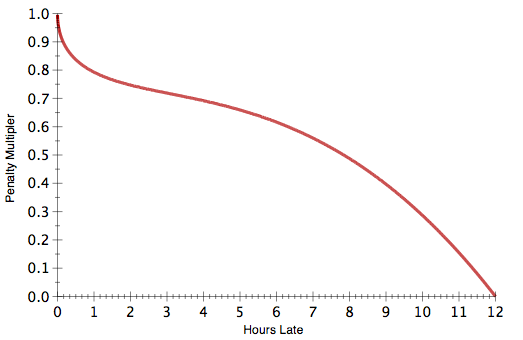
This function is swift to penalize lateness—even one minute late results in a lateness multiplier of 0.964 (i.e., a 3.6% penalty). At nine minutes late, the multiplier is 0.9, a 10% penalty. But with time the rate slows down, the 0.8 point is reached at a little before the first hour, and the 0.6 multiplier is not reached until the work is about 6.5 hours late. At, and beyond, the 12 hour point, the multiplier is zero.
Times are based on the time that the submission process finished, not when you began submitting. For assignments due at 11:59pm, we count late minutes from midnight, and round down to whole numbers of minutes. Thus, you have about two minutes of grace after the clock ticks over to reading 11:59pm. (It is, of course, risky to cut things close, especially since the submit system takes time to perform its work.)
Remember, unless you've very much underestimated the assignment, it is almost never a good idea to submit late. The added points you gain from the extra work won't compensate for the effect of the lateness multiplier.
If you wish to finish an assignment but have your predeadline work graded, do not submit your later work using the regular submit system. Instead, send mail to cs70help and ask for special instructions for submitting your finished work for grader comments.
Extenuating circumstances (such as illness) are dealt with on a case-by-case basis. In general, you are only excused for situations you could not have forseen, and only if you explain the situation at your soonest opportunity.

