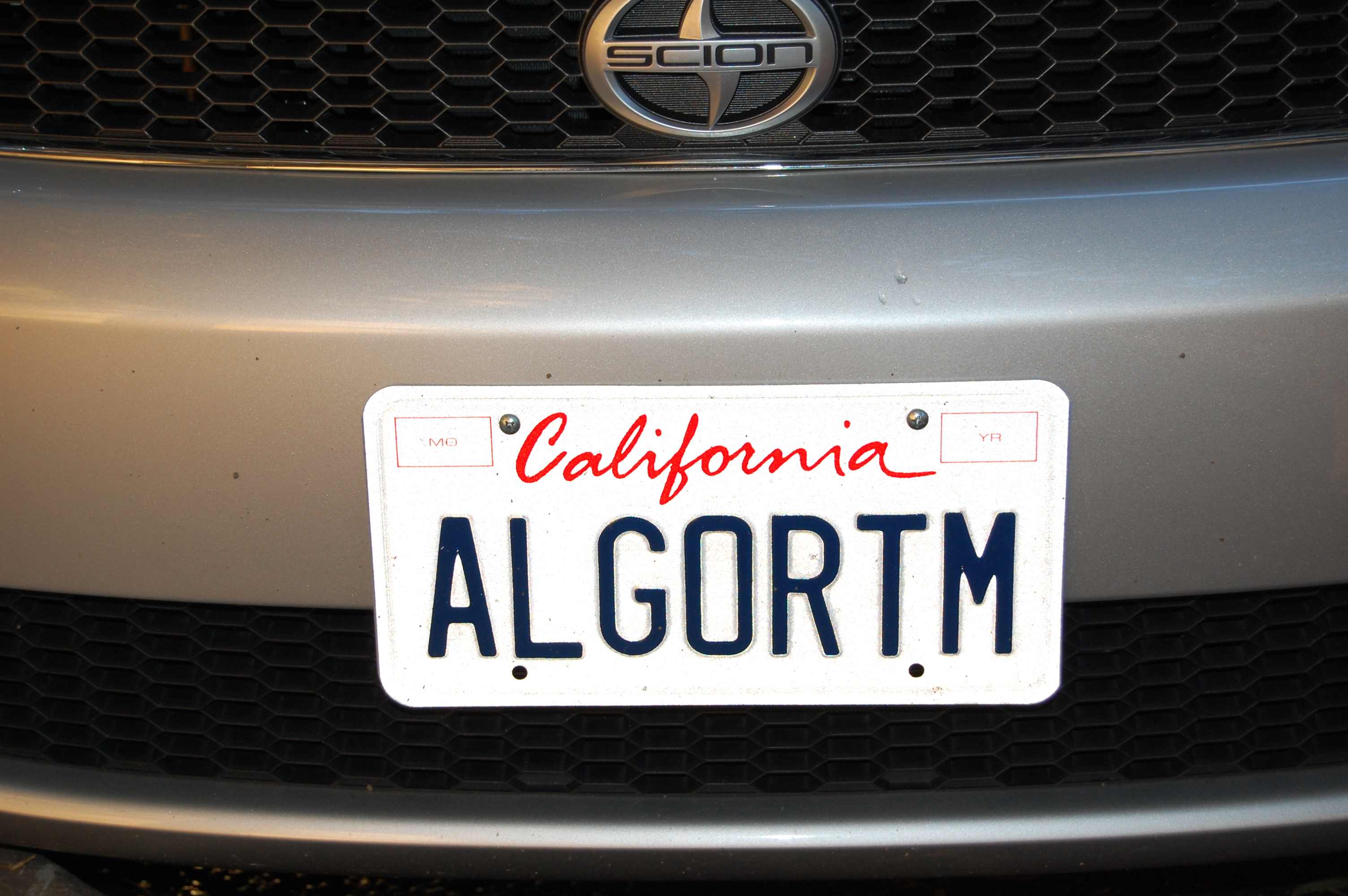
Computer Science 140 and Mathematics 168
Algorithms
Syllabus, Spring 2007
Professor: Ran ("RON") Libeskind-Hadas
Office: Olin 1258
Phone: x18976
E-mail: hadas@cs.hmc.edu
Office Hours: Monday, Tuesday, Wednesday, and Friday from
3:30-5 PM in Olin 1258. You are always welcome to get in touch
to set up a time to meet outside of regular office hours.
Course Time and Location: Tuesdays and Thursdays, 1:15-2:30 PM in
Galileo Macalister
Course Grutors: Jonathan Beall, Mike Buchanan, Nate Chenette,
Phil Miller, Carl Nygaard, and Steven Sloss
Course Homepage:
www.cs.hmc.edu/courses/2007/spring/cs140
What Is This Course About?
This course will teach you to design algorithms, prove their
correctness, and analyze their computational complexity. The course
emphasizes general problem-solving techniques that will allow you to
become a good algorithm designer.
Is This Course for You?
The answer is YES! Alright, seriously,
the prerequisites for this course are Math 55 and CS 60.
In addition, you must have completed either CS 70 or Math 131 before
enrolling in this course.
Much of our time will be spent carefully analyzing algorithms using
mathematical induction, recurrence relations, and
summation techniques.
On some homeworks there will be short programming assignments.
Any high-level language
(which is defined formally to be an element of the set {C, C++, Java,
Python, Scheme, rex, ML}) may be used for these assignments.
Lecture Notes and Text
The lecture notes provided in class will be self-contained outlines,
but will require that you fill in many of the details that we do
interactively at the blackboard.
The following book is the official textbook of this class, although it
is primarily intended as a reference to reinforce concepts from
class. It is available at Huntley Bookstore.
Algorithms, by S. Dasgupta, C. Papadimitriou, and
U. Vazirani. McGraw-Hill, ISBN 978-0-07-352340-8.
In addition, the following book is an excellent reference that you
will probably want to have in your book collection at some point. It
is not sold at Huntley but is available online at most bookstores.
Introduction to Algorithms, 2nd Edition by T. Cormen,
C. Leiserson, R. Rivest, and C. Stein. McGraw-Hill and MIT Press,
ISBN 0-07-013151-1.
Attendance
If you are sick or have a
special reason for missing class, please send Ran e-mail before the class
that you will miss. Otherwise, you are expected to be in class.
Please make sure to arrive on-time as a courtesy to the instructor and your
classmates.
Assignments
There will be two assignments each week. On Tuesdays, you will receive
a short assignment typically comprising 2-3 problems and worth approximately
20-35 points.
This assignment is
due on Thursday at the beginning of class. On Thursdays, you will receive
a longer assignment typically comprising 4-6 problems and worth approximately
65-80 points. This assignment
is due on the following Tuesday at the beginning of class.
Late homeworks will not be accepted unless arrangements have been made with Ran
in advance for special circumstances.
Typesetting your Assignments
You are expected to typeset your assignments using LaTeX for the
first two weeks of the semester. The reason for this requirement is
that LaTeX is an important
tool that is widely-used in computer science, mathematics, among
other disciplines. Its use is required in some upper-division
courses at HMC and you'll almost certainly need to use it in the
future. Learning it now is useful!
Check out the
LaTeX link (also available from the course homepage) for tutorials,
documentation, and sample latex documents.
After the second week of assignments, you may turn in your assignments any way you like
(handwritten, LaTeX, or otherwise). You are certainly strongly
encouraged to keep using LaTeX, but it's not required after the first
two weeks.
Whenever you use LaTeX, if you wish to include a figure you may
draw the figure in a drawing tool and import it, use LaTeX's own
drawing facilities, or simply leave some space in your document and do
the drawing by hand.
Worksheets
In almost every class, you will be asked to solve a problem on a worksheet.
These worksheets will be turned in at the end of class. If you turn in a
worksheet which exhibits effort, you will receive full credit for it.
Worksheets will not be returned but you can assume that you have received
full credit for it unless you hear otherwise from Ran.
Exams
There will be 3 exams in this course: Two take-home exams during the semester and a
comprehensive final exam. Dates and details of the exams will be announced in class.
Grades
The components of the course are worth the following:
	Homework: 50 course points
	Worksheets and Attendance: 10 course points
	Two "Midterm" Exams: 20 course points
	Final Exam: 20 course points
Note: You must turn in all worksheets in order to receive
the 10 points for this component (unless you miss class due to illness or
special circumstances).
Since attendance is required, it is expected that all students will receive
their 10 worksheet points.
Collaboration Policy
Collaboration on homeworks is permitted. Here are the stipulations:
- You may only discuss problems with students currently in the
class, the grutors, and with Ran. Do not discuss the problems with
other students not currently in the class.
- Collaboration is limited to discussion. Of course, you may use
a white board or paper as part of your discussion, but any such
materials should be erased or destroyed (it's generally better to erase white
boards than destroy them) before you begin writing up
your solutions.
- Each individual must write up their own solutions. Copying
written solutions from any source (classmate, web, etc.) is not
permitted.
- You should indicate at the top of your homework submission who
you collaborated or consulted with on that assignment.
List of Topics
- Fundamentals of Algorithm Design and Analysis
- Proofs of algorithm correctness
- Worst-case analysis of algorithms
- Asymptotics and recurrence relations
- Sorting algorithms
- Order statistics
- Divide-and-Conquer paradigm
- Dynamic programming paradigm
- Greed paradigm
- Amortized analysis
- Fundamental Data Structures
- Heaps
- AVL Trees
- Red-Black Trees
- B-Trees
- Union-Find structures
- Graph Algorithms
- Data structures for graphs
- Depth-first search and breadth-first search
- Minimum spanning tree algorithms
- Shortest path algorithms
- Network flow algorithms
- Linear Programming and the Simplex Algorithm
- NP-Completeness and Approximation Algorithms
- Polynomial-time reductions.
- Karp's NP-Complete problems and others.
- Approximation algorithms.
- Advanced Topics