Computer Science 153
Final Project
Final project proposal
Your final project proposal need not be long, but you should include
the following parts (perhaps a paragraph or so on each).
Submit this in the usual way, i.e., by creating a wiki page linked from
here.
- Overall project description
In essence, this is what you'd like to do. Give some attention to
how you (and I) might evaluate it. Also, you should consider the
scope of your project here -- in particular, suggest
ways that the project could be limited or simplified, if
need be, as well as some ways in which it could naturally
expand.
- References
Include at least two source-level references
to work you've found that is related to your project. More are welcome,
as well. It's also
a good idea to have higher-level links (Wikipedia, other projects' webpages, ...)
in a single place for simple access.
In this paragraph, you should explain some of the
similarities and differences between the work in these references
and what you'd
like to do (even if just based on initial impressions). Even if you're
starting from a codebase or an idea of an existing project, your proposal
should indicate how you'll be individualizing it.
- System and Starting point
Explain how you intend to start the project. Particulars of the
start-up include the language (and
perhaps platform/OS) under which you anticipate working and the source
for input to your system (still images and where they'll come from, or,
perhaps, video from somewhere). Any hardware requirements
that I need to be aware of (so we can start setting things up)?
Describe in as much detail as you can a small initial piece of the
project that you intend to start with. Also suggest a number of
separate pieces that will comprise the whole system: what are your
initial thoughts on the order in which to attack them?
Are there any that will be more difficult than others?
Ideas for the final project
Projects often fall under two broad headings: specific applications or
comparative research.
For the latter, the idea is to implement and investigate the relative
performance of some set of vision algorithms. The key contribution
is both summarizing the strengths and weaknesses of each and quantifying
where they success and they they fail.
Algorithm implementation/testing/comparison
Svetlana Lazebnik has an excellent set of
starting
points for algorithmic investigations at this link. Broad topics include
stereovision, geometric reconstruction, recognition, classification, detection, image
segmentation, and video processing.
System-building ideas
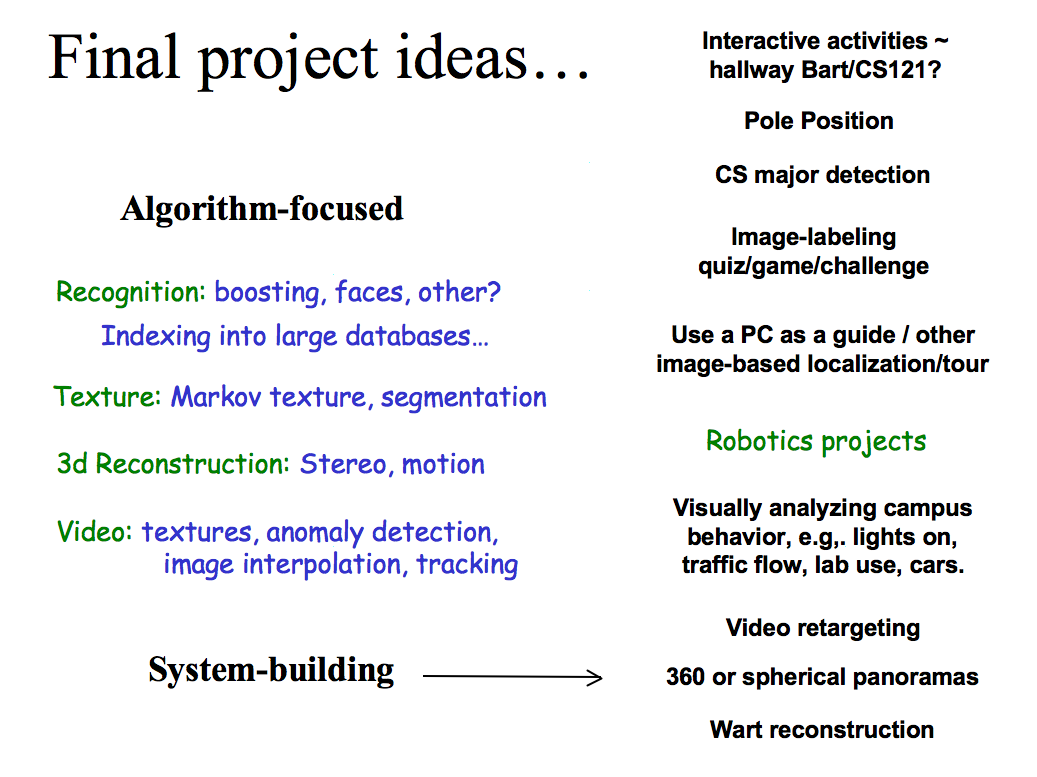
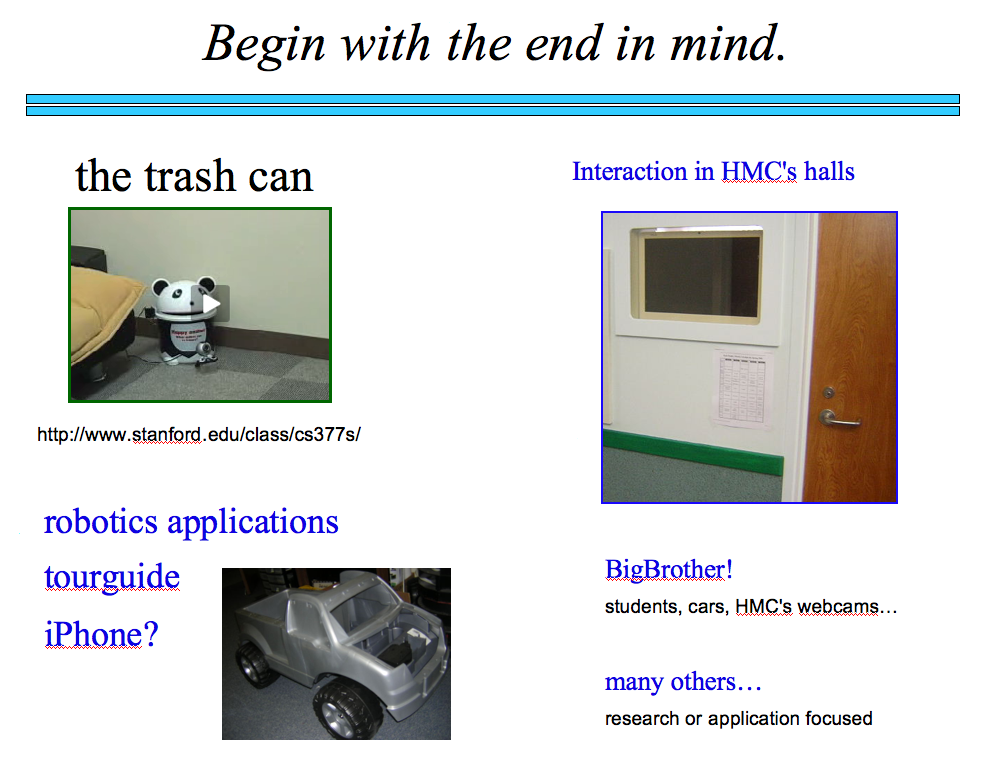
As far as imagination allows, I suppose... Here are snapshots of two slides that listed
a few of the ideas we have mentioned thus far:
Final project requirements
The final project requires four things:
- Meeting
Before Thanksgiving break each team should meet with me to discuss
their project's scope and
ideas -- also, we will schedule an in-class presentation
during one of the lecture days in December.
- Presentation
In one of the lecture sessions during the final
two weeks of classes,
each team or individual will present to the group a 15-20 minute overview
of their project and approach and its context within the
field of computer vision.
More details on the presentation will be included here...
- Write-up
The write-up is the formal documentation for the project. Although the
format is not required to adhere to any particular form, the following
sections outline a common approach to covering the important points:
- An Introduction that motivates and describes the problem
and the results at a high level.
- A Background section that explains the basics of
the algorithms you applied to the problem.
- A System Description section that provides the
details of how you constructed your system, how it works,
and how you tailored the algorithms described in the previous
section to the problem at hand.
- A Results section that describes how well the
system performs. A format that often works well here is
to first explain your evaluation techniques, provide their
results, and then explain those results and what they
say about the problem and about your approach(es) to it.
- A Conclusion, usually very brief, in which you can
summarize your system and the results. In addition, this
is a chance to be less scientific in your opinions about
the project and a chance to put it
in the larger context of larger, more general problems
(such as the general vision problem or a broad subfield).
The write-up should include a link to an archive of your source code and other
supporting materials -- this will serve as a starting point for future students
who may want to pick up where you left off... .
- Demo
The demonstrations will be done during the final-exam period for CS 153, which is
Tuesday, December 16 at 2pm. This will be the "official" demo of your system;
even if you choose an algorithm to study, implement, and/or extend, this date
will be the time to show its results.
Your demo should show off the portions of the system that went beyond
whatever foundation you used as a starting point.