with a Help menu at the top. In fact, the help option directs you to the tutorial available from this link.. The documentation is not only thorough, it even has various "haiku-help" versions scattered through it... .
This link contains a review of the Distinguishability Theorem and the Nonregular Language Theorem, and how to use them.
In this assignment you will have the opportunity to try out the very nifty JFLAP Automata Simulator developed by Dr. Susan Rodger at Duke University. JFLAP allows you to create automata on the screen and then simulate their operation with any input string you like. You will also be proving that certain tasks are unsolvable by finite automata (read: computers!)
You can download a copy of JFLAP for your own computer (or on the Macs in the CS lab) for free. It is available at www.jflap.org. To simplify downloading, you can also get a copy of JFLAP.jar from this local link. If you do go to the JFLAP site, follow the Get JFLAP link on the green left menu. From there, go to the bottom of the page and select "JFLAP software". You'll need to fill out a brief form to let the creators know who's using their software, and then choose the latest "JFLAP.jar."
JFLAP is written in java; a jar file packages a group of
Java classes in one place.
Double-clicking that JFLAP.jar file should start the
program (if Java is set up).
Alternatively, you start JFLAP from a command prompt (unix or windows)
by typing java -jar JFLAP.jar.
For this to work, java needs to be "in your path," which it most likely already
is, because of the java assignments you wrote! If it's not, feel free to ask.
Under windows, the path is set in the "System Contol Panel - Advanced -
Environment Variables."
In contrast to the prolog assignments, You will submit a different file for each of the problems on this assignment. Some will be JFLAP files, which you should name as the problem specifies to make it easy on the graders. Others will be plain-text files (.txt) which will hold your proofs. Submit the files via the website as usual, but please do name them according to the problem specification!
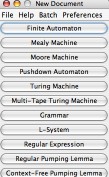
When you start JFLAP, you will see a menu that looks something like this:
with a Help menu at the top. In fact, the help option directs you to
the
tutorial available from this link..
The documentation is not only thorough, it even has various "haiku-help" versions scattered
through it... .
For each of the problems below, you should assume that the input will consist of zero or more 0's and 1's. Thus, keep in mind that every state in a DFA [Deterministic Finite Automaton] must have one outgoing transition labeled 0 and one outgoing transition labeled 1. Remember also that a DFA must accept every string in the desired language and reject every string not in the language. Finally, the empty string (λ, lambda) corresponds to no input at all. Note, for example, that if the language L is the set of all strings with an even number of 0's, then the empty string is in this language since it has zero 0's -- and zero is even! Thus, a DFA for this language must have the initial state be an accepting state, so that it accepts even if it gets no input! Be sure that your automata accept the empty string if it is in the specified language -- we'll be checking this!
Finally, since you will be applying some of the theorems from class to write your own proofs, a sample proof is available at this link. You are welcome to "copy" as much as you like from this sample proof when writing your own proofs. Simply submit each proof in an ASCII plain-text file.
{w | w contains at least two 0's and at most one 1.}
For example, the string 01000 is in the language but
01 and 0110 are not.
Save and submit your DFA in a file called part1.jff.
{w | The number of 0's in w is a multiple of 2 or a multiple of 3 or both.}
For example, the empty string, 0101, and 01000100 are
in the language but 01 is not. Your DFA should have at
most 6 states. The empty string, with zero 0s should be accepted.
Save and submit your DFA in a file called part2.jff.
Though not required, remember that you can use JFLAP to check any regular expression to see if it's the same. I suppose guessing and checking would be one way to solve this problem, though not a very efficient one -- (and you'll have to move states around to make things match, as well). If you do experiment with JFLAP's regular expressions, keep in mind that JFLAP uses + instead of the vertical bar | to indicate "or" alternatives.
{w | w is the BINARY representation of a number which is a multiple of 7.}
For example, the inputs 0, 111, 1110,
10101, 11100, and 100011 would all be accepted because they are the binary
representations of the numbers 0, 7, 14, 21, 28, and 35, respectively.
{w | The number of 0's in w is a multiple of 3 or a multiple of 5 or both.}
Notice that this machine would require at least 15 states if you were to
build a DFA. (Make sure you see why -- though you need not prove it.)
However, for credit for this NFA, it may have at most 9 states.
Save your NFA in a file called part6.jff. Again, since 0 is a multiple
of 3 (or 5, for that matter), the empty string should be accepted.
{w | w is made of 0's and 1's and is the same forwards as backwards}
For example, 0, 11, 101, and 00100 are all in
the language but 01, 100 and
010111 are not in the language.
{w | w is a string of 0's whose length is a power of 2}
For example, the strings 0, 00, 0000, 00000000
are all in the language since their lengths are 1, 2, 4, and 8, all
of which are powers of 2. On the other hand, 000, 00000,
any string containing a character other than 0, and the empty
string are all not in this language.
Prove that this language is not regular by using the Nonregular Language Theorem. Your proof must be clear and precise. Leave your proof in electronic form in a file called part8.txt.
L = { w | w contains only 0's and the length of w is a power of 2 }.
Although it is not regular, it is decidable. That is to say, there is a Turing machine that accepts it.
We highly recommend spending some time thinking about this problem and sketching a solution on paper before using JFLAP. If you design the Turing Machine carefully, you can build it using fewer than nine states. (Perhaps far fewer -- see the extra credit...)
Save your Turing Machine in a file called part9.jff.
{w | w contains an equal number of 0's and 1's in any order.}
However, now consider the following closely related language:
{w | w contains an equal number of occurrences of the substrings 01 and 10.}
  (0, 0, 0), (0, 0, 1), (0, 1, 0), (0, 1, 1), (1, 0, 0), (1, 0, 1),
  (1, 1, 0), (1, 1, 1)
For convenience, however, let's write each of these input symbols vertically and without parentheses. So, the eight symbols above will be represented as:
  0   0   0   0   1   1   1   1
  0   0   1   1   0   0   1   1
  0,  1,  0,  1,  0,  1,  0,  1
Now, define the language of valid additions to be the collection of all strings made from this alphabet that correspond to correct binary additions when the input is interpreted as the number in the first row added to the number in the second row equals the number in the third row. Note that numbers are interpreted as having the most significant digit is at the far left. This corresponds to the usual interpretation of a string of 0s and 1s as a binary number. It also means that the DFA sees the most significant digits first!
For example, consider the string of 4 symbols below:1 0 1 0 0 0 1 0 1, 1, 0, 0
This 4-symbol string is in the language of valid additions since the sum of the binary numbers 1010 (first row) and 0010 (second row) is 1100 (third row).
However, the following string is not in the language of valid additions:
  1    1
  0    1
  0,   0
This string is interpreted as the sum of 11 (first row) and 01 (second row) is 00 which is false!
For this problem, construct a DFA for the language of valid additions and then prove (using the Distinguishability Theorem) that your DFA has the fewest possible number of states! JFLAP is happy to allow three characters along a single transition, which is what you will need in this case.
Save and submit your JFLAP DFA in a file named excr.jff and submit your proof that no fewer states are possible in a file named excr2.txt.