Harvey Mudd College
Computer Science 60
Assignment 3, Due Monday, September 21, by 11:59pm
Graphical programming
Although CS 60 will introduce graphics in the coming weeks,
this week's "graphical" programming refers to mathematical graphs,
i.e., connection networks of nodes and edges that might represent
human relationships, physical links, or hierarchical structures.
This week's three (out four options) problems are fewer than previous assignments, but each
of these has
a component of open-ended algorithm design, as well
as reinforcement of this week's themes.
Feel free to seek out help in discussions with other
students, the CS 60 tutors, or to chat with me any time about
any of these problems... . Good luck!
Submitting your work
For this assignment, you should type (and test!) your programs in a
files named
- hw3part1.scm -- To be
completed individually
- hw3part2.scm
-- To be completed individually OR with a partner
You should submit your file in the usual way at the CS
60
submissions site. Keep in mind
that you may submit multple times -- only the final submission before
the deadline will be graded.
Design, commenting, and formatting
As with the previous two assignments, design and formatting will
account for roughly a quarter of the credit for each function or
program you complete. The commenting and code-formating guidelines
carry over from homework #2.
Here, however, there will also be consideration for
algorithm design and modularity:
- Your functions should have a single, well-documented
purpose. If a function is doing too many different things,
break it up further into cleanly defined pieces.
- You should document your overall approach in the
comments of the top-level functions. This will help you
track the different facets of the computation being
composed into an overall solution.
- Your functions and their arguments should have appropriate
names. More generally, one guideline I try to adhere to is that source
code
should strive to be "locally obvious." That is, when looking at a few
lines of code, it should be clear from the naming, comments,
and structure what is happening. The most valuable computational
insights
come from the high-level composition of those pieces, not from clever
low-level bits.
The graders will keep an eye out for your overall design with these
guidelines in mind.
Testing
A few tests are provided below, but as these problems become larger, it
becomes increasingly important to create and use additional tests of
your own -- not only for top-level functions, but for helper functions,
as
well. For problems 2-4 you should include these additional
tests in your submitted file (you'll be graded on them). Be
sure to test problem 1 too!
The Problems
Part 1: Complete problems 1 and 2 individually in
your hw3part1.scm
file
Problem 1: twenty-questions
20 Questions!
This problem asks you to implement the game of 20 questions.
First, to give you a sense of the game of 20 questions, here is an
example of a run in Scheme. The user's input is in blue
> (twenty-questions)

Is it bigger than a breadbox? (y/n) y
Is it a computer scientist? (y/n) n
What was it? a chemist
What's a question distinguishing a computer scientist and a chemist? Do you titrate?
And what's the answer for a chemist? (y/n) y
Play again? (y/n) y
Is it bigger than a breadbox? (y/n) y
Does you titrate? (y/n) y
Is it a chemist? (y/n) n
What was it? Wally Wart
What's a question distinguishing a chemist and Wally Wart? Is it concrete?
And what's the answer for Wally Wart? (y/n) y
Play again? (y/n) y
Is it bigger than a breadbox? (y/n) y
Do you titrate? (y/n) y
Is it concrete? (y/n) y
Is it Wally Wart? (y/n) y
I got it!
Play again? (y/n) n
Features
Your twenty questions should allow users to
- play the game, in the spirit described above
- play again, once the game ends (whether the object was
guessed or not)
- contribute new items to the computer's "database," along
with a yes/no question
distinguishing a new item from another alreay known to the system
Many of the questions can be yes/no questions. You are welcome to use
the askyn function below to handle those. In
particular, your game should
always allow y to represent a "yes" answer. Also,
n should
always be allowed to represent a "no" answer. This will make the
submissions
simpler for the graders to try out!
Representation
For consistency, your game should always start with the question Is
it bigger than a
breadbox? and should have the objects spam
and a computer scientists
available as guesses if the user answers the initial question with a n
or a y,
respectively.
You are welcome to represent the game's data however you like. However
as a guide to one possible
representation (the one used for the example program demoed in class),
you might
consider a tree in which internal nodes are questions and leaf nodes
are objects, e.g.,
(define initialTree '("Is it bigger than a breadbox?" "spam" "a computer scientist"))
Strings are likely the simplest data structure for questions and
objects. The function
string-append, along with the other string
functions noted on the Scheme
reference card may be of use.
Possible decomposition
As with the data structure, the choice here is yours. As one possible
suggestion
to get you started (if you'd like), consider the decomposition of the
demo version,
which included
- A function named (tq-once tree) that
plays the game of 20 questions, as described above, and then returns
the augmented tree after one complete
round of the game. If the computer guesses the object correctly, it
would simply
return the same tree it was originally passed.
- A function named (tq-continuer tree)
that calls tq-once in order
to run one round of the game. When finished, this function should ask
if the user
wants to play again and take the appropriate action.
- A function named (twenty-questions)
that calls tq-container using the default tree
named initialTree.
Input:
Here are two functions demonstrating how to use (read-line)
to grab a line of user input.
The first tests the resulting value (which will
be a string). The second is a more general-purpose question-asking
function:
(define (askyn Q) ;; asks a yes/no question Q and returns #t or #f
 (begin
 (display Q)
 (display " (y/n) ")
 (if (equal? "y" (read-line))
 #t
 #f)
 ))


(define (ask Q)
 (begin
 (display Q)
 (read-line)))
Hints: (feel free to
disregard!)
The binary tree used in this game is slightly different than the
numeric
ones used in last week's HW. In this case, the leaves are not empty,
but
contain possible objects; internal nodes contain questions. After the
first round
in the example above, the tree's structure would be
("Is it bigger than a breadbox?" "spam" ("Do you titrate?" "a computer scientist" "a chemist"))
Note that, by our convention, "no" traverses to the left and "yes" to
the right.
A crucial facet of the game is that (tq-once tree)
must return
a valid twenty-questions tree from all of the different conditional
branches it handles.
That returned tree will be augmented by an additional question and an
additional object if
the previous run did not guess the object correctly. If it did guess
the object
correctly, the original tree will be returned.
The tq-continuer function will want to give a
name to the value of that new tree
(using let is one way to do this). It will then
ask the user whether they would
like to continue and use that new tree as appropriate.
As with any large functional program, the key is to break up the tasks
into manageable
chunks, write functions that handle those pieces, and then compose them
into a solution.
Write a number of helper functions that will keep your code succinct
and straightforward.
Problem 2: make-change
This problem follows in the footsteps of the current
president's
ubiquitous calls for change! Here, your task is to write the
computational engine
required of the kinds of change-making devices found at supermarkets
(or vending machines, for that matter):

The idea is this: (make-change amt CoinList)
takes in a positive integer amt
and a list of positive integers CoinList. The
function should then return
a list of all the ways that the
change amt can be made using
coin-value combinations from CoinList. Your
function should return
each coin-value combination in sorted order. In addition, the function
should not return identical
coin-value combinations more than once. You're welcome to use the uniquify
function that we wrote in class to help with this, perhaps in tandem
with other
functions. The "weirdo" approach is a friend in this case!
Another hint, entirely optional of course, is that you might consider
using
pset, the powerset function we wrote in class. In
a sense, it
provides a general-purpose "weirdo" approach to problems... .
Below are some example runs. We will test your outputs against the
expected
values by using the testPrep function and its
supporting cast (also
below):
(test (testPrep (make-change 15 '(1 10 1 2 4 6 6))) '((1 4 10) (1 2 6 6)) )
(test (testPrep (make-change 16 '(1 10 1 2 4 6 6))) '((6 10) (2 4 10) (4 6 6) (1 1 4 10) (1 1 2 6 6)) )
Here are testPrep and the other helper functions
we will use to test your make-change function:
(define (listLess L1 L2)
 (cond
 [ (and (null? L1) (null? L2)) #f ]
 [ (< (length L1) (length L2)) #t ]
 [ (> (length L1) (length L2)) #f ]
 [ (< (first L1) (first L2)) #t ]
 [ (< (first L2) (first L1)) #f ]
 [ else (listLess (rest L1) (rest L2))]
 ))

(define (sortL LoL) (sort LoL listLess))

(define (uniquify L)
 (cond
 [ (null? L) L ]
 [ (member (first L) (rest L)) (uniquify (rest L)) ]
 [ else (cons (first L) (uniquify (rest L))) ]
 ))

(define (testPrep makeChangeList)
 (sortL (uniquify (map (lambda (L) (sort L <)) makeChangeList))))
Part 2: Complete EITHER problem 3 OR problem 4, individually
or with a partner, in your
hw3part1.scm file.
Completing both
problems is worth up to +20% extra credit.
Problem 3: min-dist
and min-path
Write a function (min-dist a b G),
which takes in two nodes a and b
and a directed, positively-weighted graph G.
Graph G will be represented as a list
of edges: (src dst weight). See Gt,
below, for
an example.
Your min-dist should
return the smallest distance that is required to travel from a
to b through graph G. Every
node should
be considered 0.0 away from itself. However, if
there is no path from a
to b in G, your function
should return the valid
Scheme value +inf.0, which represents positive,
floating point infinity.
For example,
(define Gt '((e b 100) (a b 25) (e a 42) (a c 7) (a d 13) (a e 15)
 (b c 10) (b d 5) (d e 2) (b e 100) (c d 1) (c e 7)) )

(test (min-dist 'a 'e Gt) 10.0)
(test (min-dist 'e 'b Gt) 67.0)
(test (min-dist 'd 'd Gt) 0.0)
(test (min-dist 'f 'a Gt) +inf.0)
To help sanity-check your tests, here is a picture of Gt:
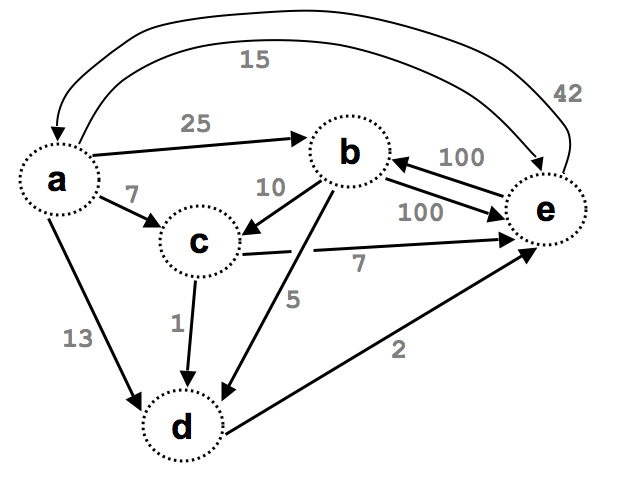
Feel free, also, to use a subgraph (as these algorithms can be very
slow!)
Hints: Consider using weirdo analysis for this
problem in a manner
similar to the reachable example we considered in
class. That file
is linked here and from
the top-level
assignment page. In fact,
you might start with that reach code and consider
how to change the
return values appropriately from booleans to numeric quantities... !
Follow up your min-dist
function with another function,
(min-path a b G), whose inputs are the same as min-dist's.
Your min-path function, on the other hand, should
return a list whose
first element is the minimum distance from a to b
in G
and whose remaining elements list the nodes, in order, on the minimum
path from a to b. The
minimum path from a to itself is
simply a. If no minimum path exists, omit the
nodes. If more
than one equal-cost minimum path exists, your function may return any
one of them. (We
will only test your code on goals and graphs offering a single minimum
path.) As examples:
(test (min-path 'a 'e Gt) '(10.0 a c d e))
(test (min-path 'e 'b Gt) '(67.0 e a b))
(test (min-path 'd 'd Gt) '(0.0 d))
(test (min-path 'a 'z Gt) '(+inf.0)) ;; z's not there!
in which Gt is the same graph used in testing min-dist.
Problem 4: min-road-cut
Preventing spam wars!
The mayors of a number of neighboring cities have been
noticing
some conflicts brewing between their cities over the rumor of an
upcoming Spam shortage. Cities with small Spam reserves have been
making plans to raid the stores of those with larger reserves, should
it come to that.
The mayors, wishing to avoid all conflicts over canned meat
products, have decided that if two cities are about to go to war, the
mayors will cut off all access from one city to another by destroying
all roads that would allow travel between the two towns (perhaps by
way of other towns). They want to do the minimal damage to their
infrastructure, so they have contacted Napquest, a popular
map-information
company, to help them determine the minimum
number of roads that must be destroyed in order to fully separate the
two cities. Napquest has hired you to help with this problem.
Thus, for this problem you should write a function
(min-road-cut a b G), whose inputs are identical
to those of min-dist
and min-path from problem 2, except that G
does not
include path costs (you can imagine all paths having a cost of 1).
In addition, the edges in G should be interpreted
as undirected:
a road from a to b will
also allow travel from b to
a.
Order does not matter.
Your min-road-cut should return the
value of the smallest number
of roads that must be destroyed to successfully separate the two
cities. Remember that roads are undirected and that it is not
sufficient
simply to cut the road between a and b
(if
one exists in the first place) because there might be
another way to get there, e.g., going through c,
for example.
The solution to this problem is not long, but your efforts
will
benefit from prior planning, so make sure you sit down and map out an
algorithm before you start coding! This planning is extremely
important to avoid confusion and frustration. Weirdo analysis
is
a good way to approach this problem, but you will need to deal with a
number of subproblems (e.g., determining when you are done).
The program need not be fast, but it must compute the
right answer. For full credit, keep your code concise.
Hints: since this problem uses reach,
but it interprets its
graphs as undirected, it will be helpful to write -
and use - an
undirected version of reachable, e.g., (ureach a b G).
Another hint, similar to problem #2, is that you might consider using
pset, the powerset function we wrote in class. In
a sense, it
provides a general-purpose "weirdo" approach to problems... .
Here are some example runs:
(define Gx '( (a b) (b c) (a c) (a d) (b d) ) )
(define Gy '( (a b) (b c) (a c) (a d) (c d) ) )

(test (min-road-cut 'a 'b Gx) 3)
(test (min-road-cut 'a 'b Gy) 2)