Resources
| Jazz Links | Recommended Listening | Application for admission to this course (Don’t show up without advanced
permission.)
Harvey
Mudd College Fall 2009
Music 84: Jazz Improvisation
What
this course is about:
This
course introduces theory and practice of modern jazz improvisation, from basic
harmonic concepts through solo and group performance. The level is typically
beginning through intermediate, with some advanced players also participating.
Each semester we base our playing on tunes by a specific celebrated
composer/performer. This semester it is
trumpeter/composer Freddie Hubbard. (We have previously featured Horace
Silver, Sonny Rollins, Miles Davis, Charlie Parker, Thelonious Monk, Dizzy
Gillespie, Benny Golson, John Coltrane, and Tom Harrell.)
Instructor
Bob
Keller 1253 Olin (office
hours 4-5:30 MTW, by drop-in, or by appointment), keller at cs dot hmc dot edu,
x 18483
Catalog
Description
The
art of simultaneously hearing, composing, and performing music. Chords, scales,
chord progressions, and tunes of modern jazz. Theory, listening, analysis, and
group practice in improvisation skills. 1.5 Credit hours, may be repeated for
credit.
Prerequisites:
Music-reading ability,
ability to play the twelve major scales on one's primary instrument, motivation
to play jazz, permission of the instructor. Please complete the application for admission to this course if interested. Note: Repeating for credit is by invitation only, based on progress
and attendance in the previous semester.
Meeting
Time and Place
Wed. 8:30-10:00 p.m., 2nd Floor, Sprague
Library
Requirements
and Grading
Participation
and practice 40%, Written work 30%, Final Performance 30%. The proficiency
level of participants generally varies widely. Accordingly, grading is based on
diligence, rather than absolute performance level.
You are expected to practice daily. It
will require self-motivation and effort. If you have no intention of exerting
yourself, please don't sign up for this class. It is not
intended as a casual jam for those who don't practice between sessions.
Please note: Attendance at class is
absolutely required. If
you need to be excused, please ask, because unexcused absences will affect your
grade negatively.
Required
Materials
There
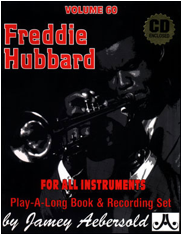
is a required book and CD combination: Jamey Aebersold, Volume 60, Freddie Hubbard Play-A-Long Book and CD For All
Instruments (available direct from the publisher http://www.jazzbooks.com).
Everyone except vocalists and drummers please acquire a copy by the first class
meeting. We will also use the free Impro-Visor
software tool from HMC.
Suggested
Instrumental Tunes
Little
Sunflower (get vocal from recording) Birdlike Up
Jumped Spring Crisis Dear
John Pensativa
(by Clare Fischer) Red
Clay (probably transpose down to C minor) Mr.
Clean (not in book) Straight
Life (not in book) Soul Surge
(7/4 time, not in book) On
the QueTee (not in book) Vocal
Tunes
Lullaby of Birdland
Summertime
and others |
|
Freddie
Hubbard Playing on YouTube
·
Moanin’ (early,
with Art Blakey)
·
Dear John (with McCoy Tyner)
·
Dear John (slower, part 1)
·
Dear John (slower, part 2)
·
Straight
Life (1975, Downbeat Awards)
·
Birdlike
(1982, with Joe Henderson, Superstar Quint.)
·
Fantasy
in D (1982, Village Vanguard, Cedar Walton)
·
A
La Mode (1984, with Art Blakey)
·
Hubtones (1987,
Mt. Fuji Jazz Festival)
·
The
Night Has a Thousand Eyes (1989)
·
Bolivia
(Blue Note, Tokyo, 1990)
·
Red
Clay (disk)
·
Cherokee, part 1 (with Don Braden)
·
Cherokee, part 2 (with Benny Green)
|
Freddie
Hubbard Tunes Played by Others on YouTube
·
Little
Sunflower (Iowa State
University) ·
Little
Sunflower (Vocal version) ·
Birdlike (Alto sax solo, by Miguel Zenon) ·
Birdlike (Jam session, Trumpet solo, by Marcus Printup, others) ·
Birdlike (Transcription of Ryan Kisor's solo) ·
Birdlike (Student performance at Stanford Jazz Residency) ·
Up Jumped Spring
(Piano, with play-a-long) ·
Up
Jumped Spring (Equinox 4) ·
Up
Jumped Spring (Hendrik Meurkens - Harmonica, Dado Moroni - Piano, Ray Drummond - Bass, Jimmy Cobb - Drums) ·
Red
Clay (Jack Wilkins, guitar) ·
Red
Clay (FH Tribute: George Cables, Jermy Pelt, Phil Ranelin, and Lenny white) |
·
Some
Last Words from Freddie Hubbard (written interview)
Optional
Materials
There are several good jazz theory
books. Ask me if you'd like a recommendation for one to suit you.
Also
see the Resources link at the top of the page.
Concept
Outline
Listening suggestions Jazz rhythmic style Intervals , Inversions Cycle of fifths Major and minor chord structures:
Dominant
and other chord structures:
Resolution of dissonant intervals Chord resolutions, Voice leading Blues progression Use of leading tones |
Concept
Outline (continued)
Scales
Keyboard voicings
Solo analysis Solo construction {Minor, Minor} ii-V-I progressions Tritone substitutions Secondary dominants |