Feel free, also, to use a much simpler graph for debugging.
This assignment has two problems and one extra credit option. In Problem 1 you will continue your development of the Unicalc application by adding error-propagation to your back-end functionality. You're ready to start this problem right away. In problem 2 you will work with a graph to find the shortest path between two nodes. You'll probably want to wait until after Thursday's lecture to start this problem. The extra credit problem is to implement a game of 20 questions. Again, you're ready to go on this one. You don't have to do the extra credit of course, but it's a lot of fun and it'll give you practice with trees, which you will be responsible for understanding on the midterm and final exams.
The same guidelines apply as for homework 1 and homework 2.
Testing
A few tests are provided below, but as these problems become larger, it
becomes increasingly important to create and use additional tests of
your own -- not only for top-level functions, but for helper functions,
as
well. For problem 1 and the extra credit, you do not have to include additional tests,
but for problem 2 you should provide at least one additional test.
Again make sure these tests are clearly identified for the graders with comments in your code.
unicalc-db.rkt to represent Uncertain Quantities,
that is, to include a value and a a standard error term in addition to
the units in the numerator and denominator. Also, remove any definitions of make-QL, get-quant, get-num, and get-den from your unicalc.rkt file.
It's up to you how
you represent the data, but you should support the following functions:
Here are some tests for the above functions. Note that no tests
are provided for make-QL or make-UQL because it doesn't matter how you
represent your Quantities, as long as the accessor functions return the
proper values. You do not have to provide any additional tests
for these functions.
(define Q1 (make-QL 3.3 '(second) '(meter meter)))
(define Q2 (make-UQL 4.23 0.23 '() '(kilometer watt)))
(check-within (get-quant Q1) 3.3 0.00001)
(check-within (get-quant Q2) 4.23 0.00001)
(check-within (get-error Q1) 0 0.00001)
(check-within (get-error Q2) 0.23 0.00001)
(check-expect (get-num Q2) '())
(check-expect (get-den Q1) '(meter meter))
Notes:
Modify all of your unicalc.rkt functions from Assignment 2 (slightly modified, see below) so
that they handle error propagation correctly. (If you prefer, you can start from the sample solution linked above
rather than your solution.)
As a reminder, here
are the functions from assignment 2.
| Function Call Form | Meaning |
| (normalize-unit Unit) | Returns a normalized Uncertain Quantity for a single unit. |
| (normalize Quantity) | Converts any Uncertain Quantity to a normalized Uncertain Quantity. |
| (multiply Quantity1 Quantity2) | Multiplies two Uncertain Quantities, returning an Uncertain Quantity. Note: This week you should not assume the given Quantities are normalized, and you should return a normalized quantity only if the inputs were already normalized (i.e., if the answer just happens to be normalized). However, your units should be simplified (canceled), so that you don't have the same unit in the numerator and the denominator. |
| (divide Quantity1 Quantity2) | Divides Uncertain Quantity1 by Uncertain Quantity2, returning an Uncertain Quantity. This week you should not assume the given Quantities are normalized, and you should return a normalized quantity only if the inputs were already normalized. However, your units should be simplified (canceled). |
| (add Quantity1 Quantity2) | Adds Uncertain Quantity1 to Uncertain Quantity2, returning a normalized Uncertain Quantity, provided the quantities are interconvertible. Returns (error "illegal add" Quantity1 Quantity2) value if not. Note: This week you should not assume the inputs will be normalized; however, you can (and should) feel free to normalized the inputs within the add function. The output should always be normalized. |
| (subtract Quantity1 Quantity2) | Subtracts normalized Uncertain Quantity2 from normalized Uncertain Quantity1, returning a normalized Uncertain Quantity, provided the quantities are interconvertible. Returns (error "illegal subtract" Quantity1 Quantity2) value if not. Note: This week you should not assume the inputs will be normalized; however, you can (and should) feel free to normalized the inputs within the subtract function. The output should always be normalized. |
| (power Quantity1 p) | Raises Uncertain Quantity1 to the integer power p returning a normalized Uncertain Quantity. You may assume that p will be an integer (though it may be positive, negative or 0). This week you should not assume the given Quantities are normalized, and you should return a normalized quantity only if the inputs were already normalized. |
Test files are also provided at the start of this problem. Be
sure your functions work on all of the tests provided last week as well
as all new tests for this week.
Graphs are an extremely important data structure in computer science. As we discussed in class, they can represent any number of things, but a popular use of graphs is to represent cities on a map. Used in this way, an important ability is to find the shortest path from one node in the graph (city) to another.
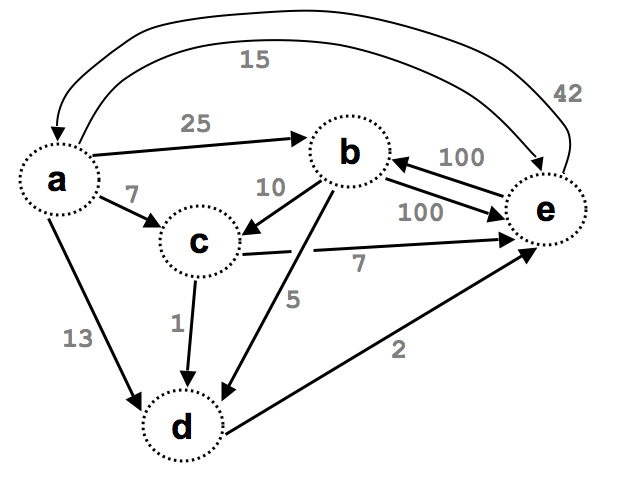
Write a function (min-path a b G), which takes in two nodes a and b and a directed, positively-weighted graph G. Graph G will be represented as a list of edges: (src dst weight). See Gt, below, for an example.
Your min-path should
return a list whose
first element is the minimum distance from a to b
in G
and whose remaining elements list the nodes, in order, on the minimum
path from a to b. The
minimum path from a to itself is
simply a. If no minimum path exists, omit the
nodes. If more
than one equal-cost minimum path exists, your function may return any
one of them. (We
will only test your code on goals and graphs offering a single minimum
path.) As examples:
(define Gt '((e b 100) (a b 25) (e a 42) (a c 7) (a d 13) (a e 15)
 (b c 10) (b d 5) (d e 2) (b e 100) (c d 1) (c e 7)) )


(define (same-path p1 p2)
	(and (= (first p1) (first p2))
        (equal? (rest p1) (rest p2))))
(check-expect (same-path (min-path 'a 'e Gt) '(10 a c d e)) #t)
(check-expect (same-path (min-path 'e 'b Gt) '(67 e a b))   #t)
(check-expect (same-path (min-path 'd 'd Gt) '(0 d))        #t)
(check-expect (same-path (min-path 'a 'z Gt) '(+inf.0))     #t) ;; z's not there!
To help sanity-check your tests, here is a picture of Gt:
Feel free, also, to use a much simpler graph for debugging.
For this problem, you should also test on at least 1 other pair of nodes from Gt. Include this test in your code with a comment that clearly identifies it as your additional test.
Hints:
> (twenty-questions)

Is it bigger than a breadbox? (y/n) y
Is it a computer scientist? (y/n) n
What was it? a chemist
What's a question distinguishing a computer scientist and a chemist? Do you titrate?
And what's the answer for a chemist? (y/n) y
Play again? (y/n) y
Is it bigger than a breadbox? (y/n) y
Does you titrate? (y/n) y
Is it a chemist? (y/n) n
What was it? Wally Wart
What's a question distinguishing a chemist and Wally Wart? Is it concrete?
And what's the answer for Wally Wart? (y/n) y
Play again? (y/n) y
Is it bigger than a breadbox? (y/n) y
Do you titrate? (y/n) y
Is it concrete? (y/n) y
Is it Wally Wart? (y/n) y
I got it!
Play again? (y/n) n
Features
Your twenty questions should allow users to
Representation
For consistency, your game should always start with the question Is
it bigger than a
breadbox? and should have the objects spam
and a computer scientists
available as guesses if the user answers the initial question with a n
or a y,
respectively.
You are welcome to represent the game's data however you like. However
as a guide to one possible
representation,
you might
consider a tree in which internal nodes are questions and leaf nodes
are objects, e.g.,
(define initialTree '("Is it bigger than a breadbox?" "spam" "a computer scientist"))
Strings are likely the simplest data structure for questions and
objects. The function
string-append, along with the other string
functions noted on the Scheme
reference card may be of use.
Possible decomposition
As with the data structure, the choice here is yours. As one possible
suggestion
to get you started (if you'd like), consider the following decomposition:
Input:
Here are two functions demonstrating how to use (read-line)
to grab a line of user input.
The first tests the resulting value (which will
be a string). The second is a more general-purpose question-asking
function that returns a string:
(define (askyn Q) ;; asks a yes/no question Q and returns #t or #f
 (begin
 (display Q)
 (display " (y/n) ")
 (if (equal? "y" (read-line))
 #t
 #f)
 ))


(define (ask Q)
 (begin
 (display Q)
 (read-line)))
Hints: (feel free to
disregard!)
The binary tree used in this game is slightly different than the
numeric
ones used in last week's HW. In this case, the leaves are not empty,
but
contain possible objects; internal nodes contain questions. After the
first round
in the example above, the tree's structure would be
("Is it bigger than a breadbox?" "spam" ("Do you titrate?" "a computer scientist" "a chemist"))
Note that, by our convention, "no" traverses to the left and "yes" to
the right.