Harvey Mudd College
Computer Science 60
Assignment 0, Due Monday, January 24, by 11:59 pm
Link to the CS submission site
Back to the top-level assignments page
Back to the top-level CS 60 page
The 3Rs: Racket, recursion, and run-time!
In this homework you will have the chance to familiarize yourself with the
Racket programming language.
Racket is considered a very "clean" language, with a minimal syntax:
few punctuation and formatting rules. In fact some might argue it's too
rktimal! As a result, Racket is one of the best examples of a language whose focus is
supporting computation
itself, as opposed to intricate data structuring. In the first
problem of this
assignment you'll work through Racket's "Quick start" tutorial;
in the second problem, you'll implement some mathematical
functions in Racket, remind yourself about recursion, and reflect on a few running times... .
Pair and individual problems
Some problems each week will be designated as individual;
others as pair problems. You should complete the individual
problems on your own, though you are - as always - welcome to
get assistance in lots of ways, as the syllabus outlines.
You're may solve pair problems individually if you'd like, but
you're also welcome to submit a single file with a partner. Pair programming
is very effective -- we encourage it! -- but it's important that
you practice pair programming as the
syllabus details:
- Every 30 minutes, the pair must switch off the
roles of driver (at the keyboard) and navigator
(looking on, perhaps with "maps," e.g., browser, slides, or notes).
- The whole problem should be completed by the pair, together, in these roles.
- The work should reflect an equal effort by both of the pair.
Because Racket is likely to be entirely new, this week both problems
may be done in a pair (but they don't have to).
In general, we will make it clear in
each assignment which problems are which.
For this assignment, you will write (and test!) your Racket code in two files:
Be sure to submit your files at the
CS 60 submissions site.
If you work with a partner, please submit only one file between the two of you -- but
be sure to indicate the partner!
To log in to the submission site, use your login id, which should
be your first initial followed by your last name. Use the
default password at first. After you log in the first time, be sure to change it to
something you'll remember. Note that the site
may ask you to re-login with your old password before asking for the new one.
You may submit your work multiple times -- only the file submitted latest (before
the deadline) will be graded, but all of them will be saved in case you or we need
to access them for any reason. The submission site is a convenient way to access
your latest copy of a HW assignment if you work on multiple computers.
Design, commenting, and formatting
Design and formatting account for roughly a quarter of the credit
for each function or program you complete. Correctness, supported
by careful testing of your code, accounts for the rest.
Design, here, means algorithm design, that is, how you break a problem
down into smaller pieces and then compose those pieces into an overall solution.
Large, convoluted functions are difficult to understand (and debug!). Use
small, clear functions with lots of small helper functions, as necessary.
Formatting includes coding style: clean and clear structure, meaningful
variable and function names, ample use of spacing, and indenting that reflects
code structure.
As for commenting,
in each assignment we ask you to include
- a top-of-file comment with
- your name and your partner's name (when applicable)
- the assignment and part number
- how long you spent on it (roughly)
- any other comments (optional) -- feel free to let us know if things
seemed god/bad - easy/difficult - worthwhile/not - and/or anything
else from your stream of consciousness, such as it is, at the end of the assignment...
Any and all feedback is more than welcome!!
- a comment for each function describing
- the function's input(s) and output(s)
- briefly, in English, what it does. Feel free to omit this if it's described
in the "output" line(s)
- comments within functions or data definitions are welcome, but not
required unless something tricky is going on.
Testing your code
Computation in the form of software is useful to the extent that it works. But it only
works (for sure) to the extent that it has been tested! Testing your own software thoroughly is
important -- we use test cases to check how well your functions work, and you will
certainly want to do the same!
It's impossible to programmatically guarantee that your code
is correct (in fact, it's provably uncomputable!)
In practice, however, creating and running a set of tests for each of your functions,
called unit-testing, is vital to producing useful, maintainable software. Unit
testing is also a standard industry practice. In particular,
- test each function individually (unit-testing) with both
the tests we provide and ones of your own design
- use the testing interface that is built-in to Racket (it's nice!)
- build at least one test (more, where appropriate) for each helper function you create. In the long run, this will save you time!
- make sure you test before submitting!
The provided example and starter file
for problem 2 reinforces all of these points -- and shows off the
built-in testing interface:
a starter file for hw0pr2.rkt, with a comment and testing template.
This includes the functions we wrote in class, which will be helpful as a starting point
for Problem 2.
(Problem 1 is both exploratory and graphical, so we will not unit-test its functions.)
Problem 1: hw0pr1.rkt
A quick tour of Racket
Get to the
Dr. Racket programming environment, either by
downloading it to your personal computer or by using the CS lab. you can use CIS's labs, too --
they likely already have Dr. Racket, or you can download it to your local drive space.
On the CS department's Macs in BkB102 and BkB105, Dr. Racket can be found in the Additional
Applications folder:
- Click on the desktop (to bring up the finder menu)
- From the top of the screen, choose the "Go" menu
- Choose "Applications"
- From the Applications window, double-click "Additional Applications"
- Among the choices, select "Programming"
- Within that Programming folder, there should be "Racket" and then "Dr. Racket" within it.
If you have forgotten your CS login or password (they may be different
than the CIS one), feel free
to ask Tim Buchheim, our administrator across the hall in Beckman B101,
to reset it. We're happy to help with this, too.
Note this your CS password and your CS submission-site password are
not the same (unless you've set them to be).
Once you have Racket running, go to the "Quick introduction" site:
The Racket quick-introduction site
which if a fun guide through a small piece of the language that uses images.
What to do
Work your way through those examples, at least up to section 6.
Do NOT worry if things start seeming crazy as you get into the later
sections -- or, perhaps, the whole time! This problem is to start
getting used to learning new computational interfaces, and they always
seem crazy at first! Sections 7 and 8 are great to try, but not required.
We will cover their ideas in detail next week. And we won't use enough Racket
in CS 60 to cover sections 9-11 at all.
Do type (or copy!) the functions from sections 4-6 into the definitions
pane of Dr. Racket's interface. Run them as you go. Also, save those definitions
as the file hw0pr1.rkt. This is
the file you will submit for problem 1.
What to add
To complete this problem, add two functions to your hw0pr1.rkt file:
Function #1: cboard
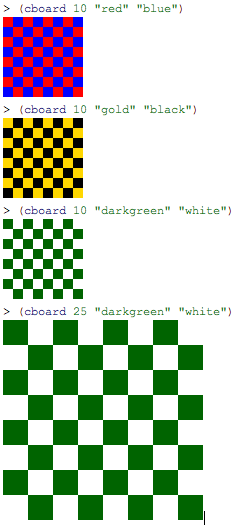
Using the provided checkerboard function as a guide, create a function
named cboard. But cboard should take three inputs, so that
its definition will begin
(define (cboard n color1 color2)
Be sure to have a header comment for your function!
Also, if you'd to add features, consider
trying the extra credit, below...!
Function #2: hcomb
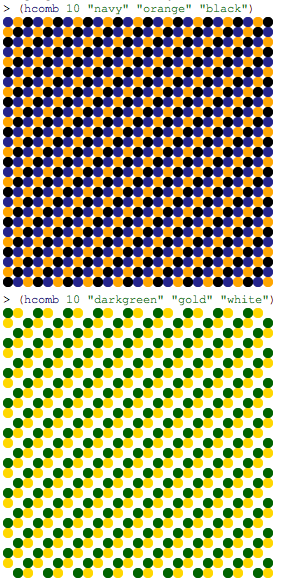
Write another function, named hcomb, whose definition will begin
(define (hcomb n color1 color2 color3)
Again, add a header comment for your function... .
Extra-credit! alien and extra
As completely optional extra-credit (of up to +5 points each),
create functions named alien and/or extra
that composes Racket's graphics primitives into artistic images of your own.
The alien function should output a picture of an alien, broadly
interpreted, and should
take one input: (alien input) - you may choose what input
does, e.g., it can control size, color, or some other feature (number of eyes?)
You have almost complete leeway in designing extra, e.g.,
it can create abstract, geometrical pictures or even more
elaborate representations of aliens. It has only two
constraints:
- extra should take at least two input argument -- and should
use its input arguments, so that it creates not only one picture, but
a family of pictures. You may choose what the input arguments mean.
- You should include a comment that describes what your extra does --
and you should include at least three example invocations of extra
that you would like the graders to try out!
Be sure to submit hw0pr1.rkt at the submission site!
Problem 2: hw0pr2.rkt
Running with racket
For this problem, you will want to start with this starter file
hw0pr2.rkt
which includes a few examples of Racket syntax and its
testing interface, along with the functions we wrote in
class this week.
As with human languages, lots of examples are the most
efficient way to start feeling comfortable with
a new programming language!
This problem asks you to write a number of mathematical functions and/or
to reflect on their running times.
Remember that for each problem below, you
should include at least one additional test in your file, beyond what
we provide. Please be sure these additional tests are clearly
marked with comments. For example, for the erdos
function you might have in your code:
; provided tests
(check-expect (erdos 6) 3)
(check-expect (erdos 7) 22)

; additional tests
(check-expect (erdos 84) 42)
(check-expect (erdos 85) 256)
Problem 2.1: erdos
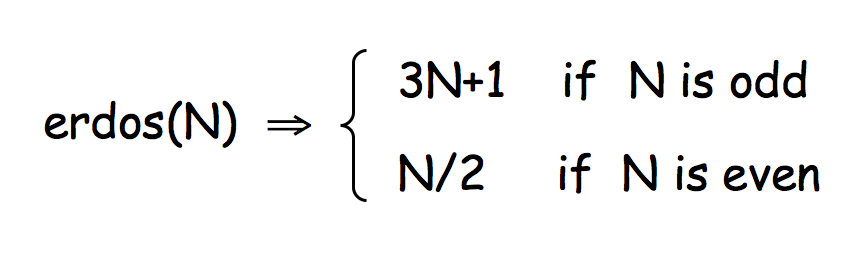
For this problem define a function, named erdos,
with one argument, N. Thus, your definition will
begin as follows:
(define (erdos N)
This function should compute the following:
Here are a couple of tests to try.
; provided tests
(check-expect (erdos 6) 3)
(check-expect (erdos 7) 22)
Warning: Racket's built-in integer-division function is
quotient, not the / symbol. If you try (/ 3 2) you will
get the rational number three-halves instead of the floating-point number 1.5
or the integer 1. But (quotient 3 2) evaluates to 1, as expected with
integer division. The "mod" function in Racket is modulo, so that (modulo 12 7)
evaluates to 5. See Prof. Keller's
Racket Reference
Card for a listing of the most important library functions.
Problem 2.2: erdos-count
Write erdos-count, a function of one positive
integer argument:
(define (erdos-count N)
where erdos-count should return the smallest
number of times erdos must be iterated, when
started
with an input of N, in order
to arrive at a value of 1. Let's use the symbol ==>
to mean "evaluates to." Then,
(erdos-count 3) ==> 7, because
(erdos (erdos (erdos (erdos (erdos (erdos (erdos 3))))))) ==> 1
and there are 7 applications of erdos above.
Here are a few Racket tests:
; provided tests
(check-expect (erdos-count 1) 0)
(check-expect (erdos-count 26) 10)
(check-expect (erdos-count 27) 111)
Run-time
The erdos-count
function is said to iterate the erdos function.
As this
link suggests, it is still unknown
whether or not (erdos-count N)
halts for every positive integer N. It does halt for all of
the values of N for which it has been tried.
It is conjectured always to halt, but no one has proven it one way or
the other. Paul Erdos (roughly pronounced air-dish) famously
quipped that "mathematics is not ready for such problems."
The fact that a general-purpose "haltchecking" program would be
powerful enough to answer this century-old
conjecture hints at how strong a capability "haltchecking" actually
is! The state-of-the-art understanding of this 3x + 1
problem is available at this
link.
Given the above background on erdos and erdos-count,
include a sentence or two in a comment at this point in your code that
answers
- what is the best-case big-O running time
of (erdos-count N) for large values of N?
The best-case running time is the smallest number of
steps that might be needed to finish running.
- what is the worst-case big-O running time
of (erdos-count N) for large values of N?
(largest number of steps that might be needed)
Consider each call to erdos to be 1 step (nothing else will count for
the purposes of this informal analysis). Briefly explain your reasoning: a phrase
or sentence will do.
Problem 2.3: count1bits
Write count1bits, a function of one nonnegative
integer argument:
(define (count1bits N)
where count1bits should return the number of times the bit 1
appears in the binary representation of N. Remember that N
will be a nonnegative integer. Feel free to review binary representation, if you have not seen
it for a while - you might also try the tests below, by hand.
Here are a few Racket tests:
; provided tests
(check-expect (count1bits 6) 2)
(check-expect (count1bits 7) 3)
(check-expect (count1bits 42) 3)
Run-time
In a comment near your count1bits function, estimate
its big-O running time for an input whose value is N.
Count the number of times that count1bits is called
recursively as the "steps." Explain briefly.
Problem 2.4: power
Write power, a function of two integer inputs (it's
OK to presume non-negative integers):
(define (power b p)
where b is the base and p is the power: it should
evaluate to bp. We also specify that, for this
function, b0 should be 1 for any b.
Note that using the built-in power function expt is not
allowed here -- imagine you're implementing it for the Racket
library... . Rather, you should implement power
in terms of multiplication, addition/subtraction,
and recursion using the formula bp = b*bp-1.
If you know a fancier algorithm for computing powers,
save it until the next problem!
Here are a few Racket tests:
; provided tests
(check-expect (power 2 5) 32)
(check-expect (power 5 2) 25)
(check-expect (power 42 1) 42)
Run-time
In a comment near your power function, estimate
its big-O running time in terms of b and p.
For this problem, consider multiplications as the "steps"
that are being counted. Explain briefly.
Problem 2.5: fast-power
Write fast-power, identical in its inputs and outputs to power:
(define (fast-power b p)
where b is the base and p is the power.
This time, however, you should use the following idea:
- If the power is 0, you're done (you're at the base case)
- If the power p is odd, compute the result
recursively just as before. That is, "peel off" one factor of b.
- If the power p is even, compute (using recursion)
the value of bp/2. Again, use quotient, not /!
Then, notice that the value you need to produce is bp/2 * bp/2.
Use this fact!
The test values will be the same as for power:
; provided tests
(check-expect (fast-power 2 5) 32)
(check-expect (fast-power 5 2) 25)
(check-expect (fast-power 42 1) 42)
Run-time
In a comment near your fast-power function, estimate
its big-O running time in terms of b and p.
For this problem, again consider multiplications as the "steps"
that are being counted. Explain briefly.
Then, at the prompt, use the timing command:
(time (fast-power 1 N))
- The return value, 1.
- The number of CPU-time milliseconds needed for the computation.
- The number of wall-clock-time milliseconds needed for the computation (this
is less accurate and can include other processes that might be running).
- The number of milliseconds spent freeing up memory that was used
in the computation ("garbage collection").
For this problem, only worry about the second value (the CPU-time).
Comment on whether these match your expectations. Keep the base 1, so that
the numbers don't get ludicrously large!
Extra! Problem 2.6: factor
For completely optional extra credit of up to +5 points each,
write two functions: first-factor and factor, each of which
take one integer input, N, which will be greater than 1.
(define (first-factor N)
(define (factor N)
These should compute the smallest ("first") factor of N and
a list of all the factors of N, respectively. (See the tests.)
Note that these
add several challenges! First, you'll need to use Racket's lists (there
are lots of references in its documentation). In addition, you'll need
helper functions, and you'll need to
be creative in what those helper functions will be!
Here are two tests for each:
; provided tests
(check-expect (first-factor 41) 41)
(check-expect (first-factor 42) 2)

(check-expect (factor 41) '(1 41))
(check-expect (factor 42) '(1 2 3 6 7 14 21 42))
Run-time
In a comment near these two functions, estimate
the best-case and worst-case big-O running time of each, in terms of N,
the input.
For this problem, consider the "steps" to be calls to modulo
and/or quotient and/or the / operator.
Explain briefly.
Submit!
Be sure to submit both hw0pr1.rkt and hw0pr2.rkt at the submission site!
A rough schedule of CS 60 topics - subject to change...