Computer Science 60
Principles of Computer Science
Spring 2011
Assignment 11 "lite": Computational Models in JFLAP [50 Points]
Due Monday, April 18 11:59pm
Because we have a midterm this week, this assignment is relatively
shorter than others. However, please do get started on it (soon)
after you've completed the midterm.
Review of the proof techniques we (will) have discussed this week...
This link contains a review of the Distinguishability Theorem and the Nonregular Language Theorem, and how
to use them.20
JFLAP!
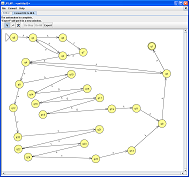
Click for a larger image of this example JFLAP NFA...
In this assignment you will have the opportunity to
try out the very nifty JFLAP Automata Simulator
developed by Dr. Susan
Rodger at Duke University. JFLAP allows you to create automata on the screen
and then simulate their operation with any input string you like. You will also
be proving that certain tasks are unsolvable by finite automata (read: computers!)
WARNING - Running JFLAP on the lab macs
On the lab Macs, JFLAP is located in Go -- Applications -- Additional Applications --
Programming -- JFLAP.jar. However, if you want to double-click it to start it, you
need to double-click the Start JFLAP application located in the same directory.
Alternatively, you can start it from the command line (and no need to log in to knuth, either!) by
running
cd /Network/Applications/Programming
and then, from that directory, run
java -jar JFLAP.java
You can download a copy of JFLAP for your own computer (or on the
Macs in the CS lab) for free.
It is available at
www.jflap.org. To simplify downloading,
you can also get a copy of JFLAP.jar from this local link.
If you do go to the JFLAP site,
follow the Get JFLAP link on the green left menu. From there, go to
the bottom of the page and select "JFLAP software". You'll need to fill out a brief form
to let the creators know who's using their software, and then
choose the latest "JFLAP.jar."
JFLAP is written in java; a jar file packages a group of
Java classes in one place.
Double-clicking that JFLAP.jar file should start the
program (if Java is set up).
Alternatively, you start JFLAP from a command prompt (unix or windows)
by typing java -jar JFLAP.jar.
For this to work, java needs to be "in your path," which it may already
be, because of the java assignments you wrote! If it's not, feel free to ask.
Under windows, the path is set via the "System Contol Panel - Advanced -
Environment Variables."
Lots of files to submit...!
Similar to previous assignments, you will submit a different
file for each of the problems on this assignment. Here, however, there
will be 5 of them. Some will be JFLAP
files, which you should name as the problem specifies -- this will make it
easy on the graders. Others will be plain-text files (.txt)
which
will hold your proofs. Submit the files via the website as usual, but
please do name them according to the problem specification!
Getting started with JFLAP
When you start JFLAP, you will see a menu that looks something like this:
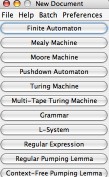
with a Help menu at the top. In fact, the help option directs you to
the
tutorial available from this link..
The documentation is not only thorough, it even has various "haiku-help"
versions scattered through it... . (Actually the haiku-help has been made
hard to find in recent version.)
Almost all of our problems use the binary alphabet: { 0, 1 }
For each of the problems below, you should assume that the input will
consist of zero or more 0's and 1's.
Thus, keep in mind that every state in a DFA [Deterministic Finite Automaton]
must have one outgoing transition
labeled 0 and one outgoing transition labeled 1.
Remember also that a DFA must accept every string in the desired language
and reject every string not in the language. Finally, the empty
string (λ, lambda) corresponds to no input at all. As a concrete
example,
consider a language L, defined to be
the set of all strings with an even number of 0's.
The empty string must be
in this language since the empty string
has zero 0's -- and zero is even! Thus, a DFA for
this language must have its initial state be an accepting state -- that way it
accepts even if it gets no input! Be sure that your automata accepts
the empty string if it is in the specified language -- we'll be checking this!
A Sample Proof
In addition, because you will be applying some of the theorems from class to
write your own proofs, a sample proof using the
nonregular language theorem is available at this link.
You are welcome to "copy" as much as you like from this sample proof when
writing your own proofs. Simply submit each proof in an ASCII plain-text
file with a name as designated by the specific problem.
The problems
The first half of these problems, #1 through #3, should be done
individually.
- [5 Points]
In JFLAP, construct a DFA for the language:
{w | w contains at least two 0's and at most one 1.}
For example, the string 01000 is in the language but
01 and 0110 are not.
Save and submit your DFA in a file called part1.jff.
- [5 Points] In JFLAP, construct a DFA for the language:
{w | The number of 0's in w is a multiple of 2 or a multiple of 3 or both.}
For example, the empty string, 0101, and 01000100 are
in the language but 01 is not. Your DFA should have at
most 6 states. The empty string, with zero 0s should be accepted.
Save and submit your DFA in a file called part2.jff.
- [10 Points] Prove that any DFA for the language in the previous problem
(part 2)
MUST have at least 6 states. You will need to use the idea of pairwise
distinguishable sets of strings as we covered in class.
Although the proof example at this link
uses the nonregular language theorem, i.e., an
infinite set of pairwise
distinguishable strings, it is still a reasonable starting
template and guide to your write-up for this problem.
Write a clear and precise proof and
save/submit it in a file called part3.txt. Notice that since
your DFA for this language had 6 states, you have proven that
yours is as succinct a DFA as is possible for this language!
By the way, one way to prove this is to show 15 separate cases of
pairwise distinguishable strings. This is fine, because the cases are
short -- however, with a little bit of
thought you may be able to have considerably fewer cases in your analysis!
The
subsequent problems, #4 through #6, may be done in
pairs or individually. If you work with a partner, please work
with the same partner for all problems (but you can complete any of
them individually still). In addition, we STRONGLY RECOMMEND that
both partners practice writing up the proofs in numbers 5 and 6.
(You only need to submit one version, but it's good practice to
at least write up one on your own, even if you come up with the proof
idea with a partner).
- [10 Points] In JFLAP, construct a DFA for the language:
{w | w is the BINARY representation of a number which is a multiple of 7.}
For example, the inputs 0, 111, 1110,
10101, 11100, and 100011 would all be accepted because they are the binary
representations of the numbers 0, 7, 14, 21, 28, and 35, respectively.
Note! Keep in mind that the DFA reads input from left to right, so that the
first digit seen will correspond to the most significant digit and the last digit
seen is the least significant digit.
The number may is permitted to begin with
leading zeroes (for example, 010101 is OK because it is still 21).
For this problem the empty string should
be interpreted as the number 0 and, thus, the empty string should be accepted.
This problem is somewhat more challenging than the ones above.
You'll need to think about this some before starting to construct
your DFA. For full credit, your solution may not use more than 8 states (it's
possible, in fact, to use fewer).
Caution: this problem is tricky - consider carefully how
reading a 1 or a 0 changes the value of
the binary number being built... especially because the number is being
built in the "wrong direction," so to speak.
Save and submit your DFA in a file called part4.jff.
- [10 Points] Next, you'll prove that several languages are not regular by using
the Nonregular Language Theorem. Recall that we say that a language is
"Nonregular" if there cannot exist a DFA for it. First, consider the palindrome language:
{w | w is made of 0's and 1's and is the same forwards as backwards}
For example, 0, 11, 101, and 00100 are all in
the language but 01, 100 and
010111 are not in the language.
Prove that that this language is not regular by using the Nonregular
Language Theorem. Save and submit your proof in a file named
part5.txt.
As an example of what such a proof should look like,
take a look at the file sampleProof.txt.
Notice that simply
giving an infinite set S does not suffice. You must also
argue that an arbitrary pair of strings from S are always
distinguishable!
- [10 Points] Now consider the language
{w | w is a string of 0's whose length is a power of 2}
For example, the strings 0, 00, 0000, 00000000
are all in the language since their lengths are 1, 2, 4, and 8, all
of which are powers of 2. On the other hand, 000, 00000,
any string containing a character other than 0, and the empty
string are all not in this language.
Prove that this language is not regular by
using the Nonregular Language Theorem. Your proof must be clear and
precise. Leave your proof in electronic
form in a file called part6.txt.
A totally optional and fun extra credit challenge...
- ExCr [up to +5 points] The binary-addition DFA!
So far, we have looked at DFAs whose input alphabet comprised only
0's and 1's. It's possible, however, for a DFA to have a different
input alphabet. In this problem, we'll consider the following funky
alphabet: A symbol in the alphabet is any 3-tuple (also known as a
"vector") whose elements are either 0's or 1's. So, here are the
eight symbols in our alphabet:
  (0, 0, 0), (0, 0, 1), (0, 1, 0), (0, 1, 1), (1, 0, 0), (1, 0, 1),
  (1, 1, 0), (1, 1, 1)
For convenience, however, let's write each of these input symbols
vertically and without parentheses. So, the eight symbols above
will be
represented as:
  0   0   0   0   1   1   1   1
  0   0   1   1   0   0   1   1
  0,  1,  0,  1,  0,  1,  0,  1
Now, define the language of valid additions to be the
collection of all strings made from this alphabet that correspond
to correct binary additions when the input is interpreted as
the number in the first row added to the number in the second row
equals the number in the third row. Note that numbers are interpreted
as having the most significant digit is at the far left. This corresponds
to the usual interpretation of a string of 0s and 1s as a binary number.
It also means that the DFA sees the most significant digits first!
For example, consider the string of 4 symbols below:
  1   0   1   0
  0   0   1   0
  1,  1,  0,  0
This 4-symbol string is in the language of valid additions since
the sum of the binary numbers 1010 (first row) and 0010 (second row)
is 1100 (third row).
However, the following string is not in the language of valid
additions:
  1    1
  0    1
  0,   0
This string is interpreted as the sum of 11 (first row) and 01
(second row) is 00 which is false!
For this problem, construct a DFA for the language of valid additions and then
prove (using the Distinguishability Theorem) that your DFA has the
fewest possible number of states! JFLAP is happy to allow three characters
along a single transition, which is what you will need in this case.
Save and submit your JFLAP DFA in a file
named excr.jff and submit your proof that no fewer states are possible
in a file named excr.txt.