Computer Science 60
Principles of Computer Science
Spring 2012
Assignment 11: Floyd-Warshall; Computability [100 Points]
Due Monday, April 23, 11:59pm
You may turn in the extra credit (only) on Tuesday, April 24, without using a Euro.
Pair Programming
If you wish, you may work as a pair to do Part 1, and specified problems from Part 2. However, remember that working as a pair obligates you to obey
the course pair-programming guidelines:
- Both members of the pair must be at one computer together while collaborating.
- One student will be the "driver" who controls the keyboard and mouse. The other is the "navigator" who observes, asks questions, suggests solutions, and thinks about slightly longer-term strategies.
- It is not permissible for one member of the pair to work on the code while his or her partner is not there or not participating actively.
- The person typing at the keyboard should be swapped at least every 30 minutes. Be vigilant about this!
- Both students should be able to explain the resulting code.
Part 1: Floyd-Warshall (35 points)
You have just been hired by the brand new startup Moogle,
which is hoping to make money off the (so far untapped) market for
internet services among cows. You have been assigned to work on
their Moogle Maps project, which will help grazing cows find
the shortest routes between various landmarks of interest (salt
licks, water, etc.).
Specifically, you are to implement the all-pairs-shortest-paths algorithm. It reads
in a graph from a file and then allow a cow to make a query against that
graph. (Admittedly, a more complete version might allow more queries,
but what are the chances that a cow will make more than one query?)
Try it!
Sample graphs and a sample solution (a compiled .class file)
are provided in fw.zip.
To run the example fw class from the command line,
you should be able to use the command java fw from the directory
where the fw.class file is located.
To run it from Dr. Java, these steps have worked for us:
- Open the map0.txt file in Dr. Java -- to see it you will
need to choose All files from the file-types dropdown menu.
This map0.txt file isn't really needed, but doing this puts
Dr. Java in the right directory. Also, it's a good idea to remind
you of this small graph's structure. The -1 values in the
file represent "no path" or, equivalently, "infinite distance."
- Next, click on the "Interactions Pane" at the bottom of Dr. Java
- At the > prompt, type java fw, which should start the program.
- The program should prompt you for a filename: type map0.txt .
- The program will print out the four "layers" of the Floyd-Warshall algorithm's
dynamic programming table. It will also print out the previous vertex
table. (All of these "tables" are 2d arrays.) You can (and should) compare your
code's results to these as part of development.
- Then, the program will ask for a source and destination vertex as a shortest-path
query. As a first trial, type 3 as the source vertex and 2 as
the destination vertex. You should see the program print that the minimum
path length in this case is 2 and that the path traversed is 3 -->
1 --> 2.
Here is the output of the run described above:
> java fw
Enter a filename:  [[user types --->]] map0.txt
Now trying to open map0.txt
Read the number of cities = 3

The FW tables:

fw[0] is
[0, 1, -1]
[-1, 0, 1]
[1, -1, 0]

fw[1] is
[0, 1, -1]
[-1, 0, 1]
[1, 2, 0]

fw[2] is
[0, 1, 2]
[-1, 0, 1]
[1, 2, 0]

fw[3] is
[0, 1, 2]
[2, 0, 1]
[1, 2, 0]

The "previous vertices":

pv is
[0, 0, 1]
[2, 1, 1]
[2, 0, 2]

From what city (1-3)?  [[user types --->]] 3
  To what city (1-3)?  [[user types --->]] 2
From city # 3
  to city# 2
  the minimum cost is 2

And the path is
 3 --> 1 --> 2
Floyd-Warshall Specifics
Your job is to define a class named fw (lowercase), in a file fw.java (also lowercase).
You will not create any objects of the fw class; all of your work can be done inside
public static void main(String[] args) { ... }
(Rather than putting all the code into main, you are free to define helper functions in the fw class
and then call them from main. Don't forget that, since there are no fw object around,
like main these helper functions will all have to be declared static.) When run, your
main function should behave as described above.
We recommend writing the code in the following sequence. Don't forget to test your code at each step.
- Reading in the graph, which involves:
- Getting the filename from the user.
(Java Hints: User Input)
- Reading the contents of that file into an array.
(Java Hints: User Input)
(Java Hints: 2D and 3D Arrays)
To start with, I recommend reading the input into a 2D array of ints.
You may assume the file will be in the following format:
    3
    0 1 -1
    -1 0 1
    1 -1 0
Here, the first line of the file contains a positive integer, n,
indicating the number of vertices in the graph.
This is followed by n lines of data, each of which
contains n integers. The integer in row src and
(column) position dst indicates the cost of the edge
from vertex src to vertex dst in the graph. If there
is no edge from vertex src to vertex dst then the
length of this edge is "infinity" which is represented by the
value -1.
Note, too, that the cost of the edge from vertex src
to dst may be different from the cost of the edge from
vertex dst to src, due to hills,
streams with strong currents, or other unusual field conditions.
For the purposes of this program, we are numbering vertices starting from 1, instead of
the traditional 0. Indexing from 1 is helpful in Floyd-Warshall, because
it means you can use the 0 for other purposes (described more below).
WARNING: If you want indexes 1 through n to be accessible, you need an array
of length at least n+1.
- Test Your Code. Make sure you are getting the input that you think you are getting (e.g.,
by displaying the contents of your array.)
- Computing (Just) the Shortest Lengths, which involves:
- Creating and initializing a 3D array. You need a 3D array fw of an appropriate size.
(Don't forget we're going up to and including vertex n). As discussed in class, the fw[0] slice will be the original graph. You can either make the copy here, or adjust the graph-reading code above to allocate fw and read the graph edges directly into the right slice of fw.
- Running the Floyd-Warshall Algorithm on fw. The algorithm was discussed in class.
Watch out: we are using -1 to stand for "infinity." You will have to watch out for
these edges, and treat them specially.
As you'll recall, vertices should be numbered from 1 upwards rather than
from 0. Here's why:
The algorithm builds a series of tables of
path lengths from every src to every dst.
The kth table represents, "the shortest path-length from
all src vertices to all dst vertices going
through no intermediate vertex numbered higher than k.
By starting at 1, the zeroth table then goes through no
intermediate vertices at all, which means it's simply the
original graph. By starting vertex-counting at 1, we avoid having
to have a special case for the original graph.
- Testing. Write code to display the slices of fw. Make sure the results agree with the example output above.
- More Interaction with the User
- Query the user for a start and destination, exactly as shown in the sample execution.
(Java Hints: User Input)
- Display the minimal distance, exactly as shown in the sample execution. This is pretty easy if Floyd-Warshall gave you the right answer!
Submission
Please submit your code as the file fw.java.
Note that (despite the sample run above) your code is not required to display the shortest path, or the previous-vertex matrix used to compute this shortest path. You may do this for extra credit, as described below.
Part 2: JFLAP!
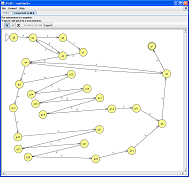
Click for a larger image of this example JFLAP NFA...
In this assignment you will have the opportunity to
try out the very nifty JFLAP Automata Simulator
developed by Dr. Susan
Rodger at Duke University. JFLAP allows you to create automata on the screen
and then simulate their operation with any input string you like. You will also
be proving that certain tasks are unsolvable by finite automata (read: computers!)
WARNING - Running JFLAP on the lab macs
JFLAP is present on the CS lab Macs - it's located in Go -- Applications -- Additional Applications --
Programming -- JFLAP.jar. However, if you want to double-click it to start it, you
need to double-click the Start JFLAP application located in the same directory.
Alternatively, you can start it from the command line (and no need to log in to knuth, either!) by
running
cd /Network/Applications/Programming
and then, from that directory, run
java -jar JFLAP.java
You can download a copy of JFLAP for your own computer (or onto the
Desktop of the PCs in the LAC lab) for free from this JFLAP software
website. The smaller one, JFLAP_Thin.jar is all you will need.
A local copy of this file is also avaiable at
this
JFLAP_Thin.jar link.
JFLAP is written in java; a jar file packages a group of
Java classes in one place.
Double-clicking that JFLAP.jar file should start the
program (if Java is set up).
Lots of files to submit...!
Similar to previous assignments, you will submit a different
file for each of the problems on this assignment. Here, however, there
will be 10 or more of them! Some will be JFLAP
files, which you should name as the problem specifies -- this will make it
easy on the graders. Others will be plain-text files (.txt)
which will hold your proofs. Submit the files via the website as usual, but please do name them according to the problem specification!
Getting started with JFLAP
When you start JFLAP, you will see a menu that looks something like this:
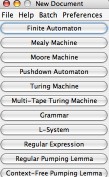 with a Help menu at the top. In fact, the help option directs you to
the
tutorial available from this link..
The documentation is not only thorough, it even has various "haiku-help"
versions scattered through it... . (Actually the haiku-help has been made
hard to find in recent versions.)
with a Help menu at the top. In fact, the help option directs you to
the
tutorial available from this link..
The documentation is not only thorough, it even has various "haiku-help"
versions scattered through it... . (Actually the haiku-help has been made
hard to find in recent versions.)
Almost all of our problems use the binary alphabet: { 0, 1 }
For each of the problems below, you should assume that the input will
consist of zero or more 0's and 1's.
Thus, keep in mind that every state in a DFA [Deterministic Finite Automaton]
must have one outgoing transition
labeled 0 and one outgoing transition labeled 1.
Remember also that a DFA must accept every string in the desired language
and reject every string not in the language. Finally, the empty
string (λ, lambda) corresponds to no input at all. As a concrete
example,
consider a language L, defined to be
the set of all strings with an even number of 0's.
The empty string must be
in this language since the empty string
has zero 0's -- and zero is even! Thus, a DFA for
this language must have its initial state be an accepting state -- that way it
accepts even if it gets no input! Be sure that your automata accepts
the empty string if it is in the specified language -- we'll be checking this!
A Sample Proof
In addition, because you will be applying some of the theorems from class to
write your own proofs, a sample proof using the
nonregular language theorem is available at this link.
You are welcome to "copy" as much as you like from this sample proof when
writing your own proofs. Simply submit each proof in an ASCII plain-text
file with a name as designated by the specific problem.
The problems
The first several subparts, #1 through #4, should be done
individually.
- [5 Points]
In JFLAP, construct a DFA for the language:
{w | w contains at least two 0's and at most one 1.}
For example, the string 01000 is in the language but
01 and 0110 are not.
Save and submit your DFA in a file called part1.jff.
- [5 Points] In JFLAP, construct a DFA for the language:
{w | The number of 0's in w is a multiple of 2 or a multiple of 3 or both.}
For example, the empty string, 0101, and 01000100 are
in the language but 01 is not. Your DFA should have at
most 6 states. The empty string, with zero 0s should be accepted.
Save and submit your DFA in a file called part2.jff.
- [10 Points] Prove that any DFA for the language in the previous problem
(part 2)
MUST have at least 6 states. You will need to use the idea of pairwise
distinguishable sets of strings as we covered in class.
Although the proof example at this link
uses the nonregular language theorem, i.e., an
infinite set of pairwise
distinguishable strings, it is still a reasonable starting
template and guide to your write-up for this problem.
Write a clear and precise proof and
save/submit it in a file called part3.txt. Notice that since
your DFA for this language had 6 states, you have proven that
yours is as succinct a DFA as is possible for this language!
By the way, one way to prove this is to show 15 separate cases of
pairwise distinguishable strings. This is fine, because the cases are
short -- however, with a little bit of
thought you may be able to have considerably fewer cases in your analysis!
- [10 points] In JFLAP, construct a nondeterministic finite automaton
(NFA) for the language:
{w | The number of 0's in w is a multiple of 3 or a multiple of 5 or both.}
Notice that this machine would require at least 15 states if you were to
build a DFA. (Make sure you see why -- though you need not prove it.)
However, for credit for this NFA, it may have at most 9 states. Again, since 0 is a multiple
of 3 (or 5, for that matter), the empty string should be accepted.
Save your NFA in a file called part4.jff and submit.
The subsequent problems, #5 through #8, may be done in pairs or
individually.
- [10 Points] In JFLAP, construct a DFA for the language:
{w | w is the BINARY representation of a number which is a multiple of 7.}
For example, the inputs 0, 111, 1110,
10101, 11100, and 100011 would all be accepted because they are the binary
representations of the numbers 0, 7, 14, 21, 28, and 35, respectively.
Note! Keep in mind that the DFA reads input from left to right, so that the
first digit seen will correspond to the most significant digit and the last digit
seen is the least significant digit.
The number may is permitted to begin with
leading zeroes (for example, 010101 is OK because it is still 21).
For this problem the empty string should
be interpreted as the number 0 and, thus, the empty string should be accepted.
This problem is somewhat more challenging than the ones above.
You'll need to think about this some before starting to construct
your DFA. For full credit, your solution may not use more than 8 states (it's
possible, in fact, to use fewer).
Caution: this problem is tricky - consider carefully how
reading a 1 or a 0 changes the value of
the binary number being built... especially because the number is being
built in the "wrong direction," so to speak.
Save and submit your DFA in a file called part5.jff.
- [10 Points] Next, you'll prove that several languages are not regular by using
the Nonregular Language Theorem. Recall that we say that a language is
"Nonregular" if there cannot exist a DFA for it. First, consider the palindrome language:
{w | w is made of 0's and 1's and is the same forwards as backwards}
For example, 0, 11, 101, and 00100 are all in
the language but 01, 100 and
010111 are not in the language.
Prove that that this language is not regular by using the Nonregular
Language Theorem. Save and submit your proof in a file named
part6.txt.
As an example of what such a proof should look like,
take a look at the file sampleProof.txt.
Notice that simply
giving an infinite set S does not suffice. You must also
argue that an arbitrary pair of strings from S are always
distinguishable!
- [10 Points] Now consider the language
{w | w is a string of 0's whose length is a power of 2}
For example, the strings 0, 00, 0000, 00000000
are all in the language since their lengths are 1, 2, 4, and 8, all
of which are powers of 2. On the other hand, 000, 00000,
any string containing a character other than 0, and the empty
string are all not in this language.
Prove that this language is not regular by
using the Nonregular Language Theorem. Your proof must be clear and
precise. Leave your proof in electronic
form in a file called part7.txt.
- [5 Points] A surprise...?! In the sampleProof.txt file
we've shown that the language
{w | w contains an equal number of 0's and 1's in any order.}
is not regular.
However, now consider the following closely related language:
{w | w contains an equal number of occurrences of the substrings 01 and 10.}
The substrings may overlap -- thus, this language contains 0110, which contains the pattern 01 once
and the pattern 10 once, as well as 101 (this contains the pattern
10 once and the pattern 01 once - they overlap, but that's fine!).
Amazingly, this language is regular! Show that this is true by building
a DFA or NFA for this language using JFLAP. Save and submit your solution in a
file named part8.jff.
Totally Optional Extra Credit 1: Displaying Shortest Paths (+15 points)
Complete your fw.java file so that it reconstructs and prints the actual shortest paths,
as shown in the sample execution. How?
- You will want to keep
a second table (named PV above, short for "previous vertex"), which
holds in PV[src][dst] the intermediate vertex immediately before
dst when traversing the shortest path from src to dst.
This entry
could start as src for all entries (src,dst) for which there
is a valid direct edge, and it could start at -1 for those cells
that do not have a direct edge. Then, the entries of this table could
be updated appropriately as the Floyd-Warshall algorithm progresses!
-
Once the algorithm finishes and you need a path from src to dst,
you can use this table to get the vertex immediately before dst on that
path. Then, you can use the table again to get the vertex immediately
before that one - and so on!
Submission
Include these changes in your fw.java submission. Additionally, put a comment at the
top of the file, to remind the graders that you did the extra credit.
Totally Optional Extra Credit 2: Turing Machines (+5 points)
Build a Turing Machine to accept the language:
L = { w | w contains only 0's and the length of w is a power of 2 }.
Although it is not regular, it is decidable. That is to say, there is a Turing machine that accepts it.
We highly recommend spending some time thinking
about this problem and sketching a solution on paper before using JFLAP.
If you design the Turing Machine carefully, you can build it using fewer
than nine states. (Perhaps far fewer, especially if you
let yourself write symbols other than 0 and 1 on the tape!)
Save your Turing Machine in a file called
part9.jff.
- To create a turing machine,
select Turing Machine option from the initial JFLAP window.
You may want to read the instructions on Turing Machines
from the JFLAP on-line tutorial.
- Notice that the transitions are of the form Read, Write,
Move. If you leave the Read or Write value alone (it will show a lambda
initially) it will mean read or write a blank (which is what the
tape is made up of, with the exception of the input). The
lambda will disappear and the blank will be displayed by a square.
-
You can assume that the input will be a single, contiguous block of all 0s.
Also, you may assume that
if there are any 0s on the turing machine's tape, that
the read/write head starts at the leftmost zero. Remember that there may be zero 0s!
- Remember that Turing Machines can write any symbols they like
on the tape. Your Turing Machine may need to write symbols other
than 0. Any symbol on your keyboard is a valid symbol to
write. Try not to use too many different types of symbols as this gets
confusing.
- JFLAP allows you to specify
multiple states as accepting states and doesn't have an explicit
rejecting state. However, your machine should have exactly one accepting
state. In order to have a rejecting state, simply make a state
that doesn't have any transition rules coming out of it. If you
end up in this state, JFLAP will reject the input.