Individual or pairs This week's problems may be done individually or in pairs (on a per-problem basis). Please be sure to indicate your partner if you do work in pairs, and make sure that you share the work fairly, as noted in the syllabus's pair-programming guidelines.
Typically puzzles ask the user to satisfy a set of constraints -- and this is precisely what prolog was designed to do. In this assignment you will be using prolog to solve several different types of puzzles. The work involved is primarily in representing the puzzles and their rules. In order to help the graders, please check that you name your prolog rules (predicates) as they're specified in the assignment.
Feel free to use Prolog's built-in predicates in solving these puzzles. In particular,
Prolog has a built-in length(L, N) which is true if and only
if list L has length N, and member( X, L ) is built-in to SWI Prolog. You may use your removeOne from the previous hw (or use this
one:
removeOne(X,[X|R],R).
removeOne(X,[F|R],[F|S]) :- removeOne(X,R,S).
Also, Prolog also has a built-in append(A, B, C) which is true if and only if the result of appending list B to the end of list A results in list C.
And certainly feel free to define your own helper rules as needed!
Submission Please submit your problems in separate files named
You will find starter files for each of these parts at the top-level assignment page. The Java problems are solved separately, on-line.
Note on spelling: Be careful with the various names in this problem -- you'll want to keep the spelling consistent. In particular, be sure collette is with two l's and two t's. (We've tried to be consistent ourselves; if you see any problems, let us know!)
For this problem, your task is to write a set of prolog rules that will solve the following logic puzzle (in the spirit of the Zebra Puzzle):
/*
 * algird, bruno, collette, dino, and edwina are each from different
 * one of five colleges: pomona, pitzer, hmc, cmc, and scripps.
 *
 * Each one brings a different snack:  jots, chocolate, donuts, pez, and spam.
 * They are all on the train together in seats 1 through 5.
 *
 * We want to know which student is in each seat, what college does each
 * student attend, what did each student bring for a snack?
 * Determine whether there is a solution, and if so, whether it is unique.
 *
 * 1.  bruno and dino sat in the end seats.
 * 2.  algird sat next to the student from hmc.
 * 3.  collette sat next to friends with chocolate and donuts.
 * 4.  The hmc student brought spam as a snack and sat in the middle seat.
 * 5.  chocolate was immediately to the left of pez.
 * 6.  bruno, dino, and algird do not go to Scripps.
 * 7.  The pomona student sat between the persons with jots and spam.
 * 8.  dino did not sit next to the person with donuts.
 * 9.  The cmc student did not sit next to edwina.
 *
 * Note that negation constraints don't generate values -- they can
 * only check for consistency of already-instantiated values. Thus,
 * they must be tested _after_ variables are instantiated with values.
 *
 * Here is the solution (which is helpful to have for debugging!)
 *
 * Seats =
   [[bruno,cmc,jots],          % Seat 1
    [algird,pomona,donuts],    % Seat 2
    [collette,hmc,spam],       % Seat 3
    [edwina,scripps,chocolate],% Seat 4
    [dino,pitzer,pez]]         % Seat 5
 *
 */
Be sure to format your output in an easy-to-read manner. In addition, make sure that you leave a comment for the graders so that they know how to generate and print the solution to the puzzle. As an example, consider the solve predicate in the zebra.pl example. It first generates the solution to the Zebra puzzle, and then it prints the five houses in a reasonable fashion:
solve :-
  einstein( [ H1, H2, H3, H4, H5 ] ),
  write( ' first house: '), write(H1), nl,
  write( 'second house: '), write(H2), nl,
  write( ' third house: '), write(H3), nl,
  write( 'fourth house: '), write(H4), nl,
  write( ' fifth house: '), write(H5), nl.
This zero-argument predicate solve is called as follows:
?- solve.

 first house: [norwegian, cat, dunhill, water, yellow]
second house: [dane, horse, marlboro, tea, blue]
 third house: [brit, bird, pallmall, milk, red]
fourth house: [german, zebra, rothmans, coffee, green]
 fifth house: [swede, dog, winfield, beer, white]

Yes
Please submit this part of the assignment in a file called logicpuzzle.pl.
This problem asks you to use Prolog to provide a solver for a generalized version of the game "Twenty-Four". In the original game, players view a card with four numbers on it and try to make an arithmetic combination of the numbers using the operators +, -, *, / so that the result is 24 (parentheses are allowed but are implicit). Each number must be used exactly once. Each operator can be used any number of times.
In our generalization of the game, the fixed number 24 is replaced with a variable, the set of operators is specified in a list, and the list of numbers can have any length, not just 4. (By definition, no result can be made if the list is empty.)
Define a 4-ary predicate solve such that
solve(Ops, Values, Result, Tree)
will solve for an arithmetic tree named Tree using operators Ops among the integers in Values to give the final value Result. For example,
 solve[('+', '*', '-'], [2, 3, 4, 5], 24, Tree).

 Tree = [*,[+,[-,3,2],5],4]
This means that we have found a solution Tree using operators +, *, and - such that the solution combines the numbers in the list [2, 3, 4, 5] to yield 24.
You may assume that the set of operators will always be a subset of ['+', '*', '-', '/'] and that '/' denotes integer division. In prolog, integer division is performed using // (which is why 1-line comments in prolog are prefaced by % and not //).
Here is an eval predicate (for evaluating trees of
opreations) that will be helpful in solving this
problem. You may copy
this code and use it freely. Note that eval can handle
numbers and it can handle known trees.
(The nonvar predicate is used here to check that A and B are not undetermined variables.) Thus, the eval predicate can not generate
trees. Allowing eval to generate trees
can lead to infinite recursion, as it looks in the (unbounded) space of
trees for operations possibly leading to R.
    eval(R, R) :- number(R).
    eval(['+', A, B], R) :- nonvar(A), nonvar(B), eval(A, AR), eval(B, BR), R is AR + BR.
    eval(['*', A, B], R) :- nonvar(A), nonvar(B), eval(A, AR), eval(B, BR), R is AR * BR.
    eval(['-', A, B], R) :- nonvar(A), nonvar(B), eval(A, AR), eval(B, BR), R is AR - BR.
    eval(['/', A, B], R) :- nonvar(A), nonvar(B), eval(A, AR), eval(B, BR), BR\==0, R is AR // BR.
You may use any of Prolog's
built-in rules and any helper rules that you like (including those
that we wrote in class).
Here are some other examples of solve in action. Warning: You may especially want to check the second of these. In particular, a common partially working solution to this problem handles the first example below, but not the second example. Note how the list of values is being split into sublists in the second case. Be careful to only allow non-empty splits; otherwise, you'll end up with an infinite recursion!
  solve(['+', '*', '-'], [1, 2, 3, 4], 24, Tree).

  Tree = [*,1,[*,2,[*,3,4]]]    % other solutions are certainly possible!


  solve(['+','-','*','/'], [2,8,22,424], 42, Tree).  % only one solution possible!

  Tree = [-,[/,424,8],[/,22,2]]


  solve(['+'], [1, 1, 1, 1], 24, Tree).   % no solution

  No.


  solve(['+'], [24], 24, Tree).    % base case

  Tree = 24
Notice that a plain integer is the simplest possible solution tree (not the one-element list, [24]). Also, there are many more answers to the first example above. Be careful, too, that your splitting of the input numbers (into a list of numbers for the left subtree and a list of numbers for the right subtree) allows for rearrangements -- otherwise the middle example, above, will not work!
For 20 points, your solve predicate should work as above, generating trees (with a value provided for Result). For the final 10 points, your predicate should also be able to generate the Result value (as well as the tree):
?- solve(['+', '*', '-'], [1, 10,100, 1000], N, Tree).

N = 1111,
Tree = [+,1,[+,10,[+,100,1000]]] ;

N = 1110,
Tree = [*,1,[+,10,[+,100,1000]]] ;

N = -1109,
Tree = [-,1,[+,10,[+,100,1000]]] ;

N = 11001,
Tree = [+,1,[*,10,[+,100,1000]]]   % and many, many more...
Note that the eval predicate given can check or generate the result value R.
Please submit this part of the assignment in a file called twentyfour.pl.
In this part of the assignment (riverpuzzle.pl), you will write a Prolog program to solve the famous Mudder, Alien, Spampede, and Spam puzzle described in class (this is similar, but far superior to, a puzzle known as "Man, Fox, Hare, and Lettuce" problem you may have seen before). Please submit your solution in a file called riverpuzzle.pl.
You might want to look at the the solution to the Towers of Hanoi problem that is posted on the assignments page. The big ideas in the two programs are very similar.
Your solution should specify valid moves in this puzzle and Prolog should use these rules to infer at least one correct solution to the puzzle. It need not be the shortest solution, but it must be valid. Moreover, Prolog (in its "infinite" wisdom) may give you the same solution many times. That's just Prolog being Prolog and it's OK!
Here are the details:
solve( InitialConfig, ListOfMoves )
When your program is done, you will be able to run it like this:
?- solve([[mudder, alien, spampede, spam], []], X).

X = [mudder_takes_spampede_right, mudder_goes_left, mudder_takes_alien_right,
     mudder_takes_spampede_left, mudder_takes_spam_right,
     mudder_goes_left, mudder_takes_spampede_right]

true
A few notes on this program:
       | ?- retractall(marked(_)).
       yes
Then, you should be able to run it again!.
Tips!
sort (L,S).is a syntax error, but
sort(L,S).is OK.
validmove( [ [mudder,spampede,spam], [alien] ], Move, NewC ).and they all work well, then you'll want to test
solve( [ [mudder,alien,spampede,spam],[] ], LoM ).What if solve doesn't work? Then, it helps to work backwards through the puzzle. That is, start with
solve( [ [], [mudder,alien,spampede,spam] ], LoM ).which should yield LoM = [] (the base case). Before you try more tests, be sure to clear your marked predicate with the line
retractall( marked(_) ).to which Prolog should say true. Then, try
solve( [ [mudder,spampede], [alien,spam] ], LoM ).which should yield LoM = [mudder_takes_spampede_right] and (after another retractall( marked(_) ) you should be able to try
solve( [ [spampede], [mudder,alien,spam] ], LoM ).which should yield LoM = [mudder_goes_left,mudder_takes_spampede_right] ... and so on, making sure it can find the answer to longer and longer partial versions of the puzzle -- until it can solve the whole thing. Note that there are small differences in order of moves that will solve the puzzle -- this is completely OK.
Submit this problem under assignment #4 as riverpuzzle.pl.
This problem continues the introduction to the syntax and some of the idiosyncrasies of Java, a language very different from Racket. We will consider the big ideas of Java and object-oriented programming next week -- this problem is about Java "in the small," as warm-up for larger applications later.
So, to start getting used to Java, we will use an online resource
known as CodingBat or JavaBat. Go to its site, at
http://codingbat.com/java
Once you're there, you might try the first problem in the Warmup-1 set of problems.
What to do? The tasks here are

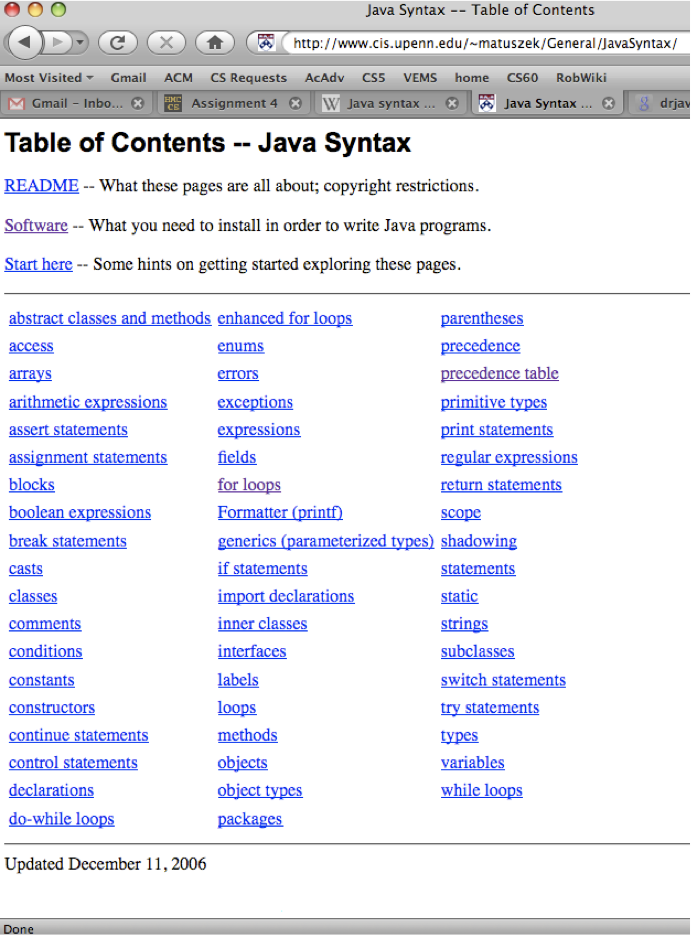
There are many other good Java resources online, including David Matusek's Website:
NEW: As long as the other problems are submitted on time, you may submit the extra credit through 11:59pm Tuesday without using a euro.
You may submit a puzzle of your choice - and its solution - for up to +5 or +10 points, depending on its complexity... .
Choose-your-own-puzzle
We've seen several puzzles and the solutions for these puzzles written
in Prolog. For up to +5 or +10 bonus points (depending on the complexity),
write a Prolog program to solve a puzzle of your choice.
Here are the requirements: