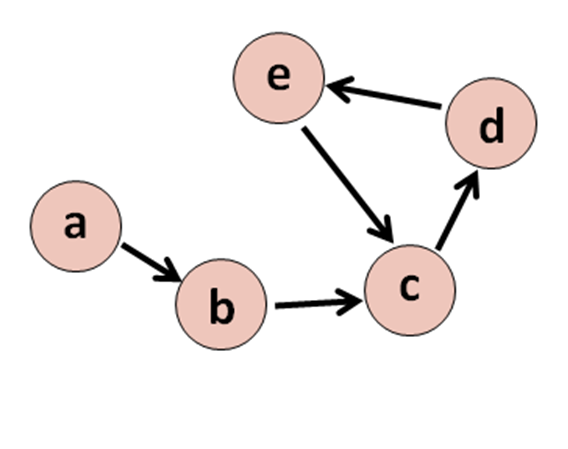
(define Graph1 '( (a b) (b c) (c d) (d e) (e c) ))
In this homework you will have the chance to hone your recursive-thinking skills using Racket, in which recursion is the primary form of computational control.
In addition, a small part of this homework (8 points) asks you to complete a few functions in the Java programming language. Informally, this gives at least a brief respite from parentheses! More seriously, Java's syntax is much more complex than Racket's; we will spend the next few weeks doing just a little bit of getting used to Java each week with a little help from the wonderful CodingBat website. See the end of this assignment for details.
Now, back to Racket...
In contrast to Java, Racket is considered a very "clean" language, very consistent, and with minimal syntax: few punctuation and formatting rules. (Some might argue it's too minimal!) Regardless, Racket is one of the best examples of a language whose focus is supporting computation itself, as opposed to intricate data structuring. In this assignment you'll implement some useful and some silly but fun functions to familiarize yourself with Racket's lists, strings, and characters, but most of all to re-familiarize yourself with recursion!
This week, Part 1 should be in a file named hw1pr1.rkt and should be written by each person individually.
Part 2 may also be completed individually, but you are welcome -- and encouraged -- to work with a partner on those functions. If you do work in a pair, be sure to follow pair-programming practices as are detailed on the course syllabus. Either way, you should submit part two in a file named hw1pr2.rkt.
Part 3 may be completed with a partner, but if you do so - switch who is using the keyboard and mouse after each function instead of every 30 minutes.
All of these are important! 25-30% of the assignment's points will be based on these. A few details:
;; problem 0
;; len
;;  inputs: L, a list of any items
;;  output: the number of top-level items in the input list
(define (len L)
  (if (null? L)
      0
      (+ 1 (len (rest L)))))
Be sure to submit your hw1pr1.rkt, hw1pr2.rkt and Hw1pr3.java files to the submission site! If you pair-programmed you should both still submit all of the files, but also indicate the login of your partner (e.g. CS60XX).
Reminder - your assignments will be graded anonymously and you should not include your name anywhere in your submitted files.
Start with this hw1pr1.rkt starter file, which helps by having the function signatures and the provided test cases already in place... . Here it is in .txt format, in case this one is simpler to copy or download.
Remember that these functions should be done individually. As always, you can seek out help from instructors, grutors, and fellow students, but the work submitted should be your own.
In class, you saw how (remove e L) works: it returns a list identical to
L, except with the first top-level instance of e removed. For this
problem, write (remove-all, which should return a list identical to
L, except that all top-level instances of e have been
removed. For example,
(check-expect (remove-all "i" '("a" "l" "i" "i" "i" "e" "n")) '("a" "l" "e" "n"))
(check-expect (remove-all "i" '( ("a" "l" "i") "i" "i" "e" "n")) '(("a" "l" "i") "e" "n"))
(check-expect (remove-all 0 '(1 0 1 0 1 0))  '(1 1 1))
Write the Racket function that begins
(define (prefix? P L)
Here are a couple of tests to help illustrate prefix?:
(check-expect (prefix? '() '(s p a m))   #t)
(check-expect (prefix? '(s p) '(s p a m))   #t)
(check-expect (prefix? '(s m) '(s p a m))   #f)
(check-expect (prefix? '(p a) '(s p a m))   #f)
Write the Racket function that begins
(define (sublist? S L)
Here are a couple of tests to help illustrate sublist?:
(check-expect (sublist? '() '(s p a m))   #t)
(check-expect (sublist? '(s p) '(s p a m))   #t)
(check-expect (sublist? '(s m) '(s p a m))   #f)
(check-expect (sublist? '(p a) '(s p a m))   #t)
Write the Racket function that begins
(define (enumerate L)
(check-expect (enumerate '(jan feb mar apr)) '((0 jan) (1 feb) (2 mar) (3 apr)))
(check-expect (enumerate '(0 I II III IV V VI)) '((0 0) (1 I) (2 II) (3 III) (4 IV) (5 V) (6 VI)))
(check-expect (enumerate '())  '())
Aside: Association lists, or "a-lists" for short, are always lists of lists. For example, the above function, enumerate outputs association lists. Association lists are one way to store data values that can be looked up by a "key": here, the first element of each sublist is the key and the rest of each sublist is the corresponding value. We'll use association lists again in the scrabble-scoring functions, below.
For this part, start a new Racket file, named hw1pr2.rkt.
Be sure to include a top-of-file-comment after the
set-up lines:
#lang racket
(require htdp/testing)
Remember that these functions may be done individually or in a pair... .
Also, as always, feel free to include helper functions of your own or from our class examples... .
Write the Racket function that begins
(define (subbag? S B)
Here are a couple of tests to help illustrate subbag?:
(check-expect (subbag? '() '(s p a m s))   #t)
(check-expect (subbag? '(s s) '(s p a m s))   #t)
(check-expect (subbag? '(s m) '(s p a m s))   #t)
(check-expect (subbag? '(a p) '(s p a m s))   #t)
(check-expect (subbag? '(a m a) '(s p a m s))   #f)
Write a function that begins
(define (superreverse L)
Here are two examples. In the first, we use Racket's single-character
datatype, just to emphasize that it differs from both symbols 'symbol
and strings "string".
(check-expect (superreverse '( (1 2 3) (4 5 6) (#\k #\o #\o #\l) (#\a #\m) ))
    '( (3 2 1) (6 5 4) (#\l #\o #\o #\k) (#\m #\a) ) )
(check-expect (superreverse '( (1 2 3) (4 5 6 (7 8) 9 ) ))
    '( (3 2 1) (9 (7 8) 6 5 4) ) )
Next, define a function
(define (duperreverse L)
(check-expect (duperreverse '( (1 2 3) (4 5 6) 42 ("k" "o" "o" "l") ("a" "m") ))
    '(  ("m" "a") ("l" "o" "o" "k") 42 (6 5 4) (3 2 1) ) )
(check-expect (duperreverse '( (1 2 3) (4 5 6 (7 8) 9 ) ))
    '( (9 (8 7) 6 5 4) (3 2 1) ) )
Write a tail-recursive function
(define (tail-fib N)
Fibonacci numbers:  1 1 2 3 5 8 13 21 ...
Their indices, N:   0 1 2 3 4 5  6  7 ...   (for this problem)
(define (fib N)
  (if (< N 2)
      1
      (+ (fib (- N 1)) (fib (- N 2)))
    ))
Here is an example test for tail-fib:
(check-expect (tail-fib 8) 34)
Hint! For tail-fib it will be simplest to create a helper function that has two accumulator arguments! You might start them out at 1 and 1 or at 1 and 0... .
(define (tail-reverse L)
(check-expect (tail-reverse '(6 7 1 2)) '(2 1 7 6))
Note that you'll need a helper function with an additional accumulator input that will do most of the work! Also, don't use Racket's reverse within tail-reverse or your helper function!
Overview: This problem asks you to
implement a set of Racket functions that computes the
highest-scoring (or "best") Scrabble word, given
a particular rack of letters rack and a list of legal words WL.
Here would be the definition line:
(define (best-word rack WL) ;; rack is a string; WL is a list of strings
Here are a few examples:
(check-expect (best-word "academy" '("ace" "ade" "cad" "cay" "day"))  '("cay" 8))
(check-expect (best-word "appler" (list "peal" "peel" "ape" "paper")) '("paper" 9))
(check-expect (best-word "paler" (list "peal" "peel" "ape" "paper"))  '("peal" 6))
(check-expect (best-word "kwyjibo" '("ace" "ade" "cad" "cay" "day"))  '("" 0))
;; Do you recognized "kwyjibo"? http://www.hulu.com/watch/29524
In general, there may be more than one best-scoring word -- in that case,
we will make sure to run tests similar to the following:
(check-expect (second (best-word "bcademy" '("ace" "ade" "cad" "cay" "bay"))) 8)
In this problem we will use an association-list to score information about scrabble
tiles. The following Racket statement defines an association-list
that provides all of the letter
scores. (Note: It also includes the number of times each tile appears
in an official Scrabble set -- this is only for the optional extra-credit
problem.)
You should copy this code into your hw1pr2.rkt file:
;; scrabble-tile-bag
;;   letter tile scores and counts from the game of Scrabble
;;   the counts aren't needed (until the ex. cr.) they're obtained from
;;   http://en.wikipedia.org/wiki/Image:Scrabble_tiles_en.jpg
;;
(define scrabble-tile-bag
  '((#\a 1 9) (#\b 3 2) (#\c 3 2) (#\d 2 4) (#\e 1 12)
   (#\f 4 2) (#\g 2 3) (#\h 4 2) (#\i 1 9) (#\j 8 1)
   (#\k 5 1) (#\l 1 4) (#\m 3 2) (#\n 1 6) (#\o 1 8)
   (#\p 3 2) (#\q 10 1)(#\r 1 6) (#\s 1 4) (#\t 1 6)
   (#\u 1 4) (#\v 4 2) (#\w 4 2) (#\x 8 1) (#\y 4 2)
   (#\z 10 1) (#\_ 0 2)) )
;; end define scrabble-tile-bag
;;
;; The underscore will be used to represent a blank tile, which is a wild-card
The function (assoc e A) takes in an association-list A (remember that
A contains lists of lists) and returns the element of A whose own
first element is equal to e. For example:
   (assoc 3 '((0 jan) (1 feb) (2 mar) (3 apr)))   ==>  (3 apr)
   (assoc 5 '((1 jan) (2 feb) (3 mar) (4 apr)))   ==>  #f
As the second example shows, assoc returns #f when e does not appear as a first element of any of A's sublists. This assoc function will help look up letters and their scores.
score-letter
As a possible helper function, you might
construct a function named score-letter that determines
the score for its argument, which will be a character. Use assoc.
For example,
(check-expect (score-letter '#\w) 4)
score-word
As another possible helper, you might
construct a function score-word that determines the score
for a string of letters. Note that strings in Racket are not the same as
symbols, nor are characters the same as strings (as they are in Python).
Strings are
doubly quoted. The built-in functions string->list and
list->string, which convert from strings to lists of characters and
vice-versa, may be of use. Here are examples of them in action:
(check-expect (string->list "hi") '(#\h #\i))
(check-expect (list->string '(#\h #\i)) "hi")
Here are three tests of score-word:
(check-expect (score-word "zzz")  30)
(check-expect (score-word "fortytwo") 17)
(check-expect (score-word "twelve")  12)
Other hints Be sure to plan out your strategy for this problem and write your test cases before diving in to the coding! In our solution, we used the subbag? predicate from earlier in this assignment.
If you want to use any definitions from hw1pr1.rkt, you can copy / paste them into hw1pr2.rkt. This practice is not very good for software engineering (what happens if you need to change your definition of subbag??), but doing so makes it possible to grade each file separately.
This problem will introduce you to the Java programming language -- ot, at least, its syntax. We will consider Java's "object-oriented" design and the capabilities that make it a popular industry/enterprise language later on in CS 60.
One of CS 60's goals is that you will feel confident that you can use any new computational language effectively and efficiently -- all you'll need is a syntax reference. This problem practices exactly that skill using problems from a site named CodingBat, which has many small one-function challenges and some succinct references.
For this problem, you should... (Steps also shown in CS60 Lecture and in this video)
For example, imagine we had needed to look at CodingBat's solution to the
sleepIn problem, above. In that case we could have used that solution
as long as we included a comment such as the one below. Multi-line
comments in Java are delimited by /* at the start and */
at the end:
/*

 I used the answers here because I didn't know that || means "or"
 in Java and that ! means "not" in Java.

 */
public boolean sleepIn(boolean weekday, boolean vacation)
{
  if (!weekday || vacation)
  {
    return true;
  }
  else
  {
    return false;
  }
}
Each one of these seven functions - plus the sleepIn function - is worth one point. These are the final 8 points of this hw1 assignment.
Be sure to submit Hw1pr3.java at the submissions site!
Good luck diving into Java!
(define (hard-scrabble rack WL)
(check-expect (hard-scrabble "iazby_q" '("biz" "jazz" "qi" "quiz"))
              '("quiz" 21)) ;
(check-expect (hard-scrabble "iazzjaq" '("biz" "jazz" "qi" "quiz"))
              '("no cheating!" 0))
For this extra-credit problem, we will use an association list as a
graph, a general-purpose representation of relationships
by connectivity. For example, the association list
(define Graph1 '( (a b) (b c) (c d) (d e) (e c) ))
In particular, this challenge is to implement the predicate reachable?:
(define (reachable? x y G)
Here are a couple of examples that use Graph1:
(check-expect (reachable? 'a 'a Graph1)  #t)
(check-expect (reachable? 'z 'z Graph1)  #t)
(check-expect (reachable? 'a 'b Graph1)  #t)
(check-expect (reachable? 'a 'e Graph1)  #t)
(check-expect (reachable? 'e 'd Graph1)  #t)
(check-expect (reachable? 'e 'a Graph1)  #f)