Harvey Mudd College
Computer Science 60
Assignment 2, Due Monday, February 10, by 11:59pm
Graphical programming
Although CS 60 will introduce graphics in the coming weeks,
this week's "graphical" programming refers to mathematical graphs, i.e.,
connection networks of nodes and edges that might represent
human relationships, physical links, or hierarchical structures.
Trees and even lists are special types of graphs:
trees are graphs for which each node has at most 1 parent node, but
any number of children nodes.
Lists are graphs in which each node has at most 1 parent node
and at most 1 child node, i.e., a purely linear structure.
Pair problems
All of the problems this week may be done in a pair, in you wish.
Certainly it's OK to work on them individually, too.
If you do work in a pair, make sure you follow the pair-programming
practices as noted on the CS 60 syllabus.
Whether individual or pair, place all of your functions
for this week in a file named hw2pr1.rkt. There is a
(small) starter file by that name linked below.
On average, each problem this week is worth 10 points
The earlier ones are a bit less; the later ones, a bit more... .
Design, testing, commenting, and formatting!
Just a reminder that these are important! 25-30% of the assignment's points will be
based on these. A few details:
- Design matters! Be sure the use small helper functions to maintain
a modular, "Racket-clean" style for your solutions.
- Testing matters! Be sure to use our tests, as well as at least one -- and
perhaps more -- of your own for all of your functions.
- Include a top-of-function comment for all functions you write, including
helper functions. Have a
brief description of what the function does and the format/meaning of its inputs
and output.
- Include a top-of-file comment with your name(s), roughly how much time
the assignment took, and any other comments you'd like to share with us or the
grutors.
- Comments are not necessary within function bodies, unless something
tricky is going on. Particularly if you are writing many small functions
(instead of fewer, larger ones), the top-of-function comment is most often enough.
- Do format your code to make it easy to understand. Choose a formatting
and indentation style that is clear and stick with it!
Formatting also includes coding style: clean and clear structure, meaningful
variable and function names, ample use of spacing, and indenting that reflects
code structure.
Submitting your work
Be sure to submit your hw2pr1.rkt file
to the submission site!
The Problems
Start with the hw2pr1.rkt starter file -- it
has placeholders for the functions you will need.
Some of these problems have
a component of open-ended algorithm design, as well
as reinforcement of this week's themes.
Feel free to seek out help in discussions with other
students, the CS 60 tutors, or to chat with Zach or Colleen any time about
any of these problems... .
Using higher-order functions
For the first three functions,
superreverse, indivisible, and
lotto-winner, see if you can use higher-order
functions (filter, map, foldr,
and sort, along with lambda) instead of using
recursion explicitly, i.e., instead of calling
superreverse from within superreverse's
definition, and so on... . This isn't a requirement,
but it will help familiarize the ideas of those HOFs (and
will be more concise, codewise).
Be sure to include (and label) at least
one test of your own for each function...
As with the previous homeworks, be sure to devise and include not only the
provided tests in your submitted hw2pr1.rkt file, but at least
one more test for each of the homework functions. Writing the tests will
ensure you're confident of what each function should do and asks you
to consider the space of possibilities for the function's
behavior. This case analysis is a crucial skill in software design and
development -- some would say the crucial skill... .
In addition, be sure to include a comment just above
the test you create in order to indicate it. For example,
;; This is an additional test I've included:
(check-expect (indivisible 1 (range 1 10))  '())
Problems 1 and 2: superreverse
and indivisible
This problem asks you to write two functions. First, implement (superreverse
L), whose functionality is identical to what it was in
hw1. Again, assume that the input L
will be a list that
contains zero or more lists (and only lists) as elements.
The output of (superreverse L) should be a list similar
to L, but with all of its top-level sublists reversed.
Two example tests:
(check-expect (superreverse '( (1 2 3) (4 5 6) (#\k #\o #\o #\l) (#\a #\m) ))
    '( (3 2 1) (6 5 4) (#\l #\o #\o #\k) (#\m #\a) ) )
(check-expect (superreverse '( (1 2 3) (4 5 6 (7 8) 9 ) ))
    '( (3 2 1) (9 (7 8) 6 5 4) ) )
Second, implement (indivisible k L), where k
is a positive
integer and L is a list of positive integers.
Then, indivisible should return a list consisting of all of the
elements of L that are not
evenly divisible by k. Those elements
should appear in the same order as they do in L.
For instance,
(check-expect (indivisible 3 '( 2 3 4 5 6 7 8 9 10 )) '(2 4 5 7 8 10))
Problem 3: lotto-winner
This problem is challenging! We have a starting point
for this one, along with suggestions to help make progress... .
For this problem, write
(define (lotto-winner list-of-tickets winning-numbers)
'( (alice 2 4 16 33 42) (bob 3 4 5 6 7) (cdrthecat 3 15 16 41 42) )
(define (matches L W)
  (length (filter (lambda (x) (member x W)) L)))

(check-expect (matches '(ace 2 3 4) '(3 42 2)) 2)
(check-expect (matches '(ace 2 3 4) '(8 4 5)) 1)
The lotto-winner function should output a list of two
things: first, the name (symbol) of the person who matched the
most numbers and, second, the number of numbers they matched.
For the above example data,
(check-expect (lotto-winner
    '( (alice 2 4 16 33 42)  (bob 3 4 5 6 7) (cdrthecat 3 15 16 41 42) )
    '(2 3 15 32 42))
              '(cdrthecat 3))
Again, if this problem seems hard to start or is going awry,
consider our lotto starting point
and suggestions on how to proceed... .
Trees!
The next few problems in this assignment ask you to implement functions that
manipulate binary search trees (BSTs) in a variety of ways. You might
recall from class that the representation of our binary search tree that we are
using is either null? (the empty list) or a list of three elements:
first, the root of the tree; second, the left-hand subtree; and third, the
right-hand subtree. Also, all leaves within a left-hand subtree are strictly
less than the value of the root. All elements within a right-hand subtree are
strictly greater than the root. Finally, no value may be repeated in a BST.
We will use binary search trees of only integers for the following
three problems.
For example,
(define BT1 '( 42
               (20 (7 (1 () ()) (8 () ())) (31 () (41 () ())))
               (100 (60 () ()) ()) )  )
Note: you're welcome to use raw
recursion for these problems -- and we encourage you
to do so. Higher-order functions are OK, too, but may not
be as natural in this context.
Code from class
This is the file of tree-based
example functions from class - at the bottom are
the find-max, find, and insert
functions, good starting points for these problems.
... what are these tree-structure things?
If you're feeling uncertain about trees, you might try Prof. Colleen Lewis's
Racket-trees YouTube channel!
If you try these and like them, drop Prof. Lewis a note to let her know :-) !
Problem 4: find-min and height
First, write a function (find-min BT)
whose input will always be a
non-empty binary search tree and whose output
is the value of the smallest node in that binary search tree.
For instance,
(check-expect (find-min BT1) 1) ;; using the tree defined above
Hint: Compare the find-max function we wrote in
class... .
Next, write a function (height BT)
whose input is a binary
search tree and whose output
is the length of the longest path from the root of BT
to any one of its bottom-level nodes, i.e.,
the height of the binary search tree.
The height of the empty binary search tree is 0.
For instance,
(check-expect (height BT1) 4) ;; using the tree defined above
(check-expect (height '()) 0)
Hint: max is built-in to Racket - it will help here!
Problem 5: flatten-tree
Write a function (flatten-tree BT) whose input is
any binary search tree and whose output
is a list of all of the elements, in order, of the input. However,
for this function you should not use the flatten
function we wrote in class, because it would require a subsequent
call to sort (and pay its penalty in big-O run time...).
Instead, use the recursive structure of the tree.
(Note that you can call flatten-tree recursively on the
left and right subtrees. Where will the root go?)
In a comment
with your code, explain what the big-O running time of your flatten-tree
function is in the worst case.
For example,
(check-expect (flatten-tree BT1) '(1 7 8 20 31 41 42 60 100)) ;; using the tree defined above
Hint: You'll want to append three lists here: what three lists? Two of
them will involve calling flatten-tree recursively... .
Problem 6: delete
The final binary search tree function this week
is to write a function
(delete value BT)
whose input
value is an integer and whose input
BT is a binary search tree. If value
does not appear in BT, then
a binary search tree identical to BT is returned.
On the other hand, if value
does appear in BT, then a tree similar to BT
is returned, except with
the node value deleted -- and other adjustments
made, as necesary, to ensure that the result is a valid
binary search tree. The next paragraph describes these
adjustments.
If the value to delete has zero children, it is
straightforward to delete.
Similarly, if it has only one non-empty child, it is replaced by that
child.
When the value to be deleted has two
non-empty children, however, it is not clear which of its children (or
descendants) are to take its place. For the
sake of this problem,
the node that should take value's place should be
the smallest value in BT
that is greater than value. (Use your
find-min function!)
Here are two examples:
(check-expect (delete 20 BT1)
    '(42
      (31 (7 (1 () ()) (8 () ())) (41 () ()))
      (100 (60 () ()) ())))

(check-expect (delete 42 BT1)
    '(60
      (20 (7 (1 ()()) (8 ()()))  (31 () (41 () ())))
      (100 ()())))
Hint #1: As with the insert example, which is
included at the bottom of this file of examples from Tuesday's class,
this is challenging because
you need to ensure your code always returns a complete binary
search tree! If you're not deleting the right-hand branch, for example,
you'll need to make sure it stays as the right-hand branch!
Hint #2: This one also has many cases. Here is only one
of those cases, when the element to be deleted is less than the
root:
   (if (< value rt)
       (list rt (delete value L) R)
       ;; otherwise, probably check some other cases...!
This problem boils down to handling all of the (many!) different
cases in appropriate ways... .
Graphs and use-it-or-lose-it
These three problems involve either the use-it-or-lose-it
approach to problem solving (discussed in the second lecture this week)
or graphs of general structure -- or both!
Code from class:
Three well-commented examples of UIOLI are at the top of the example functions from class
- you might use these as a starting point... .
Aargh! What is this UIOLI approach?
If you're feeling uncertain about use-it-or-lose-it,
you might try Prof. Colleen Lewis's
Racket-based UIOLI YouTube channel!
If you like one or more of these, drop Prof. Lewis a note to let her know :-) !
Problem 7: make-change
For this problem write a scheme function
(define (make-change total coin-list)
If no combination of coin values sums up to total, then
make-change should return #f.
For this problem, you have one coin of each value that appears in
the list coin-list: imagine a pocketful of coins of those values.
Later on in the term we'll tackle the more general problem of having as many coins of
each value as possible.
We won't limit coins to U.S. denominations: any nonnegative values
will be allowed. For example,
(check-expect (make-change 4 '(2 2)) #t)
(check-expect (make-change 4 '(2)) #f)
(check-expect (make-change 0 '(1 4 6 15 25 29 54)) #t)
(check-expect (make-change 29 '(1 4 6 15 25 29 54)) #t)
(check-expect (make-change 11 '(1 4 6 15 25 29 54)) #t)
(check-expect (make-change 76 '(1 4 6 15 25 29 54)) #t)
(check-expect (make-change 9 '(1 4 6 15 25 29 54)) #f)
(check-expect (make-change 77 '(1 4 6 15 25 29 54)) #f)
Problem 8: gchildren
Write a function
(define (gchildren N n G)
- N, a nonnegative integer
- n, a symbol representing a node in a graph
- G, a graph represented as a list of (src dst) pairs of nodes:
(source destination)
As output, gchildren should return a list of all of the N-th
generation descendants of node n in graph G.
If N is 0, then (list n) should be returned,
regardless of G.
If node n does not have any descendants that are n-levels
deep in G, the empty list should be returned.
Here is an example graph and a few examples:
;; Graph1
(define Graph1 '((a b) (b c) (c d) (d e) (c f) (e g) (e h) (f x) (x y) (y z) (z b)) )

(check-expect (gchildren 0 'a Graph1) '(a))
(check-expect (gchildren 1 'a Graph1) '(b))
(check-expect (gchildren 2 'a Graph1) '(c))

;; these tests use sortsym to avoid ambiguity in node order...
(define (sym<? s1 s2) (string<? (symbol->string s1) (symbol->string s2)))
(define (sortsym L) (sort L sym<?)) ;; will sort a list of symbols

(check-expect (sortsym (gchildren 1 'c Graph1)) '(d f))
(check-expect (sortsym (gchildren 2 'c Graph1)) '(e x))
(check-expect (sortsym (gchildren 3 'a Graph1)) '(d f))
(check-expect (sortsym (gchildren 3 'c Graph1)) '(g h y))
This problem does not really fall into the use-it-or-lose-it pattern, since "it"
is already provided (the input n). Rather, it is an extension
of the gkids function we wrote in class -- here, to handle any number
of generations of descendants!
Problem 9: min-dist and min-path
Write two related functions -- the first is (min-dist a b G),
which takes in two nodes a and b
and a directed, positively-weighted graph G.
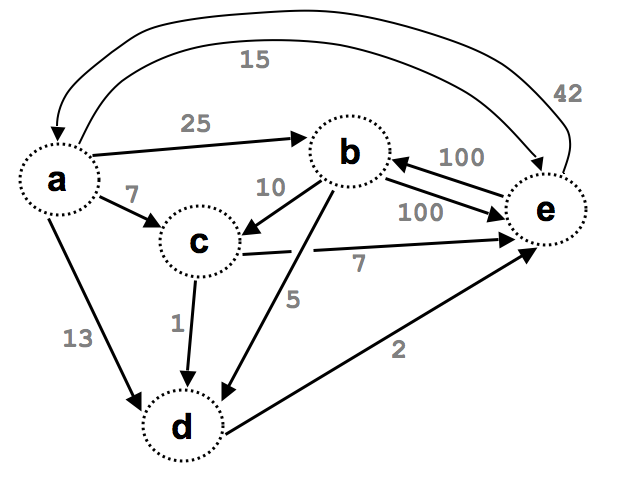
Graph G will be represented as a list
of edges: (src dst weight). See Gt,
below, for an example.
Your min-dist should
return the smallest distance that is required to travel from a
to b through graph G. Every
node should be considered 0 away from itself. However, if
there is no path from a to b in G,
for different nodes a and b, your function
should return the
value 42000000, which will be bigger than any feasible path
in our graphs. (The problem with using the value +inf.0 is
that it is floating-point, which changes check-expect's behavior.)
Just to emphasize - be sure to use 42000000
to represent the "infinite" distance between two nodes for which
there is no connecting path.
For example,
(define Gt '((e b 100) (a b 25) (e a 42) (a c 7) (a d 13) (a e 15)
             (b c 10) (b d 5) (d e 2) (b e 100) (c d 1) (c e 7)) )

(check-expect (min-dist 'a 'e Gt) 10)
(check-expect (min-dist 'e 'b Gt) 67)
(check-expect (min-dist 'd 'd Gt) 0)
(check-expect (min-dist 'f 'a Gt) 42000000)
The second function, an extension of the first, is min-path:
(define (min-path a b G)
The output of min-path should be a list whose
- first element is the minimum distance from a to
b in G, and whose
- rest is the list of nodes from a to b in
G (without repeating...)
See the check-expect examples below - they show the two base cases
(no path and trivial path), as well as several others.
Note that because of this output format, you will want to cons
the best distance onto the list of nodes in the best path.
Keep this structure in mind (dist-cons-path) to avoid lots of extra-parens
bugs!!!
Here are some examples using Gt from above:
(check-expect (min-path 'd 'd Gt) '(0 d))
(check-expect (min-path 'a 'z Gt) '(42000000)) ;; z's not there!
(check-expect (min-path 'a 'e Gt) '(10 a c d e))
(check-expect (min-path 'e 'b Gt) '(67 e a b))
Hint:
It's helpful to start with the reachable (reach) code from class
and consider how to
change the return values appropriately from booleans to numeric quantities... !
What if there are two different paths, each of which is the same
(minimal) distance? In this, case you can break ties
arbitrarily in returning a single solution.
We will, however, only test your code on
unique minimal paths -- that way there will be only one
answer to worry about... .
Problem 10: Java!
Head back to CodingBat to practice some java
- If you need a reminder about CodingBat, head back to
Homework 1
for an introduction. For this week...
- ... review the Java Example Code up through and including String on this page.
- Write code for the following 8 functions (which are the next 8 within Warmup-1.
Again there will be a show solution button. Try solving the problems without
referring to the solutions at first -- if you need to use them, however, that's not a problem at all!
The goal is that you build familiarity and comfort with the (quite different) syntax and style of
Java programming... !
Here are the 8 to solve:
- notString
- missingChar
- frontBack
- front3
- backAround
- front22
- startHi
- icyHot
- To do these, read over the Java documentation for
charAt(int index),
substring(int beginIndex, int endIndex),
subString(int beginIndex), and
length()
-
Once you've completed these eight, submit the sentence
I finished the java problems!
Good luck with Java!
Submitting your work
Be sure to submit hw2pr1.rkt
to the submission site; if you've completed the Java
problems, submit that note under hw2pr2.txt.
If you're interested in more trees, Racket, and a very
cool application (20 Q's), check out the optional extra-credit below!
Extra-credit!
twenty-questions
20 Questions!
This completely optional problem asks you to implement the game of 20 questions.
It is worth up to +10 points.
Submission Please submit this
extra credit as well-labeled functions at the
bottom of your hw2pr1.rkt file... .
First, to give you a sense of the game of 20 questions,
here is an example of a run in Scheme. The user's input is in
blue
> (twenty-questions)

Is it bigger than a breadbox? (y/n) y
Is it a computer scientist?   (y/n) n
What was it? a chemist
What's a question distinguishing a computer scientist and a chemist?  Does it titrate?
And what's the answer for a chemist?   (y/n) y


Play again?  (y/n) y
Is it bigger than a breadbox? (y/n) y
Does it titrate? (y/n) y
Is it a chemist?   (y/n) n
What was it? Wally Wart
What's a question distinguishing a chemist and Wally Wart?  Is it concrete?
And what's the answer for Wally Wart?   (y/n) y


Play again?  (y/n) y
Is it bigger than a breadbox? (y/n) y
Does it titrate? (y/n) y
Is it concrete? (y/n) y
Is it Wally Wart?   (y/n) y
I got it!

Play again?  (y/n) n
Features
Your twenty questions should allow users to
- play the game, in the spirit described above
- play again, once the game ends (whether the object was guessed or not)
- contribute new items to the computer's "database," along with a yes/no question
distinguishing a new item from another alreay known to the system
Many of the questions can be yes/no questions. Please use the
askyn function below to handle those. In particular, your game should
always allow y to represent a "yes" answer. Also, n should
always be allowed to represent a "no" answer. This will make the submissions
simpler for the graders to try out!
Representation
For consistency, your game should always start with the
question Is it bigger than a
breadbox? and should have the objects
spam and a computer scientists
available as guesses if the user answers the initial
question with a n or a y,
respectively.
You are welcome to represent the game's data however you like. However as a guide to one possible
representation (the one used for the example program demoed in class), you might
consider a tree in which internal nodes are questions and leaf nodes are objects, e.g.,
(define initialTree '("Is it bigger than a breadbox?" "spam" "a computer scientist"))
Possible approach to 20Q...
As with the data structure, the choice here is yours. As one possible suggestion
to get you started (if you'd like), consider the decomposition of the demo version,
which included
- A function named (tq-once tree) that plays the game of 20 questions, as
described above, and then returns the augmented tree after one complete
round of the game. If the computer guesses the object correctly, it would simply
return the same tree it was originally passed.
- A function named (tq-continuer tree) that calls tq-once in order
to run one round of the game. When finished, this function should ask if the user
wants to play again and take the appropriate action.
- A function named (twenty-questions) that calls tq-container using
the default tree named initialTree.
Input:
Here are two functions demonstrating how to use (read-line) to
grab a line of user input.
The first tests the resulting value (which will
be a string). The second is a more general-purpose question-asking function:
(define (askyn Q)  ;; asks a yes/no question Q and returns #t or #f
  (begin
    (display Q)
    (display " (y/n) ")
    (if (equal? "y" (read-line))
        #t
        #f)
    ))


(define (ask Q)
  (begin
    (display Q)
    (read-line)))
Hints: (feel free to disregard!)
The binary tree used in this game is slightly different than the numeric
ones used earlier in the HW. In this case, the leaves are not empty lists;
rather, they contain possible objects; internal nodes contain questions.
After the first round
in the example above, the tree's structure would be
("Is it bigger than a breadbox?" "spam" ("Do you titrate?" "a computer scientist" "a chemist"))
A crucial facet of the game is that (tq-once tree) must return
a valid twenty-questions tree from all of the different conditional branches it handles.
That returned tree will be augmented by an additional question and an additional object if
the previous run did not guess the object correctly. If it did guess the object
correctly, the original tree will be returned.
The tq-continuer function will want to give a name to the value of that new tree
(using let is one way to do this). It will then ask the user whether they would
like to continue and use that new tree as appropriate.
As with any large functional program, the key is to break up the tasks into manageable
chunks, write functions that handle those pieces, and then compose them into a solution.
Write a number of helper functions that will keep your code succinct and straightforward.