Operating Systems Principles
My background is not academic, but in Operating Systems development.
I have spent over 40 years designing, building, and guiding operating systems,
operating systems related projects, and system software development teams.
Much of my work has focused on high performance and highly available
multi-processor and distributed systems.
I teach for fun, and to help develop the next generation of engineers.
My goal in this course is to identify the most valuable
concepts and techniques, and to make them interesting and clear.
Operating Systems has been considered a core computer science
course for a very long time.
This is a new syllabus, developed by Paul Eggert, Mark Kampe, and Peter Reiher.
While the list of covered topics is quite similar to most other Operating
Systems courses, the detailed learning objectives have been updated to
reflect the needs of a new generation of computer science students:
- provide all students with OS related concepts and exploitation skills
that they (a) will all likely need and (b) are unlikely to get in other
courses.
- provide Computer Science majors with an introduction to key concepts
and principles that have emerged from (or been best articulated in)
operating systems.
- provide all students with a conceptual foundation that will enable
them to read well written introductory level OS-related papers,
engage in intelligent discussions of those topics, and participate
in entry-level OS-related projects.
- non-objectives ... things often taught in other OS courses:
- prepare students to write or work with kernel code.
Very few of our students will ever have need to do this,
and the pendulum now appears to be swinging away
from kernel-mode implementations (even for file systems
and other performance-critical data-paths).
- understanding of the issues and techniques associated
with device drivers and low level platform support code
in operating systems. This may be crucial background
for hardware system designers and embedded software
developers, but this course seeks to provide
a more general introduction for a much broader audience.
The reading, lectures, projects, and exams are all designed around
a large set of detailed learning objectives.
In addition to giving students a detailed overview of the material
to be covered in this course, this list is an excellent starting
point for exam study.
Assumed Student Background
- abiliy to design, write, build, and debug C software
- familiarity with basic computer architecture (registers, memory,
instruction pointer, processor status word) and instruction sets
(load, store, test, branch, logical/arithmetic operations).
- familiarity with the stack model of program execution (parameter
passing, saving/restoring registers, local variables, return values).
- familiarity with the software generation tool chain (compilers, assemblers,
object modules, linkage editors, load modules).
- familiarity with the use of libraries.
This course introduces an extremely wide range of new concepts, and so
involves a great deal of reading.
Most of the readings for this course will come from
Remzi Arpaci-Dusseau's
Operating Systems in Three Easy Pieces.
This text was
selected, after evaluating numerous alternatives, for several reasons:
- a good introduction to an appropriate range of topics.
- a practical treatment with numerous code examples that
students can run for themselves.
- highly readable.
- presentations are based on readily available (Linux) systems.
- numerous quantitative analyses of performance implications.
- excellent explorations of important performance issues
in synchronization and file systems.
- avoidance of gratuitous formalisms, ancient history, and
low-value tangents.
- it is an Open Source
effort ... a movement for which many
of us have tremendous respect. A very practical implication
of this decision is that students are not required to
purchase a text book.
The primary weaknesses of this text seem to be:
- focused on mechanisms than principles
- subjects and examples are limited to those found in the Linux kernel
Hence, there will be a few areas that must be covered from
alternative readings (all available on-line):
- numerous monographs written specifically for this course
- numerous readings from chapter 2 (System Calls) of the Linux
Programmers' Manual as detailed examples
- Wikipedia articles for general overviews of areas not covered by
the other readings
Lecture, Reading, Lab, and Exam Schedule
It is not my intention to use the lectures to review topics that are well
presented in the reading. I hope to use the lecture time to:
- discuss student questions arising from the reading.
- expand on key results that should be drawn from reading.
- work through and discuss important but non-trivial examples from the reading.
- discuss perspectives, implications, and applications not covered by the reading.
You can help to enrich the quality of the lecture sessions by:
- using the on-line Piazza forum to suggest questions and topics
to be discussed during the lecture sessions.
- asking questions during the lecture sessions.
To ensure that students have done the reading, and come to class prepared to engage
in deeper exploration of the topics, an on-line quiz (based on the assigned reading)
will be due before the start of each lecture. Nobody likes these quizzes, but
experience has shown that
(a) quizzes force students to do the reading before the lectures, and
(b) students who have done the reading get more out of the lectures,
and develop a better understanding of the material.
All
lecture slides
will be available on-line before the start of each lecture.
This should simplify your own note-taking and give you a starting point for exam preparation.
It will also give you the opportunity to see what topics I am planning to discuss
in each lecture. If you find (after reading or a lecture) that there are additional
topics you would like to discuss, please post them to the course discussion forum.
Years of experience have consistently taught me that the greatest single
predictor of how much a student will get from a lecture is how well they
understood the material before the start of the lecture.
I have found (and student surveys regularly confirm) that giving daily
quizzes on the assigned reading gets students to do the reading before
the lecture, and greatly enhances learning.
A secondary purpose of the quizzes is to
enable me to assess what concepts you are having trouble with, so that I
can give them greater emphasis in future lectures.
I attempt to choose quiz questions, based on key concepts, that
few people could answer from common sense or general knolwedge,
but should not be too difficult to answer the day after a single
reading.
Each quiz will have four or five questions, typically asking
- definitions of or distinctions between key terms
- distinctions between key terms
- descriptions or examples of key concepts
- applicability, efficacies and issues with techniques
- key results from studies
Most of these questions will be based on the associated learning
objectives, so you may find it helpful to review the list of
learning objectives for the next lecture before starting the reading.
Most quiz questions can be answered with a single sentence
(or even a few words). Since the quizzes are timed, short
answers are pretty clearly the best.
It is important that you review the feedback you receive on
your quiz answers ...
- to improve your understanding.
- to help me identify bad questions or grading errors.
- because quiz questions where people have trouble often
reappear on exams.
There are two exams: a mid-term, and a two-part final.
These are closed book exams.
The purpose of these exams is to determine whether or not you understand
the key concepts that have been discussed in the preceding lectures and
chapters.
The mid-term, and part-one of the final will be comprised of roughly
10-12 multi-part questions, covering (respectively) the first, and
second halves of the course. Some may ask for definitions and examples,
but most will ask you to describe how or why something works,
to contrast related concepts, to explain which principles are applicable,
or to predict what would happen in some situation.
The vast majority of these questions will pertain to designated
key concepts,
and in most cases the answers will have been presented in
the text, the lectures or both. Most exam questions have brief (2-4
sentence or a simple diagram) answers. Typical types of questions
might be:
- simple "do you remember" questions, comparable in
nature and difficulty to quiz questions.
- moderate "can you describe/contrast/apply" questions,
comparable in nature and difficulty to in-class
discussions.
- moderate "consider this" questions, asking you to
find answers not specifically discussed in class.
- a philosophical extra credit question, related to key
concepts, but un-related to any reading or
in-class discussion.
Part-two of the final exam will be a set (6-8) more difficult
(analyze this situation, propose a solution) questions spanning
the entire course. You can choose any four of these that you want
to answer.
Different study techniques are more effective for different people.
This is a general suggestion for review, that is meant only to guide
your own study efforts:
- Start by reviewing the key learning objectives.
- If there is a concept, issue or technique that you don't
think you could talk about for five minutes, go back and
review the
lecture notes.
- If anything in the lecture
notes (including the discussion points) is not completely obvious,
go back and review the
related reading.
Exam (and quiz) questions are almost entirely based on the
key concepts list. You are encouraged
to pose questions and continue discussions of these key concepts
in Piazza.
Viewed in terms of problem domains, the projects are C
programming problems in several key operating systems areas:
- processes and threads
- file I/O and Inter-Process Communication
- synchronization, and contention
- file systems
- Internet-of-Things (IOT) and embedded system security
But they also span a wide range of software development skills:
- developing software to specifications
- learning and mastering complex APIs
- performance analysis
- consistency analysis of complex data structures
- developing and debugging parallel, distributed, and embedded applications
The projects in this course will require you to have:
- Access to a Linux system on which you can build and test C programs.
If you are taking this course, there is a better-than-even chance
that you already have a Linux system, but if you don't there are
several options:
- Install Linux on your own laptop or desktop.
- Install Linux in a virtual machine inside your own laptop or desktop.
- Do your project work on CS department Linux servers.
- Get a free (low powered) Linux virtual machine from Amazon Web Services.
For most of the projects any Linux system will do, but ...
- Project 2 (synchronization and contention) will require you
to have access to a multi-core CPU (departmental servers
will do).
- Parts of Project 4 (Embedded System) will require you to be able to
connect your embedded system directly (via USB) to another computer.
- An embedded development system, including:
- an BeagleBone Green ... a small, low-power,
system on a chip with numerous general purpose I/O pins
- a Grove Starter Kit ... a collection of
sensors, actuators, and display devices for embedded
system hobby projects
- a suitable micro-USB power supply for the embedded board
All of these parts are widely avaiable and,
ironically, they will cost you just about the same amount
of money you would have otherwise spent on an Operating
Systems text. But, if you are taking this course, the
odds are that you will find many other uses for your embedded
development system after this course is over.
Students will form two-person teams, choose a lecture, and research and
prepare a related presentation and discussion (beyond the material covered
by the assigned reading and prepared lecture slides). Suggested topics
are recent problems, solutions, issues, or incidents ... but what
I am looking for is good research and interesting discussions of relevant
topics.
Activity Objectives:
- To develop and demonstrate the ability to do research into current OS-related topics.
- To develop and demonstrate the ability to prepare and deliver Transfer-of-Information presentations.
- To develop additional depth and explore interesting issues beyond the planned course syllabus.
Grades in this course are based on:
- 10% daily quizzes on the assigned reading.
These must be completed, on-line, prior to each lecture.
Each quiz is a one digit number of short-answer questions.
The purpose of the quizzes is to ensure that you have
you have done the reading, and come to each lecture
prepared for a more in-depth discussion of the topic.
- 10% student presentations and discussions.
Presenters will be graded on relevance of topic, depth
of research, and quality of preparation/presentation. The remainder
of the class will be graded on the regularity and quality of their
participation in these discussions.
- 40% lab projects
The labs are programming exercises in which you
will use the mechanisms and techniques
that have been discussed in the reading and lecture.
The dual purpose of the labs is to:
- consolidate your understanding of non-trivial concepts
- develop the ability to apply new techniques
Breakdown of points among the individual projects:
- 5% Project 0: warm-up exercise
- 10% Project 1: I/O and signals
- 10% Project 2: Synchronization
- 10% Project 3: File Systems
- 5% Project 4: Embedded System/Internet of Things
- 40% exams
All the exams are closed-book, multi-question, with each part
of each question requiring a brief (e.g. 1-3 sentence) answer.
The purpose of the mid-term and part 1 of the final exam is to
assess your familiarity with, and ability to apply the concepts,
principles, and techniques listed in the course learning objectives.
The purpose of (the more difficult) part 2 of the final exam
is to assess your ability to apply these lessons to the
understanding and solution of new and non-trivial problems.
Breakdown of points among the exams:
- 15% midterm (concepts)
- 15% final exam - part 1 (concepts)
- 10% final exam - part 2 (applications)
Students with good programming backgrounds generally do very well on the lab projects.
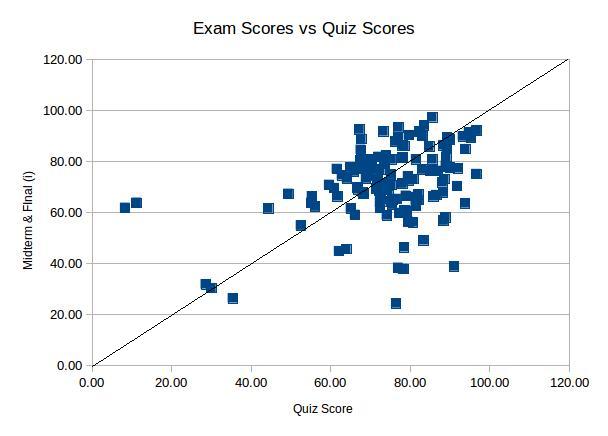
Quiz scores tend to be well corellated with scores on the mid-term and part 1 of the final.
Scores for part 2 of the final exam (problem solving vs. memory/understanding) tend to
be distributed over a much wider range.
Letter Grading Scale
- I do not grade on a curve, but a fixed scale.
I am not trying to assign students to performance percentiles,
but rather to assess their mastery of the
course learning objectives.
- I do look carefully at the break points to try to ensure
that students who did similar work do not get different
grades, but the major break points generally fall within a point or
two of 88/78/68/58.
- if I make a mistake in a problem that makes it significantly
more difficult than intended, I will adjust the scale
to compensate for my mistake
Late and make-up policy
- there are no make-ups for quizzes, but you can
take a quiz before it is due.
- each student has 5 slip days that can be used for
any lab due date (before the end of the quarter).
After those have been used up, a grade is reduced by 10% for each 24 hours
late the assignment is.
- if you are unable to make an exam, it may be possible
(with prior notice) to arrange to take a (different) make-up exam at some later date.
Grade Adjustments:
- I will always correct any (promptly reported) error in score computation or recording.
You are encouraged to check the on-line grade book regularly to ensure that all of
your assignement grades have been properly recorded.
- I am always willing to explain the correct answers and
exam grading criteria.
- I am always willing to regrade an exam problem
if I misunderstood a clearly correct answer ...
but this does not extend to
- reinterpreting vague or poorly written answers
- giving credit for not having properly or fully understood problem
- I will correct a quiz score if the auto-grader was unable to accept
a correct answer.
- I never raise grades in response to excuses or hardship stories.
- I never assign makeup projects. The only opportunity to improve
a grade is before the assignment is submitted.
The most valuable thing you will get from this course is a mastery of concepts and
techiques that will serve you throughout your career.
Your grade in this course gives testimony to that mastery.
But those benefits will only accrue, and the grade will only be meaningful if it is honestly earned.
Students must follow the
Academic Honesty Standards
of both Harvey Mudd and the Computer Science Department
which prohibit cheating, fabrication, multiple submissions, and facilitating academic dishonesty.
Students are encouraged to study together, and to discuss general
problem-solving techniques that are useful on assignments;
but all exams are to be completed individually without assistance or references;
when working on the projects students must not share work with others,
and must specify the sources for all parts of their submitted work.
If you have questions about the policy, please discuss them with me.
Be warned that I take Academic Honesty deadly seriously. I use a variety of tools and
techniques to detect plagiarism, I report all suspected cases to the Dean's office,
and I seek full prosecution of every case I report.
Please, do not test me on this matter.
General Warnings:
You will find the material in this course to be exteremely useful.
But, this is widely held to be one of the most difficult courses in the
undergraduate Computer Science catalog, due to:
- the amount of reading
- the number of new and subtle concepts to be mastered
- the complexity of the principles that must be applied
- the amount of work involved in the projects
People who have had little difficulty with previous Computer Science courses
are often surprised by the work load in this course.
Keeping up in this course requires considerable work and discipline.
In particular, projects must be started as soon as possible.
All (but the first) involve difficulties, and students wind up
losing many more points due to late submission than to
functionality deficiencies.
Catching up after falling behind is extremely difficult.
Related Computer
Science Curricula 2013 knowledge areas:
- OS/Overview of Operating Systems
- OS/Operating System Principles
- OS/Concurrency
- OS/Scheduling and Dispatch
- OS/Memory Management
- OS/Security and Protection
- OS/Virtual Machines
- OS/Device Management
- OS/File Systems
- OS/System Performance Evaluation
- PD/Communication and Coordination
- PD/Distributed Systems
- IAS/Foundational Concepts in Security
- IAS/Threats and Attacks
- NC/Networked Applications
- SF/Cross-Layer Communications
- SF/Resource Allocation and Scheduling
- SF/Virtualization and Isolation
- SF/Reliability through Redundancy
Related IEEE/ACM Software Engineering
2004 (SE2004) bodies of knowledge:
- CMP.cf.4. Abstraction – use and support for (encapsulation, hierarchy, etc.)
- CMP.cf.10. Operating system basics
- CMP.cf.12. Network communication basics
- CMP.ct.1. API design and use
- CMP.ct.2. Code reuse and libraries
- CMP.ct.10. Concurrency primitives (e.g., semaphores, monitors, etc.)
- CMP.ct.14. Performance analysis and tuning
- CMP.ct.15. Platform standards (POSIX etc.)
- FND.ef.4. Systems development (e.g., security, safety, performance, effects of scaling, feature interaction, etc.)
*These sections are taken, with permission, from Prof Eggert's CS111 Syllabus.
Last updated: "Jan 10 2022"
For information about these pages, contact
Mark Kampe.