Natural Deduction - Introduction & Elimination Rules
“I could not help laughing at the ease with which he explained his process of deduction.”
—Sir Arthur Conan Doyle
Natural Deduction is a formal proof system that most closely corresponds to the kind of reasoning we normally see in mathematics. The rules (allowed proof steps) can be divided into three groups: Introduction Rules, Elimination Rules, and Classical Rules.
Introduction Rules
The introduction rules let us prove formulas involving logical operators in the most direct and obvious ways.
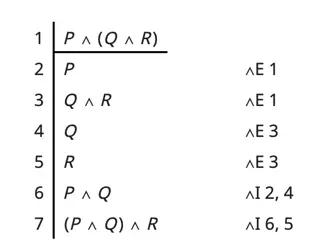
The rule (“and introduction” or “conjunction introduction”) lets us prove a brand-new conjunction in a way that reflects our intuitive understanding of the operator: we can prove the formula immediately once we have proved and :
Similarly, the rules (“or introduction” or “disjunction introduction”) lets us prove a brand-new disjunction in a way that reflects our intuitive understanding of the operator: we can prove the formula immediately once we have proved either or :
(Although technically there are two rules, instead of calling them and we will just use the name and you can infer from context which of the two rules we are referring to.)
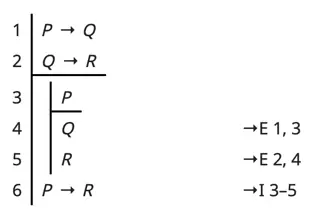
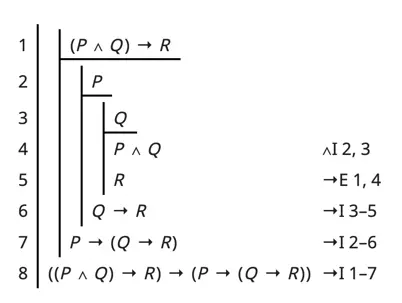
The rule (“arrow introduction” or “implication introduction”) if we can show the conclusion does indeed follow from the premise:
In this rule, the notation
means “a subproof that (temporarily) assumes , and manages to prove .” The horizontal line separates the assumption from the following derivations, and the vertical line indicates the scope of that assumption (how far into the proof we can rely on the temporary assumption .
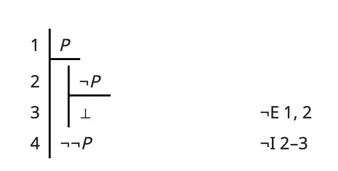
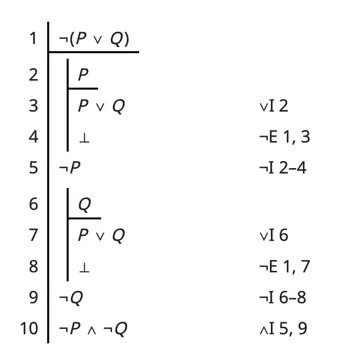
The rule (“not introduction” or “negation introduction”) lets us directly prove a negation (i.e., that the formula isn’t true), if we can show that assuming the formula is true would lead to a contradiction:
Finally, the and rules let us prove and directly. The only way to prove is to show we’ve already reached a contradiction. But proving is trivial (and boring), because is always true:
Elimination Rules
The elimination rules let us use existing formulas according to their logical connectives. For example lets us derive consequences from an existing conjunction, while lets us derive consequences from an existing implication.
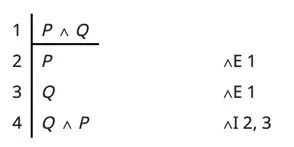
What can we immediately conclude from a conjunction? That each of the individual conjuncts is true.
(As with , we use the same name for two closely related rules and context will tell us which one we are referring to.)
What can we immediately conclude from an implication? If the premise of that formula is also true, we can conclude the conclusion is true:
In fact, is the same rule as Modus Ponens from the Hilbert System, just under another name.
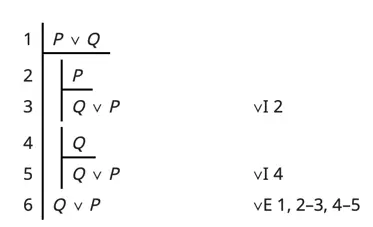
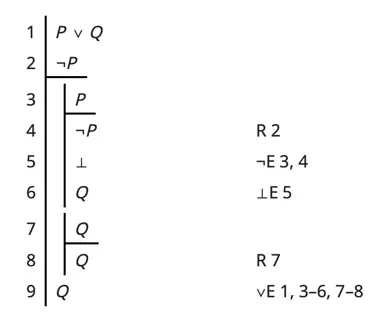
The rule may look a bit complicated, but it is exactly the reasoning principle that mathematicians call “Proof by Cases”. If we already know the disjunction is true, and (by checking both cases) we discover that some conclusion follows regardless of whether it is or that is true, then the conclusion is definitely true:
Next, the most direct way we can draw a conclusion from an existing negation is if we discover that negation is part of a contradiction:
In fact, is the same rule as . The rule has two names, depending on whether we think of it as making use of an existing negation, or recording the existance of the contradiction.
Finally, there is the rule. Since asserting is a way of announcing we’ve reached a contradiction, and since (according to our definition of entailment) any formula follows from a contradiction, we can derive any formula we want from :
(There is no rule, because the fact that is true gives us no information at all, so there’s no useful consequence we can derive from it.)
Example Proofs