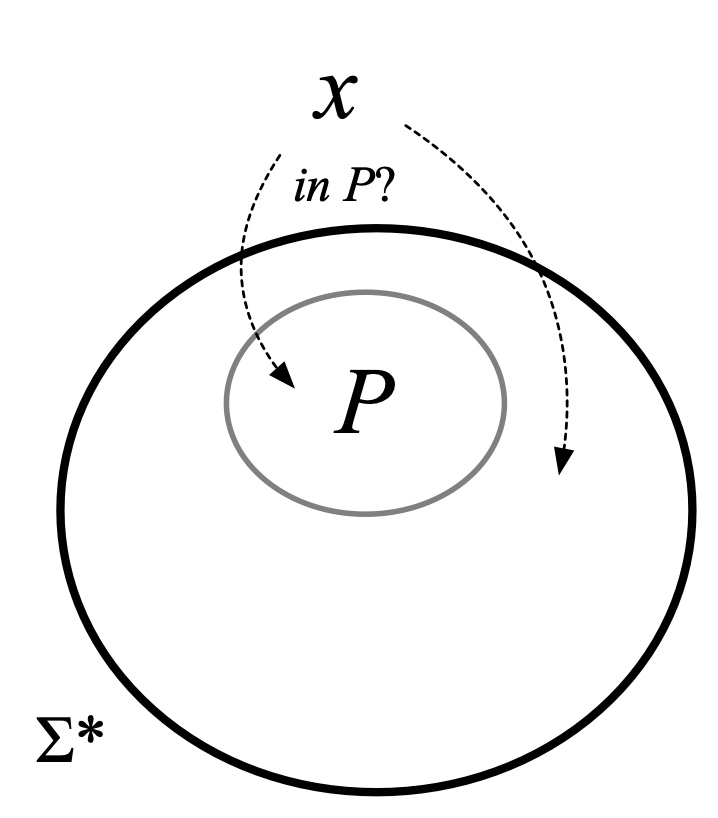
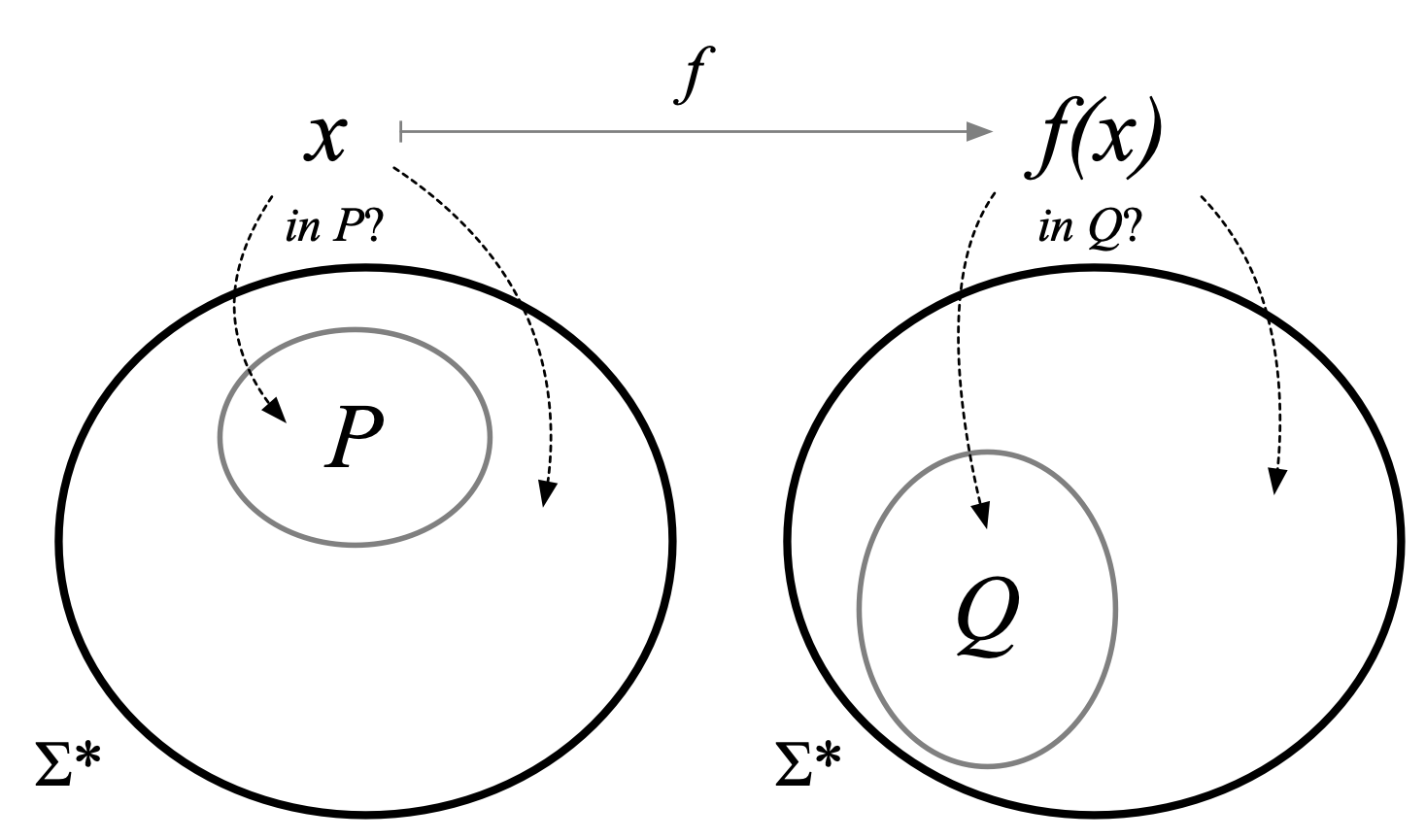
The goal of a reduction proof is to bootstrap what we already know, arguing that since \(X\) is not decidable (or not semidecidable), \(Y\) can’t be decidable (or semidecidable) either. One particularly convenient form of reduction is mapping reduction (also known as many-one reduction).
We say that \(P \leq_m Q\) if there is a computable function \(f:\Sigma^* \to \Sigma^*\) such that \[ x\in P\quad\leftrightarrow\quad f(x)\in Q \] for all \(x\in \Sigma^*\).
The intuition is this: we have a language \(P\) and a string \(x\) which may or may not be in \(P\).
The trick is that instead of answering “is \(x\) in \(P\)?” directly, we can ask the question “is \(f(x)\) in \(Q\)?” for some computable function \(f\) chosen so that the answers to the two questions are the same.
As soon as we find a computable function \(f\) with this property, we have a mapping reduction \(P \leq_m Q\); any question about membership in \(P\) can be turned into a question about membership in \(Q\), and so determining membership in \(P\) cannot be any harder than determining membership in \(Q\).
Theorem
Suppose \(P \leq_m Q\). > >1.
If \(P\) is not decidable, then \(Q\) is not decidable. >2. If \(P\) is not semidecidable, then \(Q\) is not semidecidable. >
>Proof: > >1. Suppose \(x\in P\) iff \(f(x)\in Q\). If \(f\) is a function that a TM can compute,
then given any algorithm decide_Q, we can write a decider
for \(P\) that uses the following
algorithm: > >
> def decide_P(x): > return decide_Q(f(x)) >
> > It follows that if \(Q\) is
decidable then so is \(P\). >
>By the contrapositive, if \(P\) is
not decidable, then \(Q\) is not
decidable. > >2. Suppose \(x\in
P\) iff \(f(x)\in Q\). If \(f\) is a function that a TM can compute,
then given any algorithm semidecide_Q, we can write a
semidecider for \(P\) that uses the
following algorithm: > >
> def semidecide_P(x): > return semidecide_Q(f(x)) >
> > It follows that if \(Q\) is
semidecidable then so is \(P\).
>
> By the contrapositive, if \(P\) is
not semidecidable, then \(Q\) is not
semidecidable.
We have already seen that \[ A_\mathrm{TM} = \{\ \langle M, w\rangle\ |\ w\in L(M)\ \} \] is not decidable, and that \[ \lnot A_\mathrm{TM} = \{\ \langle M, w\rangle\ |\ w\not\in L(M)\ \} \] is not semidecidable, which gives us:
Corollary
A typical mapping reduction proof that \(L_1\leq_m L_2\) goes as follows:
[Define a function \(f\) mapping
strings to strings.]
[If nonobvious, explain why \(f\) is
computable.]
[Show that if \(x\in L_1\) then \(f(x) \in L_2\).]
[Show that if \(x\not\in L_1\) then
\(f(x)\not\in L_2\).]
Therefore \(x\in L_1\) iff \(f(x)\in L_2\), so \(L_1\) map-reduces to \(L_2\).
QED.
A successful proof (exhibiting a function \(f\) that maps strings in \(L_1\) to strings in \(L_2\) and maps strings not in \(L_1\) to strings not in \(L_2\)) guarantees that \(L_1 \leq L_2\) both in terms of decidability (if \(L_1\) is not decidable then \(L_2\) is not decidable) and in terms of semidecidability (if \(L_1\) is not semidecidable then \(L_2\) is not semidecidable).
This means that if we do a mapping-reduction proof where \(L_1\) is a language like \(A_\mathrm{TM}\) that we already know is not decidable, then just finding a suitable function \(f\) guarantees that \(L_2\) is not decidable.
And if we do a mapping-reduction proof where \(L_1\) is a language like \(\lnot A_\mathrm{TM}\) that we already know is not semidecidable, then just finding a suitable function \(f\) guarantees that \(L_2\) is not semidecidable.
Example
We previously showed that the language >\[
>\mathit{NE}_\mathrm{TM} = \{\ \langle M\rangle\ |\ L(M) \not=
\emptyset\ \}
>\] >of Turing Machines (programs) that accept at least one
string is semidecidable. > >Let \(f\) be the function that takes \(\langle M,w\rangle\) and returns (the code
for) a Turing Machine \(M'\) that
ignores its input, and instead simulates \(M\) running on the specific input \(w\). > Clearly \(f\) is computable. (Given the code for
\(M\) and a specific string \(w\), we can produce a slightly longer piece
of code that ignores its input and runs the code \(M\) on the specific string \(w\).). Note that \(f\) does not run \(M\) on \(w\)! The input of \(f\) is a piece of code and a string; the
output is a slightly longer piece of code. > >- If \(\langle M,w\rangle\in A_\mathrm{TM}\), then
\(L(M') = \Sigma^*\), and so \(M' \in \mathit{NE}_\mathrm{TM}\). If
\(M\) accepts \(w\), a Turing Machine that ignores its
input and runs \(M\) on \(w\) will accept not matter what input we
provide. > >- If \(\langle
M,w\rangle\not\in A_\mathrm{TM}\), then \(L(M') = \emptyset\), and so \(M' \not\in \mathit{NE}_\mathrm{TM}\).
If \(M\) does not accept \(w\), a Turing Machine that ignores its
input and runs \(M\) on \(w\) will not accept any input we provide.
> >So \(\langle M,w\rangle\in
A_\mathrm{TM}\) if and only if \(f(\langle M,w\rangle) = M'\in
\mathit{NE}_\mathrm{TM}\) . > >This proves \(A_\mathrm{TM} \leq_m
\mathit{NE}_\mathrm{TM}\) and so \(\mathit{NE}_\mathrm{TM}\) is not decidable.
> >— > >Intuitively, the above proof shows that \(\mathit{NE}_\mathrm{TM}\) is not decidable
because it is “harder than” the undecidable language \(A_\mathrm{TM}\), as shown by the following
mapping reduction: > 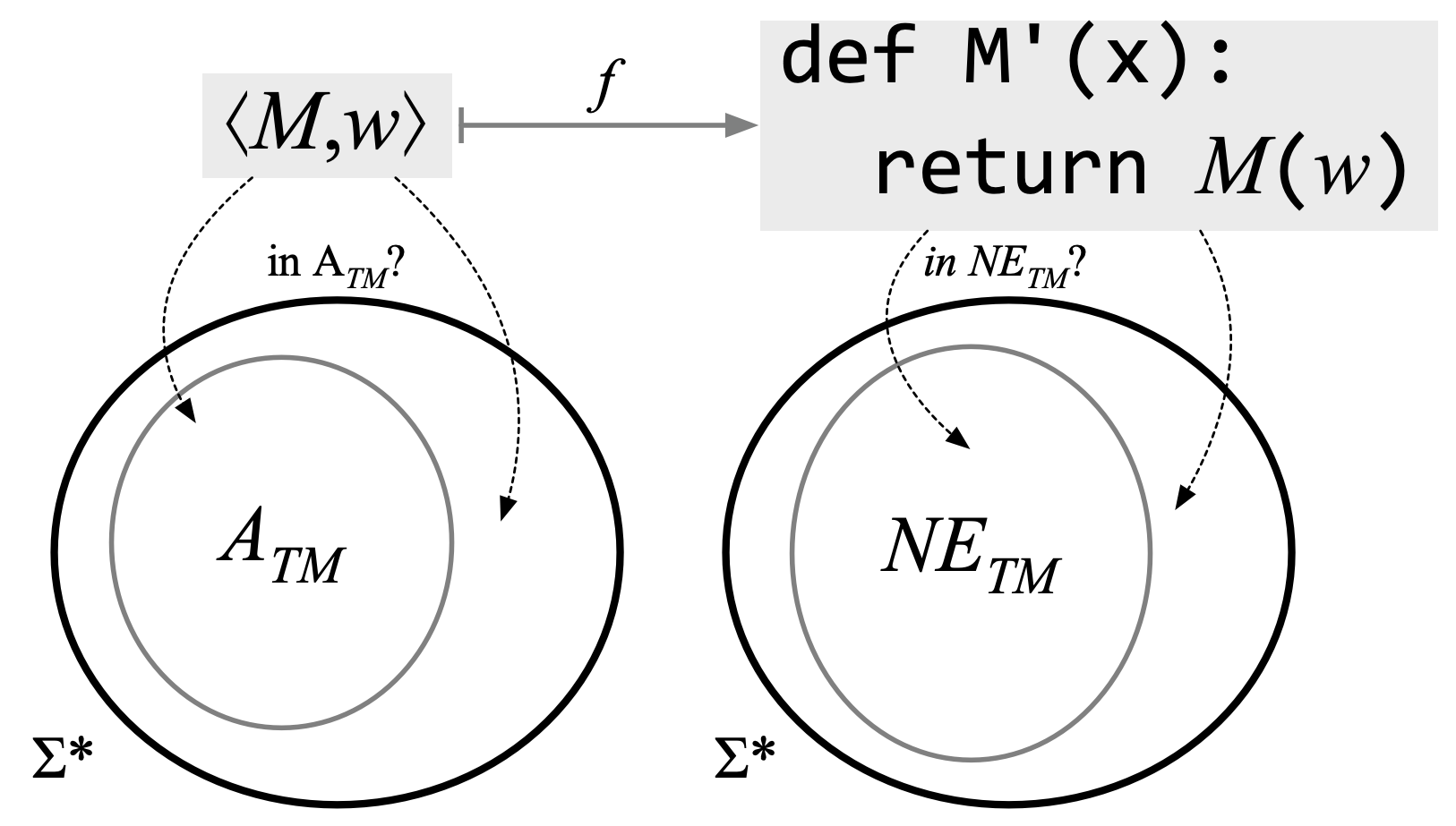 > which shows that if we had a
decider for \(\mathit{NE}_\mathrm{TM}\)
(on the right) then we could combine it with this mapping function \(f\) to build a decider for \(A_\mathrm{TM}\) (on the left).
> which shows that if we had a
decider for \(\mathit{NE}_\mathrm{TM}\)
(on the right) then we could combine it with this mapping function \(f\) to build a decider for \(A_\mathrm{TM}\) (on the left).
Example
There is no algorithm that can always tell us whether an arbitrary TM
(code) accepts the string abba and nothing else. That is,
the language >\[
>\mathtt{abba}{-}\mathit{fanatics}\quad:=\quad\{\ \langle M\rangle\
|\ L(M) = \{\mathtt{abba}\}\ \}
>\] >is not decidable. > >— >To show: \(A_\mathrm{TM} \leq_m
\mathtt{abba}{-}\mathit{fanatics}\) > >Let \(f\) be the function that takes \(\langle M,w\rangle\) and returns (the code
for!) a Turing Machine \(M'\) that
accepts its input if the input is abba and \(M\) accepts \(w\). > >- If \(\langle M,w\rangle\in A_\mathrm{TM}\), then
\(L(M') = \{\mathtt{abba}\}\).
>- If \(\langle M,w\rangle\not\in
A_\mathrm{TM}\), then \(L(M') =
\emptyset \not= \{\mathtt{abba}\}\). > >So \(\langle M,w\rangle\in A_\mathrm{TM}\) if
and only if \(f(\langle M,w\rangle) =
M'\in
\mathtt{abba}{-}\mathit{fanatics}\) , as required. > 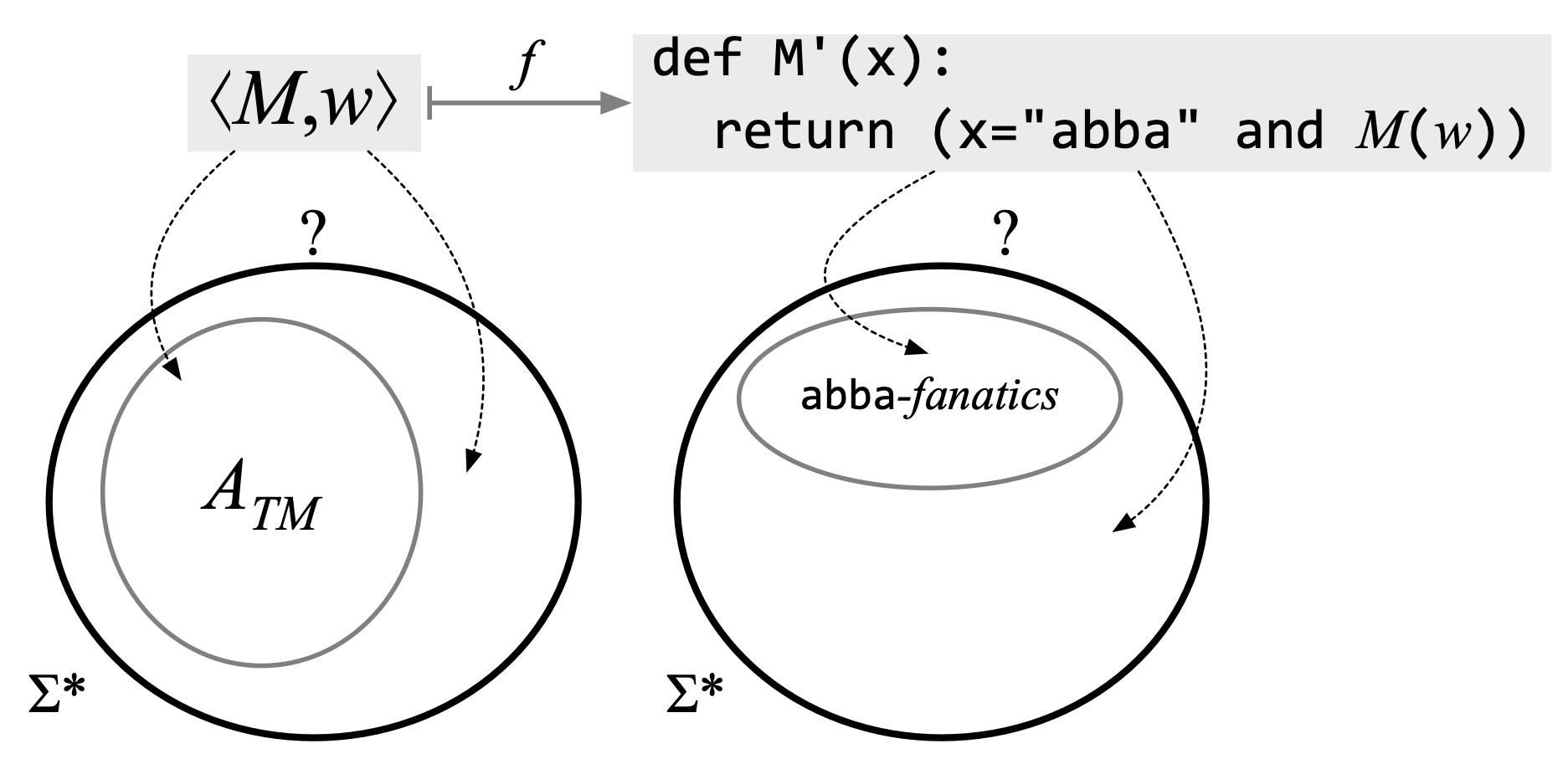
Example
There is no algorithm that can always tell us whether an arbitrary TM (code) could be reimplemented as a DFA. That is, the language \[ \mathit{DFA{-}like}\quad:=\quad\{\ \langle M\rangle\ |\ L(M) \mathrm{~is~regular}\ \} \] is not decidable.
To show: \(A_\mathrm{TM} \leq_m \mathit{DFA{-}like}\)
Let \(f\) be the function that takes
\(\langle M,w\rangle\) and returns (the
code for!) a Turing Machine \(M'\)
that accepts its input if the input has the form \(\mathtt{0}^n\mathtt{1}^n\) for some \(n\geq 0\) or if \(M\) accepts \(w\). > >- If \(\langle M,w\rangle\in A_\mathrm{TM}\), then
\(L(M') = \Sigma^{*}\) (which is
regular). >- If \(\langle M,w\rangle\not\in
A_\mathrm{TM}\), then \(L(M') = \{\
\ 0^n1^n\ |\ n\geq 0\ \}\) (non-regular). > So \(\langle M,w\rangle\in A_\mathrm{TM}\) if
and only if \(f(\langle M,w\rangle) =
M'\in
\mathit{DFA{-}like}\), as required. > 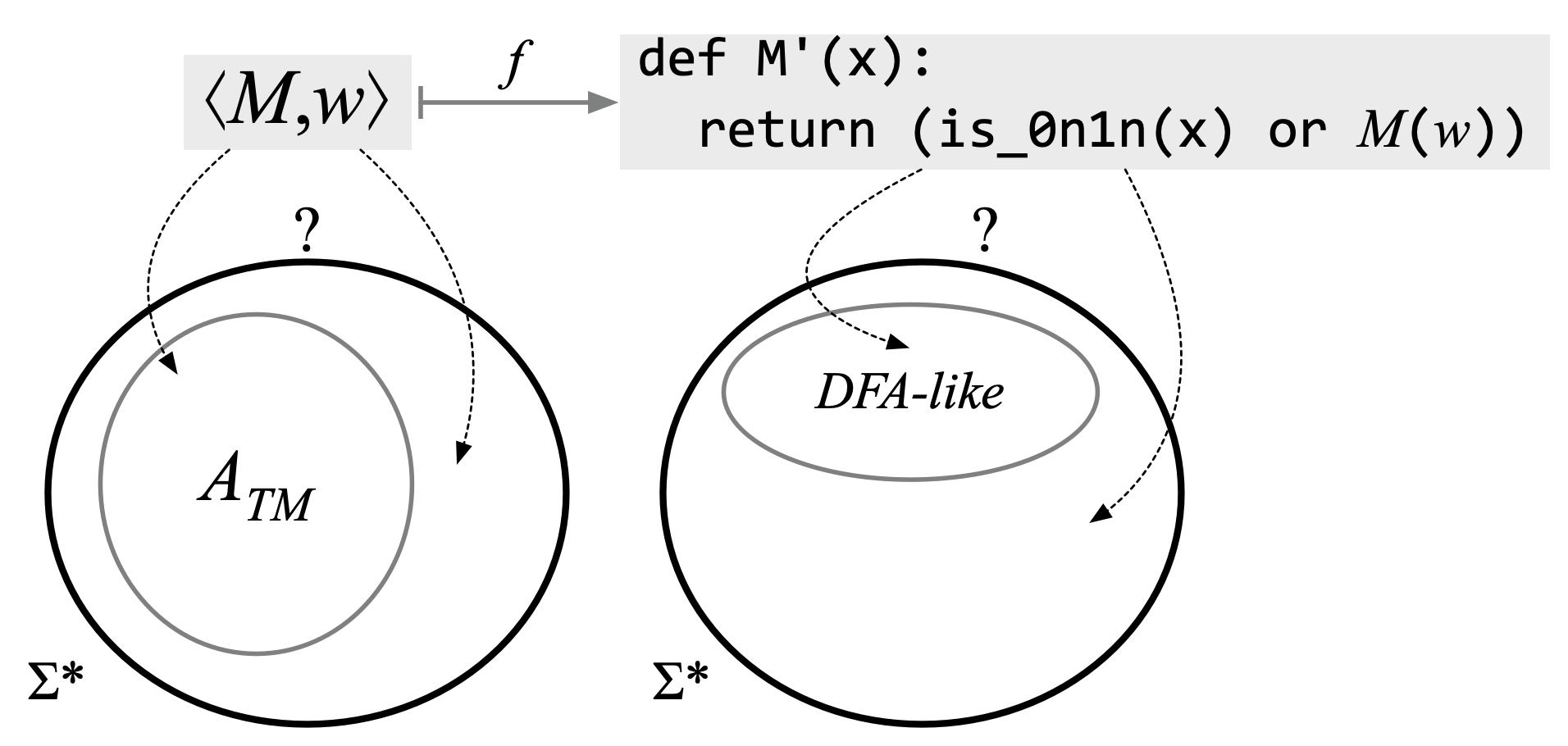
Example
In fact, the language >\[
>\mathit{DFA{-}like}\quad:=\quad\{\ \langle M\rangle\ |\ L(M)
\mathrm{~is~regular}\ \}
>\] >of TMs equivalent to some DFA is not even
semidecidable. > >— > >To show: \(\lnot A_\mathrm{TM} \leq_m
\mathit{DFA{-}like}\) > >Let \(f\) be the function that takes \(\langle M,w\rangle\) and returns (the code
for!) a Turing Machine \(M'\) that
accepts its input if the input has the form \(\mathtt{0}^n\mathtt{1}^n\) for some \(n\geq 0\) and \(M\) accepts \(w\). > >- If \(\langle M,w\rangle\in \lnot
A_\mathrm{TM}\), then \(L(M') =
\emptyset\) (which is regular). >- If \(\langle M,w\rangle\not\in \lnot
A_\mathrm{TM}\), then \(L(M') = \{\
\ 0^n1^n\ |\ n\geq 0\ \}\) (which is not regular). >
>So \(\langle M,w\rangle\in
A_\mathrm{TM}\) if and only if \(f(\langle M,w\rangle) = M'\in
\mathit{DFA{-}like}\), as required. > Since \(\mathit{DFA{-}like}\) is not semidecidable,
it is also not decidable. Had we done this reduction first, we could
have skipped the previous Example. > 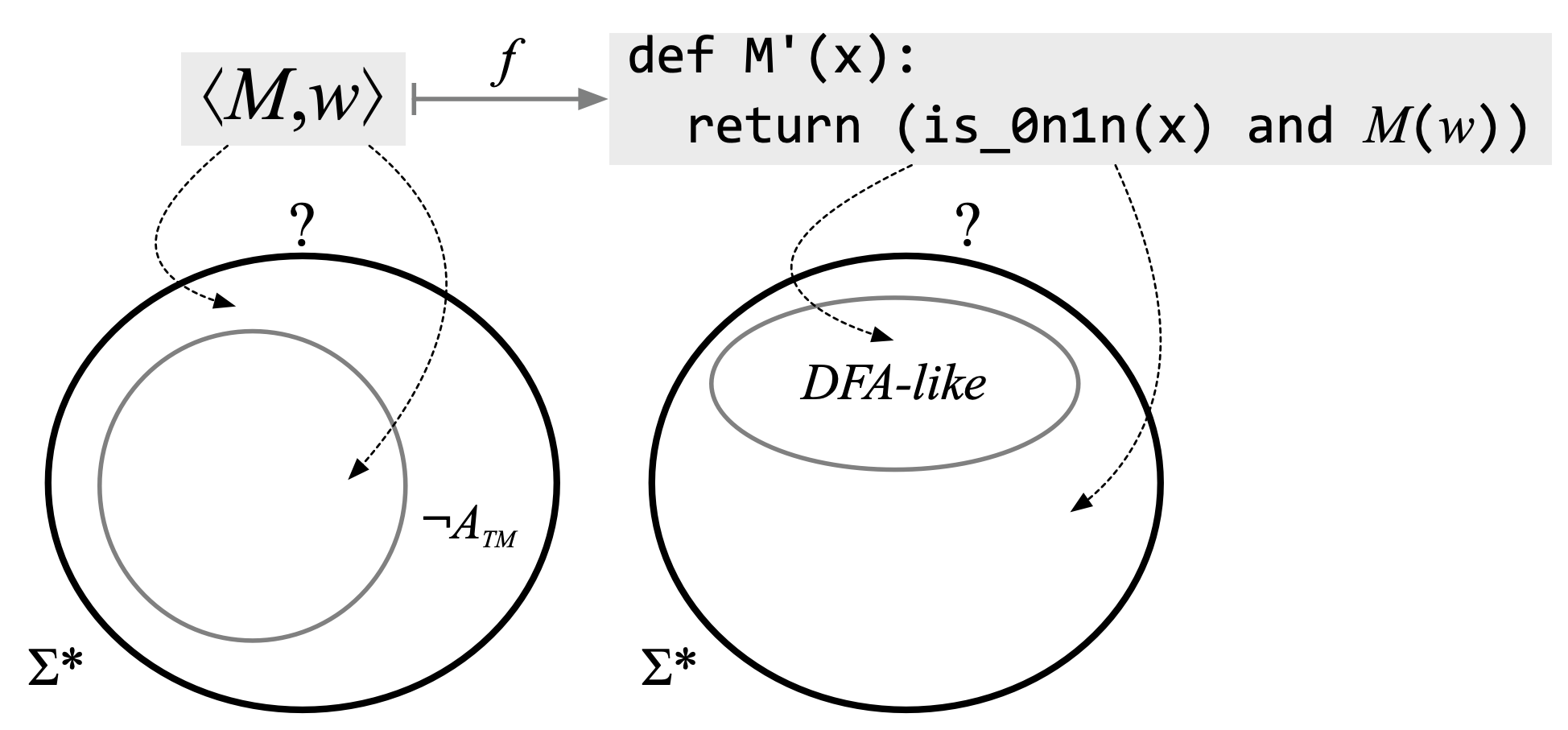
Example
The language \[ \mathit{EQ}_\mathrm{TM} = \{\ \langle M_1,M_2\rangle\ |\ L(M_1) =L(M_2)\ \} \] is not even semidecidable.
Proof. We will prove that \(E_\mathrm{TM} \leq
\mathit{EQ}_\mathrm{TM}\) .
Let \(f\) be the function that turns
the code \(\langle M\rangle\) into the
pair \(\langle M,N\rangle\) where \(N\) is a Turing Machine that rejects all
strings.
(It’s not difficult to define a TM that rejects all strings; we just pick one and call it \(N\), and then define \(f\) to be the function that returns its input \(M\) paired with the fixed piece of code \(N\).)
Previous: 6.20 Reductions
Next: Rice’s Theorem