[3 problems, 100 points total]
This assignment consists of one textual answer embedded as a comment in a Java program, one Prolog program, and another Java program. To simplify handling, please submit them as if they were three separate assignments, numbered 6, 7, and 8.
6. [25 points]
Devise an appropriate loop invariant (for the point marked by /* */) and use it to show that the following function returns the cube of its argument, provided that the argument is non-negative.
static long cube(long N)
  {
  long i, x, y, z;
  x = 0;
  y = 1;
  z = 6;

  for( i = 0; /* */ i < N; i++ )
    {
    x = x + y;
    y = y + z;
    z = z + 6;
    }
  return x;
}
Devise an appropriate energy function and use it to show that the program terminates for arguments N >= 0. What invariant do you need to show that your function really is an energy function?
(This is how Babbage's difference engine might have computed cube. To see how the method is derived, execute the following in rex:
cubes = map((i) => i*i*i, from(0)); // sequence of all cubesfirst_diffs = diff(-, cubes); // first differences of cubessecond_diffs = diff(-, first_diffs); // second differences of cubesthird_diffs = diff(-, second_diffs); // third differences of cube
Then look at each of the sequences defined.)
The proof of invariance should be inserted as a comment in the .java file.
Once you have your invariant, include it as the argument to an assert predicate in the code which is included in the loop test as shown below and test its validity by running the code on various input values, say 0 to 25, checking that the invariant never fails:
assert(.... your invariant ....) && i < N
Here the definition of assert is:
static boolean assert(boolean PredicateValue){if( PredicateValue )return true;System.err.println("*** assertion failed ***");System.exit(1);return false;}
Thus a true assertion will have no effect on the test which follows, while a false assertion will terminate the program immediately, printing a message.
(This is how Babbage's difference engine might have computed cube. To see how the method can be derived, execute the following in rex:
     cubes = map((X) => X*X*X, range(0, 10)); // sequence of all cubes
     first_diffs = diff(-, cubes);            // first differences of cubes
     second_diffs = diff(-, first_diffs);     // second differences of cubes
     third_diffs = diff(-, second_diffs);     // third differences of cubes
Then look at each of the sequences defined.)
7. [25 points]
This problem entails coding information and queries into predicate logic using Prolog. Your file should be a program which will load and run in Prolog. (The executable on turing is called 'bp'. As always, you may need to ask some questions about the formulation of certain types of information. The names are in lower-case for convenience in working with Prolog; to capitalize them would require that we include them in single quotes.)
a. Code the following predicates about local restaurants in Prolog:
serves predicate:
american restaurants serve
salad, steak, sandwiches, burgers, and fried chicken.
burger_place restaurants serve
burgers, fries, and salad.
cajun restaurants serve
rice, beans, gumbo, and sausage.
chinese restaurants serve
eggrolls, rice, shrimp, soup, and noodles.
indian restaurants serve
papadam, bagan_bharta, rice, tandoori, and naan.
italian restaurants serve
salad, pasta, cioppino, snapper, and bread.
japanese restaurants serve
sashimi, rice, tempura, and noodles.
mediterranean restaurants serve
gyros, humus, pita, and falafel.
mexican restaurants serve
tacos, beans, rice, enchiladas, and snapper.
pizza restaurants serve
pizza, salad, garlic_bread
seafood_place restaurants serve
salad, shrimp, snapper, bouillabaisse, and clams.
thai restaurants serve
eggrolls, rice, noodles, and pad_thai.
dish predicate:
vegetarian dishes:
beans, bagan_bharta, enchiladas, falafel, humus,
pizza, salad, soup, tempura, and all starch dishes
meat dishes:
burgers, enchiladas, gyros, pad_thai, pizza, steak, sandwiches,
fried_chicken, tacos, tandoori
seafood dishes:
eggrolls, snapper, cioppino, sashimi, shrimp, bouillabaisse,
tempura
starch dishes:
naan, papadam, bread, rice, noodles, pita, garlic_bread, pasta, fries
cuisine and location predicate:
arrufos is an italian restaurant in claremont.
bamboo_yuan is a chinese restaurant in claremont.
bombay is an indian restaurant in ontario.
chilis is an american restaurant in laverne.
don_salsa is a mexican restaurant in claremont.
el_gato is a mexican restaurant in upland.
full_house is a chinese restaurant in upland.
islands is a burger place in montclair.
kishi is a japanese restaurant in upland.
nirvana is an indian restaurant in montclair.
nogi is a japanese restaurant in claremont.
orchid_garden is a thai restaurant in laverne.
pizza_n_such is a pizza_place restaurant in claremont.
rosas is an italian restaurant in ontario.
sacas is a mediterranean restaurant in claremont.
sanamluang_cafe is a thai restaurant in pomona.
shrimp_house is a seafood restaurant in claremont.
tutti_mangia is an italian restaurant in claremont.
warehouse is a pizza_place restaurant in laverne.
yiannis is a mediterranean restaurant in claremont.
county predicate:
claremont is in los_angeles_county.
laverne is in los_angeles_county.
montclair is in san_bernardino_county.
ontario is in san_bernardino_county.
pomona is in los_angeles_county.
upland is in san_bernardino_county.
b. Code the following queries in Prolog and show their execution relative to the database above. In some cases, you may find it helpful to define auxiliary predicates to assist.
8. [50 points]
This problem exercises several ideas:
The problem is to program class mergesort in Java for sorting data of type float. This form of sort is described in greater detail below. The actual merge sort should be a static method called sort of class mergesort. The header for this method will thus be:
static List sort(List list)
Here are the requirements for your sort:
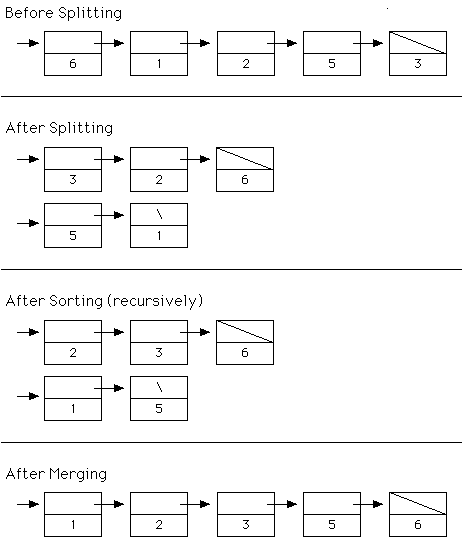
Below we show the mergesort process. The original list is split into two lists of roughly equal length. This can be done most easily by modifying the references in the original list, scanning it from front to back and building the split lists back to front. After splitting, the two lists are sorted by recursive calls to mergesort. Then the two resulting lists are merged. Merging consists of traversing the two sorted lists from front to back and "building" a new list from front to back at the same time.
Here are some hints and suggestions:
random N low high | java -cs mergesort
will generate N random integers in a range low to high and pipe them into your program.