 Home Tutorial Home What is UML? History of UML UML Diagrams
UML Resources
Class Diagrams
Class diagrams are widely used to describe the types of objects in a system and their relationships. Class diagrams model class structure and contents using design elements such as classes, packages and objects.2 Class diagrams describe three different perspectives when designing a system, conceptual, specification, and implementation.1 These perspectives become evident as the diagram is created and help solidify the design. This example is only meant as an introduction to the UML and class diagrams. If you would like to learn more see the Resources page for more detailed resources on UML.
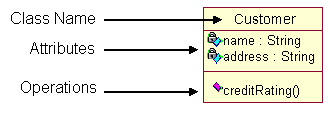
Classes are composed of three things: a name, attributes, and operations. Below is an example of a class.
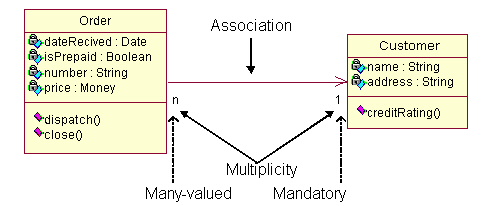
Class diagrams also display relationships such as containment, inheritance, associations and others.2 Below is an example of an associative relationship:
The association relationship is the most common relationship in a class diagram. The association shows the relationship between instances of classes. For example, the class Order is associated with the class Customer. The multiplicity of the association denotes the number of objects that can participate in then relationship.1 For example, an Order object can be associated to only one customer, but a customer can be associated to many orders.
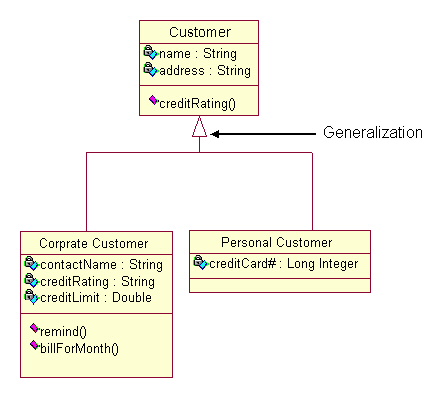
Another common relationship in class diagrams is a generalization. A generalization is used when two classes are similar, but have some differences. Look at the generalization below:
In this example the classes Corporate Customer and Personal Customer have some similarities such as name and address, but each class has some of its own attributes and operations. The class Customer is a general form of both the Corporate Customer and Personal Customer classes.1 This allows the designers to just use the Customer class for modules and do not require in-depth representation of each type of customer.
When to Use: Class Diagrams
Class diagrams are used in nearly all Object Oriented software designs. Use them to describe the Classes of the system and their relationships to each other.
How to Draw: Class Diagrams
Class diagrams are some of the most difficult UML diagrams to draw. To draw detailed and useful diagrams a person would have to study UML and Object Oriented principles for a long time. Therefore, this page will give a very high level overview of the process. To find list of where to find more information see the Resources page.
Before drawing a class diagram consider the three different perspectives of the system the diagram will present; conceptual, specification, and implementation. Try not to focus on one perspective and try see how they all work together.
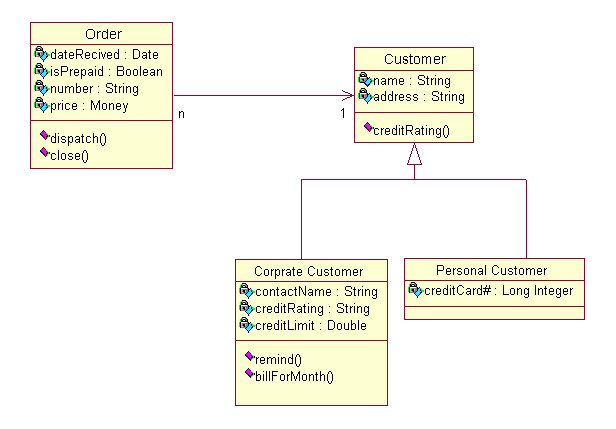
When designing classes consider what attributes and operations it will have. Then try to determine how instances of the classes will interact with each other. These are the very first steps of many in developing a class diagram. However, using just these basic techniques one can develop a complete view of the software system.
This example is only meant as an introduction to the UML and use cases. If you would like to learn more see the Resources page for more detailed resources on UML.
References:
1 Martin Fowler, Kendall Scott: UML Distilled Addison-Wesley 2000