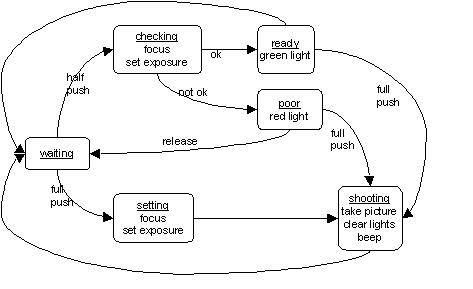
Create a UML diagram for the interaction between a user and digital camera, where a half-press checks focus/exposure (confirmed w/lights), and a full press takes a picture (confirmed w/beep).
All of the quizzes combined are worth a measurable fraction of the course grade, and each quiz covers one day's assigned reading. One will be given in the first five minutes of every lecture period for which reading was assigned. The primary purposes of the quizzes is to encourage you to do the reading, and thus come to each lecture well prepared to understand the material that will be presented. A secondary purpose of the quizzes is to enable me to assess what concepts you are having trouble with, so that I can give them greater emphasis in future lectures.
Each quiz will have four or five questions. Quiz questions usually ask for the definition of a key term, distinctions between two key terms, or examples of a key concept. Most quiz questions can be answered in a single sentence (or even a few words).
There are no make-ups for missed quizzes.
What is "white box testing"?
White box test cases are informed by an understanding of the design of the component to be tested.
There are two normal exams, each covering approximately 14 lectures worth of material. The first will be given near the end of the eighth week. The last is given during the first half of the final exam period. These are closed book exams. The purpose of these exams is to determine whether or not you understand the key concepts that have been discussed in the preceding lectures and chapters.
A typical exam will be comprised of roughly 10-20 questions. Some may ask for definitions and examples, but most will ask you to describe how or why something works, to contrast related concepts, to explain which principles are applicable, or to predict what would happen in some situation. The vast majority of these questions will pertain to designated key concepts, and in most cases the answers will have been presented in the text, the lectures or both. Most exam questions have brief (2-4 sentence or a simple diagram) answers.
Make-ups for missed exams will be administered only if you were medically incapacitated at the time of the exam, and will require a physician's certification. In those cases, a (very different) make-up exam will be administered after the end of the session.
Define "Legacy Software", and explain why it is difficult to maintain.
Legacy software is software that is old, but is still used for critical business functions, and that the customers don't want to replace (for fear of disrupting their business).
It is hard to maintain because it has far-outlived its design, is technologically obsolete, increasingly hard to add new features to, and the original designers are long gone.
Create a UML diagram for the interaction between a user and digital camera, where a half-press checks focus/exposure (confirmed w/lights), and a full press takes a picture (confirmed w/beep).
There is also a comprehensive final exam, covering the entire course. The final exam is given during the last half of the final exam period. This is an open book exam. The purpose of the final exam is to determine whether or not you understand the key principles well enough to work with them and apply them to real problems.
The final exam questions are much harder than the questions on the normal exams. A few students always score in the 90s, but the median scores tend to be in the 55-60 range. The final exam is usually what separates the A students from the B students.
The final exam contains multiple (6-12) multi-part problems, half conceptual and half practical. You can choose a few of those questions (e.g. 2 conceptual and 2 practical) to answer. All of the questions will center around the designated key concepts, and they will all involve applications or extensions of those concepts that were never discussed in class. The required answers are not necessarily long, but may require considerable thought.
Consider the version and change control needs of two different environments, and suggest an appropriate source tree strategy and version/change control discipline for each.
(a) a new (not yet delivered) ten person project, where each component has a single primary engineer.
(b) a three hundred person engineering department, supporting dozens of projects on a large source-base for a mature product that does weekly builds. A particular component may or may not have a primary engineer, but many people might have occasional need to change that component (for bug fixes, or to add features for their own projects).
The next three questions are general, and do not refer specifically to the above situations.
(c) discuss the respective advantages of blocking and warning when someone attempts to check out a module that someone else is already working on.
(d) why would a change control system need to know what version someone started with when they attempt to check-in a change.
(e) suggest two different and reasonable ways of dealing with the problem in part (d).
(a) ten person new project
People can safely make all of their changes to the live sources, because nobody else should be making conflicting changes or be adversely affected by their work-in progress.
(b)300 person stable product
In this situation there should be a master source tree, and only completely tested projects ready to integrate back should be checked in to it. Work in progress should be done in a local copy of that source tree, and the many changes made in that working tree should be put back into the master tree as a single huge transaction when the project is ready to integrate.
(c) block vs warn
Blocking a second person from checking out a source for change is an effective way to prevent conflicting check-ins ... but it precludes coordination as described below. Warnings allow people to continue and manage the conflict in their own way ... but it leaves open the possibility of a failed put-back later.
(d) knowing starting version
Knowing what version someone started with enables the change control mechanism to detect check-ins that may have been invalidated by intervening changes made by other users between the time of check-out and check-in.
It also enables the version control mechanism to figure out exactly what changes you made (by comparing it with your starting point).
(e) conflicting check-ins
We could try to preempt the conflict, by noticing someone else was already working on the module and talking to them about how to coordinate our changes.
Alternatively, the second person to put-back could re-check out the updated version and re-make their changes to the current version.
Last updated: Jan 12, 2007