|
|
Welcome to Jazz
Improvisation Advisor for the
Improviser Free
Open-Source Software from
Harvey Mudd
College Computer
Science Department This
document is by Robert M.
Keller, all rights reserved. The
software is free and licensed under |
Impro-Visor is a Registered Trademark. |


Last update: 1 August 2019
Version 10.2 is now available for Download on SourceForge
Support by the developer is free through the Yahoo! user group
Uses
| Classroom Use
| FAQ
| Certifications
| Tutorials
| Reference Card
| Bob Keller's Jazz Page
| Videos
60+ Ideas for Using
| Samples
| Roadmap Garden
| Licks
| Comments
| Papers
| References to
| Photos
| Links
Impro-Visor (short for “Improvisation Advisor”) is a music
notation program designed to help jazz musicians compose and hear solos similar
to ones that might be improvised. The objective is to improve understanding of
solo construction and tune chord changes. There are other, secondary, things it
can do, such as improvise on its own. It has also been used for transcription.
Because rhythm-section (e.g. piano, bass, drums) accompaniment is automatically
generated from chords, Impro-Visor can be used as a play-along device. Now
having a wider array of accompaniment styles,
its use is not limited to jazz.
Impro-Visor Screen Shot:
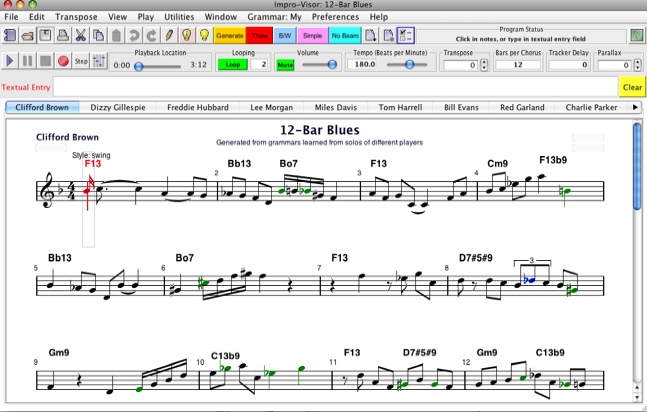
Partial List of Features:
Lead sheets
and solos can be constructed through either point-and-click or using a plain
text editor (one is provided, but any editor can be used).
Optional
automatic note coloration shows whether notes are consonant or dissonant with chords
and scales.
Chords may also be entered quickly through a "roadmap" editor, which also analyzes chord changes for implied keys and idiomatic progressions ("bricks").
Harmonic note
entry option guides the user to select notes that are consonant with harmony.
Similarly, transposition options provide chromatic or harmonic transposition.
Solos or solo
fragments can be played back immediately on the computer, with automatic
rhythm section accompaniment.
Can be used
for self-study, classroom, or play-along. Any segment of a leadsheet can be
played back in looped mode.
Users can
define new accompaniment styles. There is spreadsheet-like Style
Editor, and a Style Extractor facility that helps create styles from MIDI
performances. .
Solos and heads may be
exported as MIDI files, with accompaniment if desired.
Solos and heads may be
exported as MusicXML, for import to other popular music notation software.
It is not
necessary that the soloist memorize the solos that are created in Impro-Visor.
The act of constructing solos is intended to help one get a better
understanding of the tune and of solo construction. But one can use some or all
of the ideas from pre-constructed solos, as many generations of outstanding
players have done.
Impro-Visor
also provides a way for the user to create and save licks for later
use. Lick creation is helpful in understanding how to construct interesting
lines over chord changes.
When used for
transcription, Impro-Visor allows easy "mining" of selected licks from a solo
for future reference.
Impro-Visor
uses menus to help one choose notes, cells, idioms, licks, and quotes for use
in constructing a solo.
Musical
knowledge about chords, scales, licks, etc. are definable by the user or
instructor, in the form of a vocabulary text file. These items are defined in a
single key, and Impro-Visor will transpose them to any key.
Impro-Visor
includes a powerful lick generation capability. Licks, or entire
choruses, can be generated in near-real time just by pressing a button. The
generation of licks is controlled by a user-modifiable grammar, so that a
range of styles and complexities is possible.
Impro-Visor
can learn grammars for a particular style from a corpus of solos.
Impro-Visor
saves solos and other lead sheets as free-form text. We call this
leadsheet notation. Although a point-and-click interface is provided, users can
optionally enter chords and/or melody in this notation with a standard text
editor and have them displayed as a lead sheet in Impro-Visor. The
documentation tells how to create and interpret the notation. The notation also
provides slash-chords and polychords.
Any number of
leadsheet windows can be open simultaneously. The user can cut and paste melody
and chords from one window to another.
The release of
Impro-Visor comes with a few example leadsheets. More resources are available through the Yahoo! users group: https://groups.yahoo.com/neo/groups/impro-visor/info
Impro-Visor is
free and runs on any platform that supports Java 1.8
or later, including:
Windows
(10, 7, 8, Vista, XP, 2000, maybe others)
MacOSX (with
Java 1.8 installed)
Linux
Documentation that you might find helpful:
Impro-Visor's Scale and Chord Repertoire
How
To Improvise Jazz Melodies by Bob Keller
Guide to
Leadsheet Notation (pdf)
Other papers and presentations on, or related to, Impro-Visor
Credits:
Concept:
Bob Keller
Design:
Bob Keller, Steve Gomez, Martin Hunt,
Stephen Jones,
David Morrison,
Belinda Thom,
Aaron Wolin,
Jim
Herold, Brandy McMenamy, Sayuri Soejima,
Jon Gillick,
Kevin Tang, Emma Carlson, Stephen Lee, Lasconic (Nicolas Froment),
Zack Merritt,
Xanda Schofield, August Toman-Yih, David Halpern, Jack Davison,
Audrey Musselman-Brown, Kevin Choi, Brian Howell,
Caitlin Chen, Nicolas Chung, Anna Turner,
Hayden Blauzvern,
Nate Tarrh, Brian Kwak, Eric Chicot, Alex Putman, Carli Lessard,
Mark Heimann, Nava Dallal, Becki Yukman, Nathan Kim, Zach Kondak, Mikayla Konst,
Daniel Scanteianu, Amelia Sheppard, David Siah, Daniel Johnson, Nicholas Weintraut, Joseph Yaconelli,
Cai Glencross, Lukas Gnirke
Implementation:
Bob Keller,
Steve Gomez, Martin Hunt, Stephen Jones,
David
Morrison, Aaron Wolin, Jim Herold, Brandy McMenamy, Sayuri Soejima, John
Goodman,
Jon Gillick,
Kevin Tang, Emma Carlson, Stephen Lee, Chad Waters, Lasconic (Nicolas Froment)
Zack Merritt,
Xanda Schofield, August Toman-Yih, David Halpern, Jack Davison,
Audrey Musselman-Brown, Kevin Choi, Brian Howell,
Caitlin Chen, Nicolas Chung, Anna Turner,
Hayden Blauzvern,
Nate Tarrh, Brian Kwak, Willem Engen, Eric Chicot, Alex Putman,
Carli Lessard, Mark Heimann, Nava Dallal, Becki Yukman, Errick Jackson, Nathan Kim,
Zach Kondak, Mikayla Konst, Baunnee Martinez, Daniel Scanteianu, Amelia Sheppard, David Siah,
Daniel Johnson, Nicholas Weintraut, Sam Goree, Samantha Long, Isys Johnson, Joseph Yaconelli,
Cai Glencross, Lukas Gnirke
Support:
This project was supported by a Mellon
Foundation Faculty Enhancement grant to Professors Keller
and Thom,
by the National Science Foundation REU
Program under grant Award No. 0451293 to Harvey Mudd
College,
by a grant from the Baker
Foundation, and by Harvey Mudd College.
Software Libraries and Tools Used in Development:
install4j Multi-Platform Installer Builder by ej-Technologies GmbH
NetBeans Interactive Development Environment, versions 4-8.2
jMusic Java Library by Andrew
Sorensen and Andrew Brown, Griffith University
Polya Java Library, created by Robert Keller
vectorz, created by Mike Anderson
Sincerely,
Bob Keller
Professor of Computer Science
Harvey Mudd College