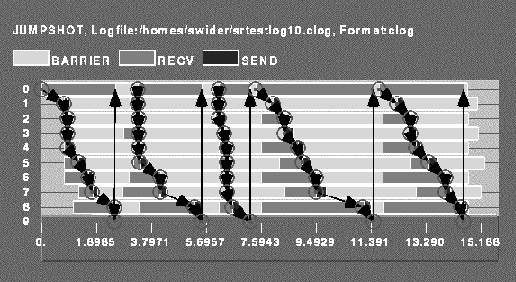
Another tool that is new and is now available is called Jumpshot, which has evolved from Upshot and Nupshot. Jumpshot, which is written in java, is a graphical visualization tool for interpreting binary clog tracefiles which displays them onto a canvas object, such as the one depicted in Figure 2 .
Jumpshot Window
File
- New Frame
- Opens a new jumpshot window
- Select Logfile
- Opens up a window that allows you to select a logfile to view
- Exit
- Quit jumpshot
Display Select the type of display jumpshot should show.
System Select the look and feel of choice. Certain look and feel may not be supported. Enable or disable tool tips. Tool tips are small descriptions that become visible when user places mouse over some region like a button, window, etc.
Help
- Manual
- Opens a window containing this section
- About
- Gives a short description of jumpshot
Logfile Contains name of loaded logfile
Display Display loaded logfile
Display Window
In, Out, Reset These buttons are used to zoom in and out horizontally.
Print Clicking on this button will bring up the Print Dialog window where you will be able to choose printer-related options and print display of this window.
Options Clicking on this button will bring up the Options window.
Process #s Double clicking on process #s will bring up the Adjust Process window
Scroll Bar Use to move forward or backward in time
Keyboard Keys
- Z or z
- Lock Zoom at point where the mouse is positioned.
- T or t
- Set a time marker at point where the mouse is positioned.
- Mouse Button
- Clicking of any mouse button on a specific state instance on the display will bring State Info window which displays information on that state instance. Clicking on this window will dispose of it. Clicking of any mouse button on the circle at origin of a message will open up a window containing information on that message. Clicking on this window will dispose of it.
Options Window
Line Display Turn off/on the zoom lock line and elapsed time line. These are the vertical lines that you see in the Display Window.
Display Options Add/Cut time lines or mountain ranges to/from the display window
Zoom & Time Zoom Factor: Length of display is multiplied by this value when you zoom in. Length of display is divided by this value when you zoom out. From and To are starting and ending times in viewport respectively. To change these values edit and press enter.
Nesting Nest Factor: Measure of difference between heights of successive nested levels. The larger the value, the larger the difference. To change the value, edit and press enter. DO OPTIMAL NESTING: Calculates most appropriate nest factor and implements it.
Adjust Process Window
This window contains options used to manipulate processes.
Scrollbar The scrollbar is used to move the current process forward and backward in time.
Forward/Backward This button is used to determine the direction in which the current process is to be moved.
Reset This causes the process to take up its original position in time.
Display This checkbox controls the display status of the selected process. A process can be selected from the AVAILABLE list.
Swap This causes the selected process to be swapped with the current process.
Delete The selected process is deleted. The deleted process is removed from the AVAILABLE list and placed in the DELETED list.
Insert This causes the selected process from the DELETED list to be placed just above the selected process from the AVAILABLE list.
Process States
Initially below the Display Window, the process states region contains buttons for each state and message. This region can be attached to any of the 4 sides of the Display Window. It can also be torn away from the Display Window and made to form its own window.
All States On Turn on all possible states
ALL States Off Turn off all possible states
[State] Clicking on any state will produce a histogram window for that state.
checkbox Use this to enable/disable this state's display.
State Histogram Window
This window contains information on an associated state. The histogram given is the plot of the number of state instances (y-axis) versus duration in seconds (x-axis).