ptd::CGameState Class Reference
#include <PtdGameModule.h>
Public Member Functions | |
| std::string | gameStateToString () |
| Method for converting the entire game state to a string, to be sent. | |
Creators | |
| CGameState () | |
| Default constructor. | |
| CGameState (fsf::CNode *pParent, fsf::Time tTime=0) | |
| 2-parameter constructor: parent and time stamp | |
| CGameState (std::string &strName, fsf::CNode *pParent, fsf::Time tTime=0) | |
| 3-parameter constructor: node name, parent and time stamp | |
| CGameState (const CGameState &rhs) | |
| Copy constructor. | |
| virtual fsf::CNode * | clone () const |
| Cloning: necessary for run-time polymorphism. | |
Manipulators | |
| CGameState & | operator= (const CGameState &) |
| Assignment operator. | |
| CPlatformer * | getPlatformer (int playerID) |
| CCollisionObject * | getCollisionObject (int objectID) |
| CMobileObject * | getMobileObject (int objectID) |
Accessors | |
| virtual void | getTypeID (std::string &str) const |
| double | getMapHeight () |
| Map interaction. | |
| double | getMapWidth () |
| void | setMapSize (double width, double height) |
| std::list< CCollisionObject * > ::iterator | getIterCollisionObj () |
| Iterators for CollisionObjects. | |
|
std::list< CCollisionObject * > ::iterator | getCollisionObjEnd () |
|
std::list< CMobileObject * > ::iterator | getIterMobileObjects () |
| Iterators for items affected by physics. | |
|
std::list< CMobileObject * > ::iterator | getMobileObjectsEnd () |
|
std::list< CCollisionObject * > ::iterator | getIterLevelPieces () |
| Iterators for all LevelPieces. | |
|
std::list< CCollisionObject * > ::iterator | getLevelPiecesEnd () |
|
std::list< CPlatformer * > ::iterator | getIterPlatformers () |
| Iterators for platformer players. | |
|
std::list< CPlatformer * > ::iterator | getPlatformersEnd () |
| int | addCollisionObject (CCollisionObject *object) |
| int | addMobileObject (CMobileObject *object) |
| int | addPlatformer (CPlatformer *platformer) |
| int | addBuilder (CBuilder *builder) |
| int | addLevelPiece (CCollisionObject *levelPiece) |
| void | removeCollisionObject (int objectID) |
| void | removeMobileObject (int objectID) |
| void | removePlatformer (int platformerID) |
| void | removeLevelPiece (int levelPieceID) |
| void | lockCollisionObjects () |
| void | unlockCollisionObjects () |
| void | lockMobileObjects () |
| void | unlockMobileObjects () |
| void | lockPlatformers () |
| void | unlockPlatformers () |
| CBuilderObject * | itemSelected () |
| void | selectItem (CBuilderObject *object) |
| CBuilder * | getBuilder () |
| fsf::CCharBuffer * | toBuffer () |
| void | fromBuffer (fsf::CCharBuffer *gameStateBuffer) |
| void | initialize () |
| int | getNextObjectID () |
| std::list< int > | getAvailableObjectIDs () |
| std::list< int > | getAvailablePlayerIDs () |
Private Attributes | |
| std::list< CCollisionObject * > | m_collisionObjects |
| fsf::CMutex | m_csCollisionObjects |
| std::list< CMobileObject * > | m_mobileObjects |
| All objects that can be affected by physics. | |
| fsf::CMutex | m_csMobileObjects |
| std::list< CCollisionObject * > | m_level |
| fsf::CMutex | m_csLevel |
| double | m_mapHeight |
| double | m_mapWidth |
| fsf::CMutex | m_csObjectIDs |
| int | m_nextObjectID |
| std::list< int > | m_availableObjectIDs |
Static Private Attributes | |
| static const int | NUM_PLAYERS = 5 |
Players | |
| std::list< CPlatformer * > | m_platformers |
| List of all Platfomer objects. | |
| fsf::CMutex | m_csPlatformers |
| std::list< int > | m_availablePlayerIDs |
| fsf::CMutex | m_csPlayerIDs |
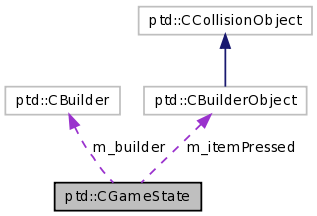
| CBuilder * | m_builder |
| A pointer to the builder object. | |
| fsf::CMutex | m_csBuilder |
| CBuilderObject * | m_itemPressed |
| int | m_score |
| Current game score. | |
| fsf::CMutex | m_csScore |
| void | lockBuilder () |
| void | unlockBuilder () |
Detailed Description
The game state node type encapsulates all the elements necessary to describe the game stateMember Function Documentation
| void CGameState::fromBuffer | ( | fsf::CCharBuffer * | gameStateBuffer | ) |
Reads from an encoding from a buffer and updates the data members of this object
- Parameters:
-
an object of type fsf::CCharBuffer which represents the updated game state
Updating the list of CollisionObjects
Updating the list of MobileObjects
Updating the list of Platformers
| std::list< CCollisionObject * >::iterator CGameState::getIterCollisionObj | ( | ) |
Iterators for CollisionObjects.
Methods to get Iterators over the various lists of objects. For each list, the first method returns an iterator to the beginning of the list and the second mehtod returns an iterator to the end of the list NOTE: Please lock the lists before iterating over them!
| fsf::CCharBuffer * CGameState::toBuffer | ( | ) |
Places a byte-level encoding of this object into a buffer
- Returns:
- an object of type fsf::CCharBuffer which represents the game state.
Member Data Documentation
std::list<int> ptd::CGameState::m_availableObjectIDs [private] |
m_availableObjectIDs : Keeps track of available object IDs. Starts out empty, but as objects are removed from the game state their IDs are pushed onto the back of the list. When an object is added to the game state and needs an ID, it checks this list first and takes the first value if there is one. If there isn't, it takes and then increments m_nextObjectID.
std::list<int> ptd::CGameState::m_availablePlayerIDs [private] |
Keeps track of the playerIDs not currently in use.
- Should be initialized to hold 1-5, in order
- When a player is added to the game, it gets its player ID by calling pop_front on this list
- When a player leaves the game, its player ID should be pushed onto the end of this list
std::list<CCollisionObject*> ptd::CGameState::m_collisionObjects [private] |
This list contains all objects in play that can be collided with CBuilderObjects, which are created by the builder will go in this list when a new CBuilderObject is placed in the game. CBuilderObject is a subClass of CCollisionObject, so there is no typing issues. A method which wishes to access a CBuilderObject's cost or label field after it's placed in the game will have to perform a cast operation.
fsf::CMutex ptd::CGameState::m_csObjectIDs [private] |
The next two data members keep track of the unique identifiers for the objects in the game state. For now, CollisionObjects, MobileObjects, and LevelPieces all share the same ID list! This reduces clutter, but may become a problem if we're ever adding/removing lots of objects to the game state
std::list<CCollisionObject*> ptd::CGameState::m_level [private] |
The level is made up of LevelPieces (ground, walls platforms, etc)
int ptd::CGameState::m_nextObjectID [private] |
m_nextObjectID : keeps track of the next new value that can be assigned as an object ID. The platformers always hold spots 1-NUM_PLAYERS, so it starts 1 above that and is incremented as objects are added to the game state.
The documentation for this class was generated from the following files:
- /Users/alex/Projects/Platitude/PtdGameModule.h
- /Users/alex/Projects/Platitude/PtdGameModule.cc