 CS131Spring2020 Web
Welcome!
Who Are We?
Melissa O'Neill (“Prof. Melissa”)- Office: Olin 1262
- Email:
oneill@cs.hmc.edu(but use Piazza) - Interested in systems areas, including
- Programming languages
- Operating systems
- Parallel computing
- Office: Olin Olin B161C
- Email:
benw@cs.hmc.edu(but use Piazza) - Interested in language design, including
- Social consequences of language design
- Whose needs have been ignored
- Design vs Analysability
Optimizing Our Time
We won't go over syllabus today, but it is REALLY IMPORTANT. The Read the syllabus! It has lots of important information, including:- Course goals
- Attendance policies
- Late homework submission policy
- Early homework submission bonus
- How to get help
Survey Results
The background survey lets us see the big picture...Self Presentation
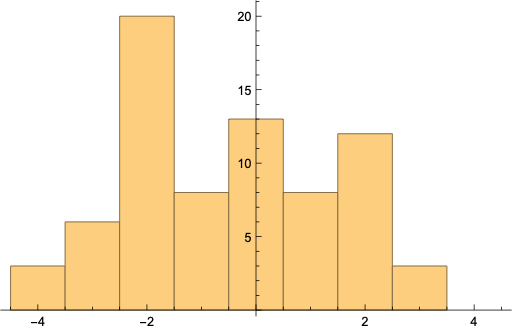 (from "Quiet" to "Loud")
Attitude to Mistakes/Errors
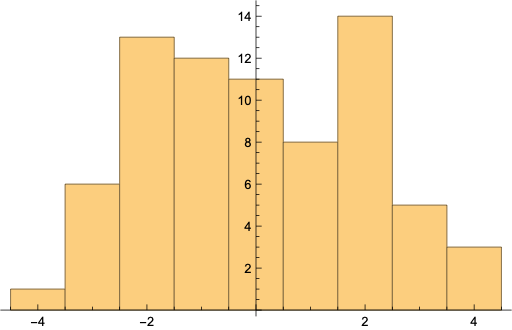 (from "Hate mistakes" to "Like mistakes")
Feedback preference
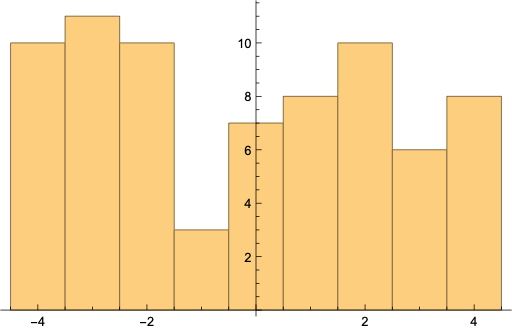 (from "Be blunt" to "Be inquisitive")
Programming in Python
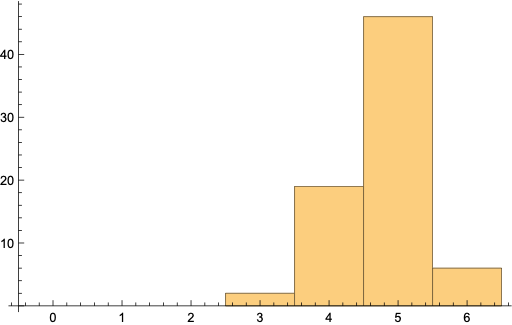 (from "Know nothing" to "Know lots")
Programming in Java
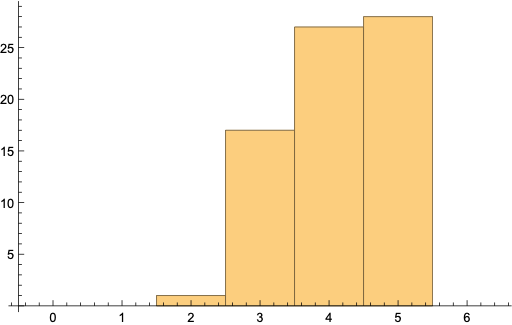 (from "Know nothing" to "Know lots")
Programming in C
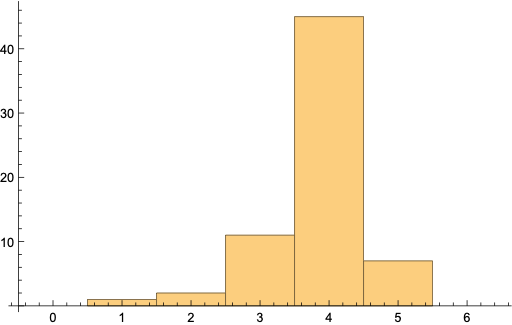 (from "Know nothing" to "Know lots")
Programming in C++
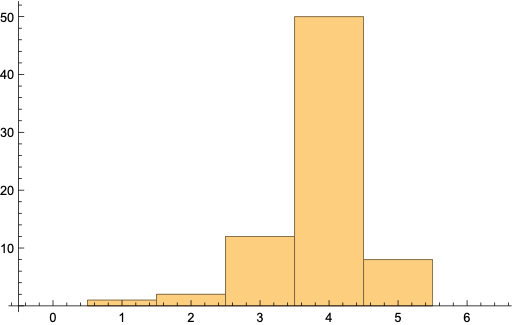 (from "Know nothing" to "Know lots")
Programming in Standard ML
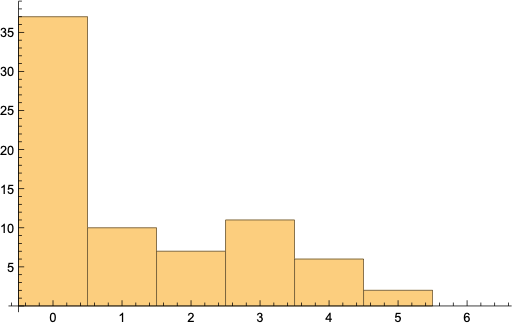 (from "Know nothing" to "Know lots")
Programming in Haskell
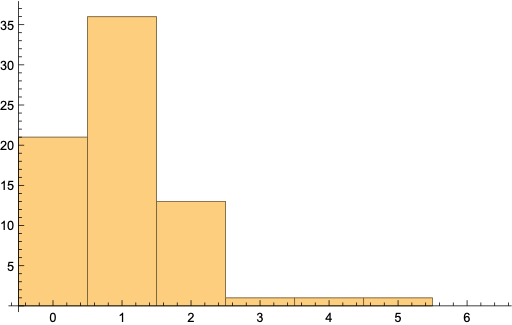 (from "Know nothing" to "Know lots")
Programming in Prolog
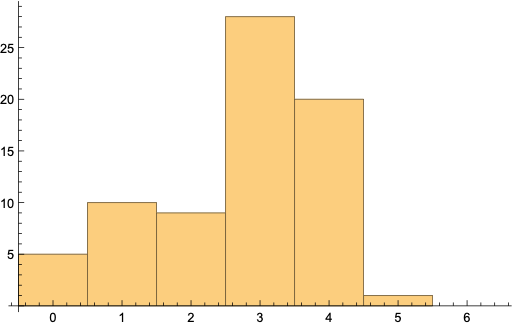 (from "Know nothing" to "Know lots")
Programming in Scheme / Racket / Lisp
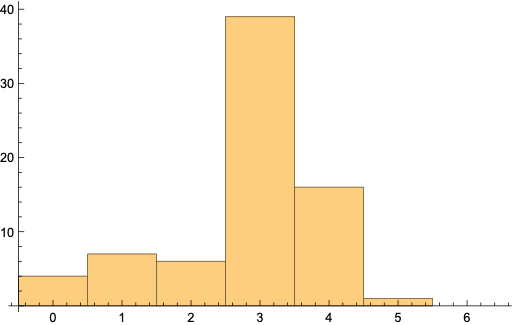 (from "Know nothing" to "Know lots")
Programming in Lua
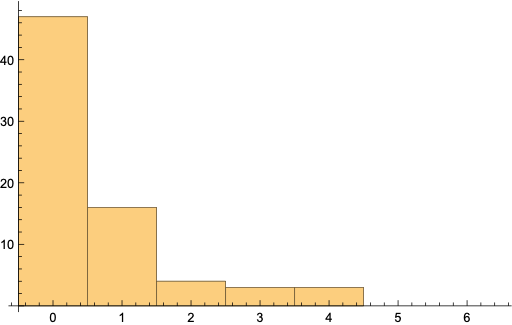 (from "Know nothing" to "Know lots")
Programming in Go
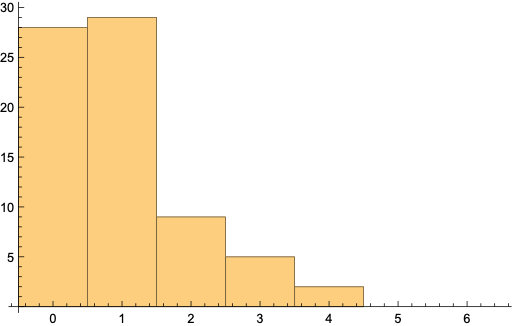 (from "Know nothing" to "Know lots")
Programming in D
 (from "Know nothing" to "Know lots")
Using Unix from the command line
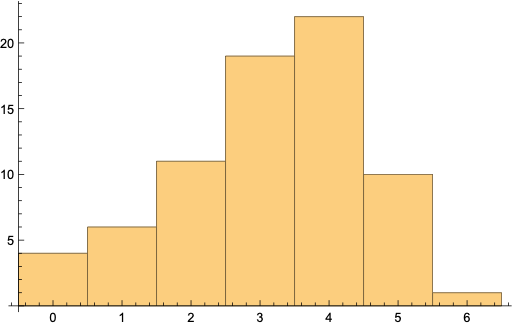 (from "Know nothing" to "Know lots")
Version control with Subversion
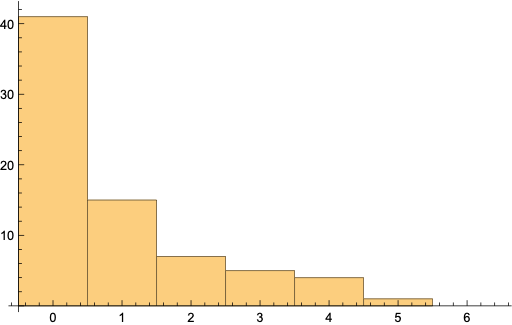 (from "Know nothing" to "Know lots")
Version control with Git
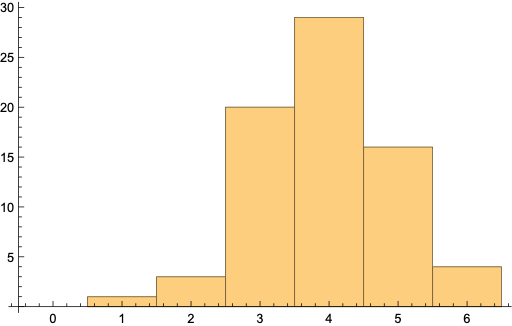 (from "Know nothing" to "Know lots")
Proof by Induction
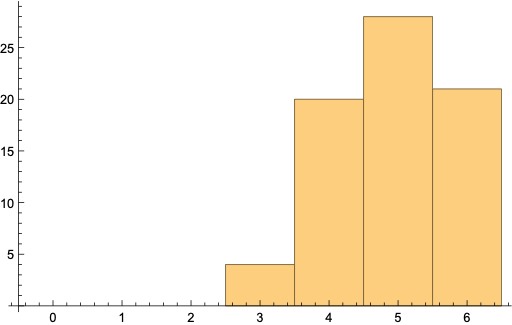 (from "Know nothing" to "Know lots")
Formal Logic
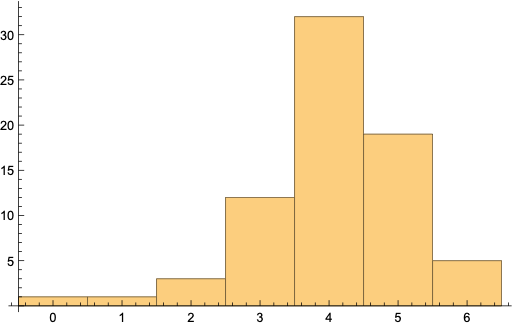 (from "Know nothing" to "Know lots")
Lambda Calculus
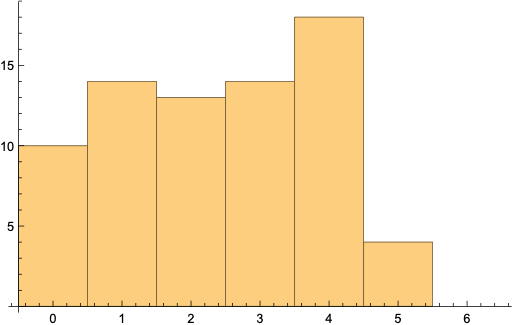 (from "Know nothing" to "Know lots")
Working in Pairs
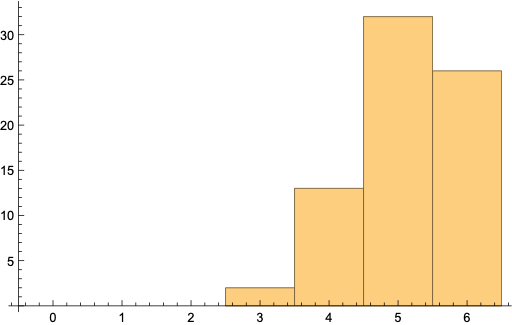 (from "Know nothing" to "Know lots")
I'm really excited about taking CS 131
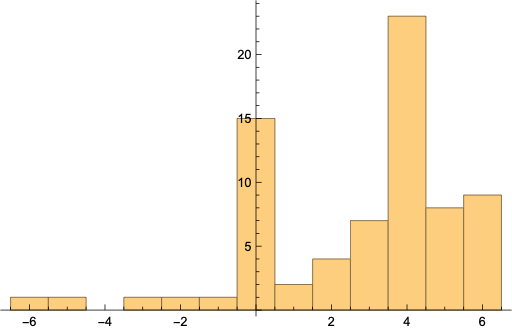 Hopefully we'll have everyone feel excited!
I'm expecting to learn a lot in this class
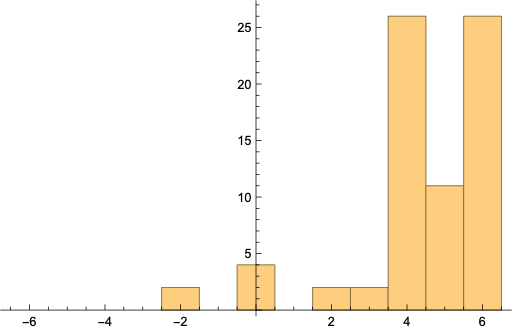
- It's ok if you don't know all the languages. That's what is expected!
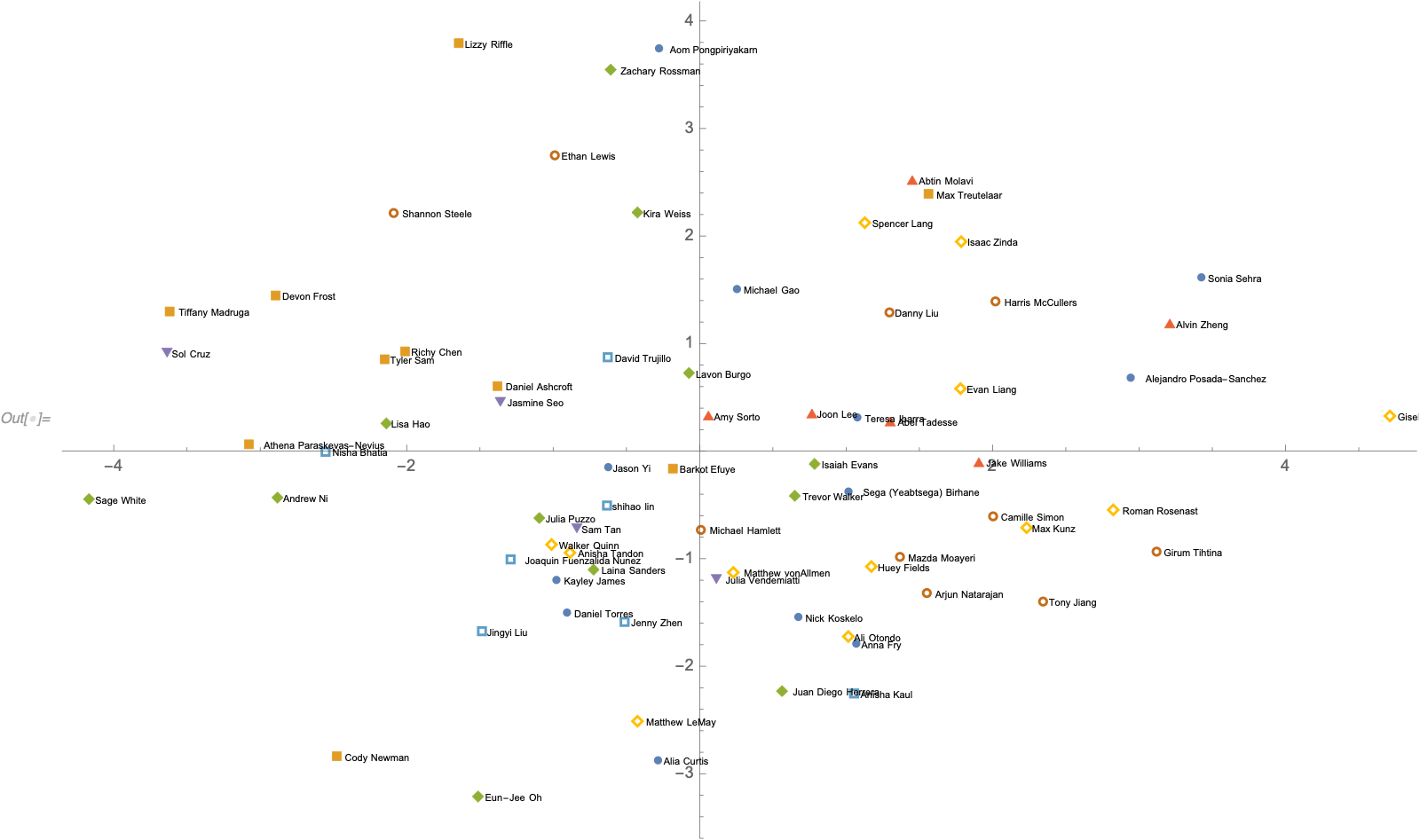
- There is no correlation betweeen grades and connections on the similarity graph.
Who You're “Most Similar” to...(?)
Wiki Extra: What are Programming Languages?
- Communication with a computer
- Use of an abstraction
- Description of a computation that we want a machine to perform
We Want This Class To Be Useful to Everyone
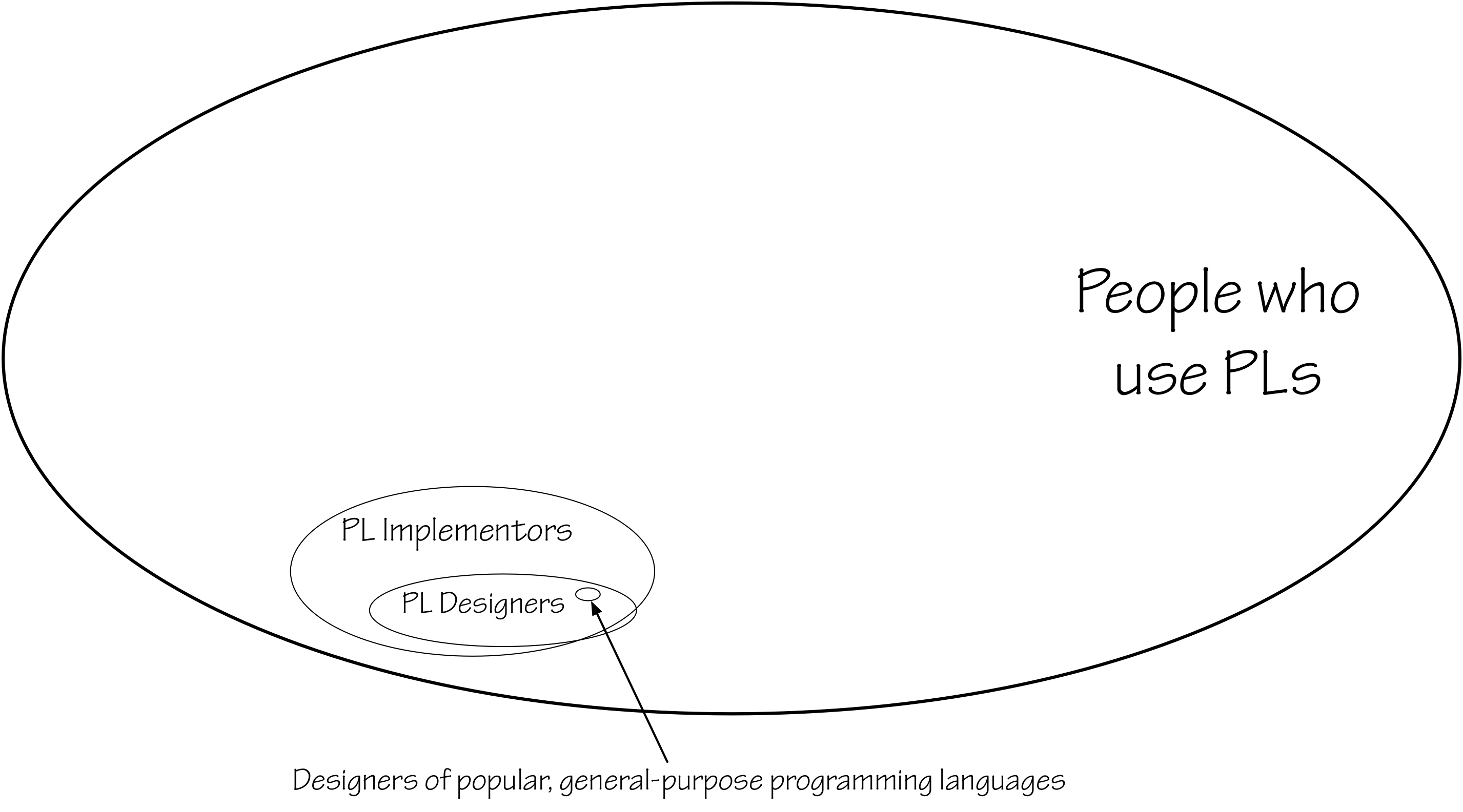 CS 131 is aiming at the big circle, not just people whose goal in life is to design or implement programming languages.
This picture vastly exaggerates the number of programmers who have gone on to invent successful general-purpose programming languages --- it's probably just a few dozen in the last 50 years.
CS 131 is aiming at the big circle, not just people whose goal in life is to design or implement programming languages.
This picture vastly exaggerates the number of programmers who have gone on to invent successful general-purpose programming languages --- it's probably just a few dozen in the last 50 years.
Not our plan. But why not?
| Week | Language |
| 1 | Haskell |
| 2 | C# |
| 3 | F# |
| 4 | Ruby |
| 5 | JavaScript |
| 6 | TypeScript |
| 7 | Clojure |
| 8 | Rust |
| 9 | Idris |
| 10 | Scala |
| 11 | Swift |
| 12 | Elixir |
| 13 | Go |
| 14 | D |
A Similar List from 1980...
| Week | Language |
| 1 | Fortran |
| 2 | Lisp |
| 3 | Cobol |
| 4 | Algol |
| 5 | Snobol |
| 6 | BASIC |
| 7 | APL |
| 8 | PL/I |
| 9 | Mumps |
| 10 | Pascal |
| 11 | C |
| 12 | Modula-2 |
| 13 | Ada |
| 14 | C with Classes |
C. J. Date on Principles
The point about
principles is this: they endure....
if you know the underlying principles then you have knowledge and skills that
will be transferable: knowledge and skills that you'll be able to apply in
every environment and that will never be obsolete.
What are we going to study?
- Not the tiny details from many specific programming languages since they may be obsolete in 20 years
- Higher level principles that stick around like binding variables, making trees, object oriented programming, anonymous functions...
- Processing symbolic data
Superficial differences, deeper similarities
| \(x \,\mapsto\, x{+}1\) | math |
| \(\lambda x.\, x{+}1\) | logic |
lambda x: x+1 |
Python |
(lambda (x) (+ x 1)) |
Scheme/Racket |
\x -> x+1 |
Haskell |
[](int x) { return x+1; } |
C++11 |
x => x+1 |
C# |
(x) => x+1 |
Dart, JavaScript 6 |
{ x in x+1 } |
Swift |
fn x => x+1 |
SML |
function x -> x+1 |
OCaml |
function(x) { return x+1; } |
JavaScript 5 |
Function[x,x+1] |
Mathematica |
Tentative Order of Topics (subject to change)
| Week | Topic |
| 1 | Introduction |
| 2 | Lambda Calculus |
| 3 | Functional Programming |
| 4 | Abstract Syntax and Interpreters |
| 5 | Closures and Scope |
| 6 | Parsing |
| 7 | Side-Effects |
| 8 | Types and Subtypes |
| 9 | Dispatch |
| 10 | Objects (with and without Classes) |
| 11 | Control Flow |
| 12-13 | Concurrency and Parallelism |
| 14 | Memory and Garbage Collection |
| 15 | Wrap up |
Shouldn't real PLs show up somewhere, though?
Nearly all of the homeworks ask you to write Haskell code We'll also encounter examples of- Domain-specific languages (PostScript, pic, ...)
- Object-oriented languages (Java, C++, JavaScript, ...)
- Parallel languages (D, Go, ...)
- And more!
The Problem With Strings
If we want to process symbolic data (e.g., mathematical expressions), strings are a painful representation.
     "3.0 + x"
     "3.0 * y + 2 * exp(exp(x) + 7.0)"
     "3.0 * y + exp(2) * exp(x + 7.0)"
     "3.0 * x + exp (x * x + y)"
Why are strings a painful representation for processing symbolic data? - Parsing characters one at a time means that you can't see the structure
- Symbols are characters and are not representative of the actual values
Better: Trees
A better way to represent symbolic data is with a tree!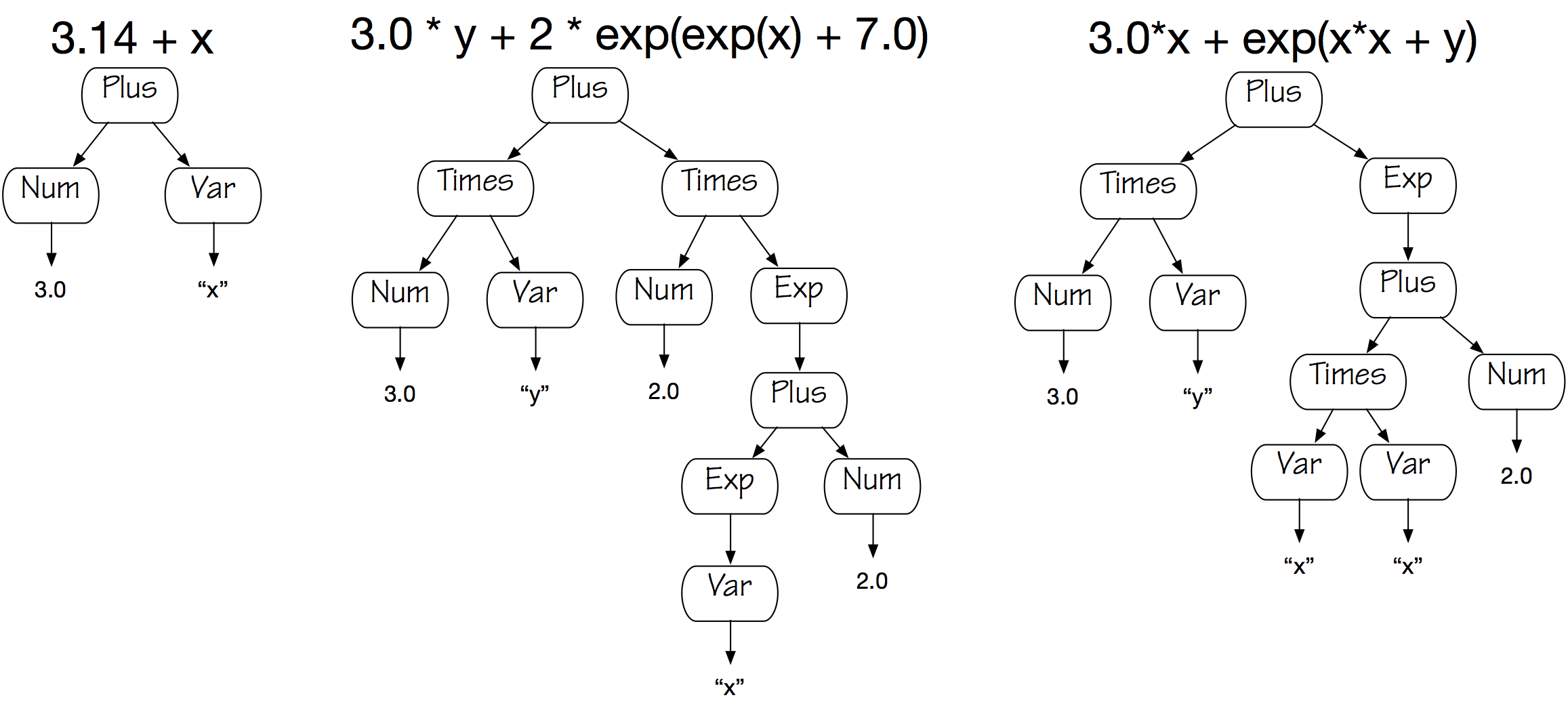 Challenge: Using one of {Python, Racket, Java, C++, C}, write the code required
to represent any such tree as data. How would you build trees for "2" or "2+x"?
Too easy? Add code that, given one of these trees, computes
the derivative with respect to a variable (returning a new expression tree)
In class we came up with solutions like defining separate classes for the nodes of the tree, making a generic node with an assumed left and right node but all of these solutions were like trying to hammer in a screw.
Probably the simplest approach is to use Python or Racket and represent trees with nested lists,where we use numbers or strings for the base case of
Challenge: Using one of {Python, Racket, Java, C++, C}, write the code required
to represent any such tree as data. How would you build trees for "2" or "2+x"?
Too easy? Add code that, given one of these trees, computes
the derivative with respect to a variable (returning a new expression tree)
In class we came up with solutions like defining separate classes for the nodes of the tree, making a generic node with an assumed left and right node but all of these solutions were like trying to hammer in a screw.
Probably the simplest approach is to use Python or Racket and represent trees with nested lists,where we use numbers or strings for the base case of Num or Var nodes, and lists otherwise (with the first element of the list giving the label of the node, and the remainder of the list being the 1 or 2 subtrees)
For example, "2" would be represented as the python value 2 and
"2+x" would be represented as the Python value ["Plus", 2, "x"]
and the last tree "3.0*x+exp(x*x+y)" would be
["Plus", ["Times", 3.0, "x"], ["Exp", ["Plus", ["Times", "x", "x"], 2.0]]]Then if you weanted to "traverse" such a tree, you first check if the tree is a python number, python string, or python list; if it's a list, you can check the first string element to know the node label, and then recurse on the remaining list elements (subtrees).
But if you feel determined to have nodes represented as objects, then that could lead to much more complicated code, e.g.,
public interface Node { ... };

public class Num implementes Node { private double value; };
public class Var implements Node { private String varname; };
public class Plus implements Node { private Node left;
                                    private Node right;};
public class Times implements Node { private Node left;
                                     private Node right;};
public class Exp implements Node { private Node exponent; };
plus all the constructors and other code that would let you say
new Num(2.0)and
new Plus(new Num(2.0), new Var("x"))
and
  new Plus(new Times(new Num(3.0), new Var("x")),
           new Exp(new Plus(new Times(new Var("x"), new Var("x")),
                            new Num(2.0))))
Even this isn't so bad, but the code to implement tree traversal would be even longer...
You could do something in similar in Python, perhaps even simplifying the number of classes because we don't have to worry about types (although that means we don't have any confirmation that our trees are not broken). Doing all this in C would probably be a disaster.
If we wanted to do the bonus part of the question, trying to compute the derivative would be even harder -- accounting for rules like the produce rule would get very complicated.
My Haskell Solution
Luckily, there is a more simple implementation in Haskell that uses pattern matching instead of many classes that makes computing the derivative easy.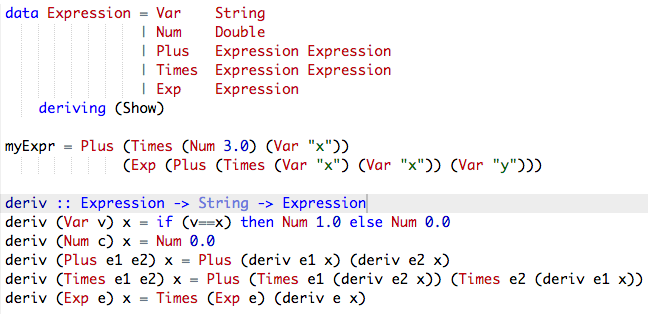 Haskell is a means, not an end. CS 131 has all sorts of examples of tree-structured data, and so we want to choose a language (like Haskell or Standard ML or OCaml; we picked Haskell this semester) that lets us create and manipulate trees easily.
It's always a good idea to pick a language based not on fashion, or what you happen to have been using lately, but based on whether it is a good match for the specific problem to be solved.
Haskell is a means, not an end. CS 131 has all sorts of examples of tree-structured data, and so we want to choose a language (like Haskell or Standard ML or OCaml; we picked Haskell this semester) that lets us create and manipulate trees easily.
It's always a good idea to pick a language based not on fashion, or what you happen to have been using lately, but based on whether it is a good match for the specific problem to be solved.
Nodes
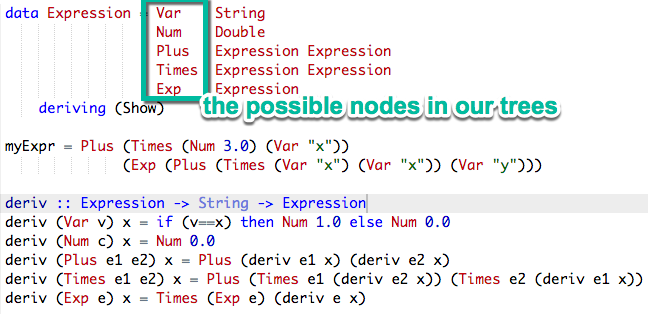 This creates a new type "Expression" of expression trees. There are only five possible labels for nodes in these trees; we just list them.
Children
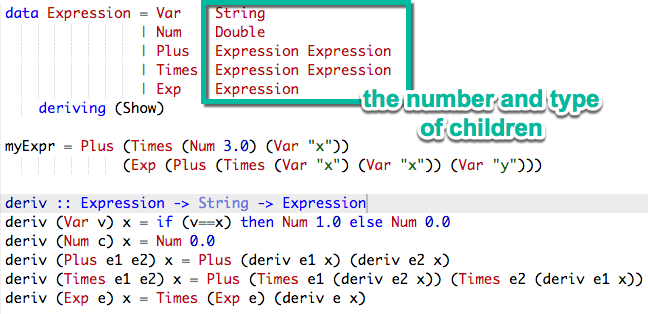 For each possible node label, we specify what sort of children it has -- one string, one double-precision floating-point value, two
 Expressions subtrees, or a single Expression subtree.
3.0_x + exp(x_x + y)
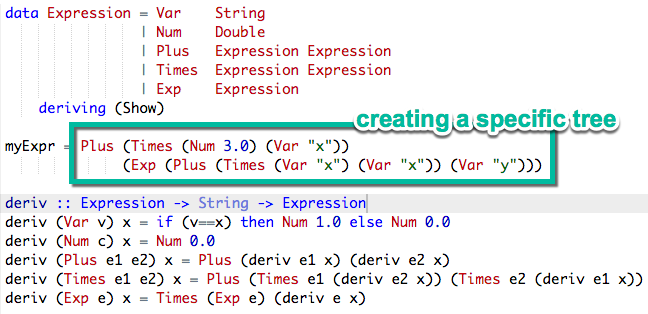 We just specify the root, and recursively the values of the children.
Computing Symbolic Derivatives
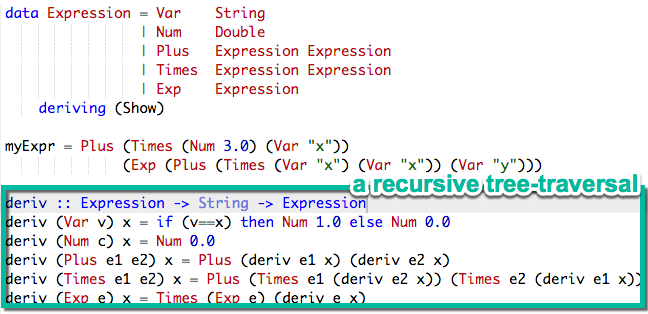 The nice thing about Haskell is that it is really easy to write functions that do different things for different kinds of trees.
If it's a binary tree with the
The nice thing about Haskell is that it is really easy to write functions that do different things for different kinds of trees.
If it's a binary tree with the Plus label at the root, we apply the rule for the derivative of a sum. If it's a binary tree with the Times label at the root, we instead apply the product rule.
If it's a unary tree with the Num label at the root, we know the derivative is zero. Since the result of this function is always supposed to be a symbolic expression (represented as a tree), we represent the symbolic expression zero by the tree that has Num at the root and the floating-point value 0.0 as its child.
Wiki Extra: Back to Programming Language Principles
Mental Chunking
This is hard to remember:
CIAD HSF BIAT FNSA
Remembering multiple nonsense words (or equivalently, 15 letters in no meaningful order) is hard.
These might be much easier
CIA DHS FBI ATF NSA
It's much more likely that in a few days or weeks you can remember some of these government agencies, even though it's exactly the same 15 letters as above!
Chunking of Code
   for (int i = 0; i < 10; ++i) {
     x += i;
   }
What does an experienced C/Java programmer see?
A loop that counts up from 0 to 9; adding each index value to an accumulator.
What might a novice student see?
Let's see. There's the "for" keyword; I think that's a loop. It's creating a variable for some reason, and assigning 0 to that variable. Why are there two pluses in a row? Why is there a semicolon
on after i < 10 but not after ++i? Oh god, there are parentheses and curly braces here; why the difference? and so on...
Big Idea: Languages Can Be Further Chunked
- Racket (Scheme) is a statically scoped, dynamically typed, higher-order, eager, functional language.
- Emacs Lisp is a dynamically scoped, dynamically typed, higher-order, eager, functional language.
- Standard ML is a statically scoped, statically typed, polymorphic, higher-order, eager, functional language.
- Haskell is a statically scoped, statically typed, polymorphic, higher-order, lazy, purely functional language.
- Ruby is a statically scoped, dynamically typed, single-inheritance (with mixins), object-oriented, (mostly) class-based, object-oriented, imperative language.
In general, by learning the things to look for --- ideas that recur in programming languages, or for which there's a small menu of choices made by each language --- you can look at a new programming language, quickly recognize most of the language (scoping behavior, evaluation behavior, parameter-passing behavior, etc.) and then focus in on learning the "weird" parts of the specific language. -- MelissaONeill - 26 Jan 2020
 Log In
 CS131Spring2020 Web
 Create New Topic
 Index
Index Search
 Changes
 Notifications
 Statistics
 Preferences
- Current Courses
 |
|
 Copyright © by the contributing authors. All material on this collaboration platform is the property of the contributing authors.
 Ideas, requests, problems regarding TWiki? Send feedback