A Mystery Blog Post
You are about to read an excerpt from a blog post that was written sometime in the past, praising a then-recent NLP breakthrough. As noted on the previous page, your job will be to guess what year this blog post was written (and, optionally, you can also try to guess what specific NLP algorithm the blog post was about). We have edited the excerpt to replace all references to the name of the specific NLP algorithm with the generic text "[ALGORITHM NAME]". Additionally, we have also "censored" some details that might have accidentally given some clues to the answer; all such cuts are noted.
For your own sake (to get the most out of this activity), please aim to "play fair"! In particular, please do not attempt to find the original, "uncensored" text on the internet, since that would obviously give away the answer! (Of course, it's unavoidable that some of you may already be familiar with the original text and have therefore already been "spoiled", in which case we will offer an option for you to abstain from the guessing game).

Remember, this isn't being graded or anything like that; you get full credit just for participating. So there's really no reason to cheat!
Without further ado, here's the excerpt:
A Mystery Blog Post
By: A Mystery Author
Introduction
There's something magical about [ALGORITHM NAME]. I still remember when I trained my first [ALGORITHM NAME] for Image Captioning. Within a few dozen minutes of training my first baby model (with rather arbitrarily-chosen hyperparameters) started to generate very nice looking descriptions of images that were on the edge of making sense. Sometimes the ratio of how simple your model is to the quality of the results you get out of it blows past your expectations, and this was one of those times. What made this result so shocking at the time was that the common wisdom was that [ALGORITHM NAME]s were supposed to be difficult to train (with more experience I’ve in fact reached the opposite conclusion). Fast forward about a year: I’m training [ALGORITHM NAME]s all the time and I’ve witnessed their power and robustness many times, and yet their magical outputs still find ways of amusing me. This post is about sharing some of that magic with you.
We’ll train [ALGORITHM NAME] to generate text character by character and ponder the question “how is that even possible?”
[Two sections covering details of the algorithm have been cut to prevent spoilers. We skip straight to the discussion of the results.]
Fun With [ALGORITHM NAME]
All 5 example character models below were trained with the code I’m releasing on Github. The input in each case is a single file with some text, and we’re training [ALGORITHM NAME] to predict the next character in the sequence.
Paul Graham generator
Lets first try a small dataset of English as a sanity check. My favorite fun dataset is the concatenation of Paul Graham’s essays. The basic idea is that there’s a lot of wisdom in these essays, but unfortunately Paul Graham is a relatively slow generator. Wouldn’t it be great if we could sample startup wisdom on demand? That’s where [ALGORITHM NAME] comes in.
Concatenating all Paul Graham essays over the last ~5 years we get approximately 1MB text file, or about 1 million characters (this is considered a very small dataset by the way). [Some technical details of the model omitted to prevent spoilers]. Without further ado, lets see a sample from [ALGORITHM NAME]:
The surprised in investors weren’t going to raise money. I’m not the company with the time there are all interesting quickly, don’t have to get off the same programmers. There’s a super-angel round fundraising, why do you can do. If you have a different physical investment are become in people who reduced in a startup with the way to argument the acquirer could see them just that you’re also the founders will part of users’ affords that and an alternation to the idea. [2] Don’t work at first member to see the way kids will seem in advance of a bad successful startup. And if you have to act the big company too.”
Okay, clearly the above is unfortunately not going to replace Paul Graham anytime soon, but remember that [ALGORITHM NAME] had to learn English completely from scratch and with a small dataset (including where you put commas, apostrophes and spaces). I also like that it learns to support its own arguments (e.g. [2], above). Sometimes it says something that offers a glimmer of insight, such as “a company is a meeting to think to investors”.
We can also play with [technical term related to the model; cut to prevent spoilers]. Decreasing [technical term] from 1 to some lower number (e.g. 0.5) makes [ALGORITHM NAME] more confident, but also more conservative in its samples. Conversely, higher [technical term] will give more diversity but at cost of more mistakes (e.g. spelling mistakes, etc). In particular, setting [technical term] very near zero will give the most likely thing that Paul Graham might say:
“is that they were all the same thing that was a startup is that they were all the same thing that was a startup is that they were all the same thing that was a startup is that they were all the same”
looks like we’ve reached an infinite loop about startups.
Shakespeare
It looks like we can learn to spell English words. But how about if there is more structure and style in the data? To examine this I downloaded all the works of Shakespeare and concatenated them into a single (4.4MB) file. [Some technical details of the model omitted to prevent spoilers]. After we train [ALGORITHM NAME] for a few hours we obtain samples such as:
PANDARUS:
Alas, I think he shall be come approached and the day
When little srain would be attain'd into being never fed,
And who is but a chain and subjects of his death,
I should not sleep.

Second Senator:
They are away this miseries, produced upon my soul,
Breaking and strongly should be buried, when I perish
The earth and thoughts of many states.

DUKE VINCENTIO:
Well, your wit is in the care of side and that.

Second Lord:
They would be ruled after this chamber, and
my fair nues begun out of the fact, to be conveyed,
Whose noble souls I'll have the heart of the wars.

Clown:
Come, sir, I will make did behold your worship.

VIOLA:
I'll drink it.
Remember, all [ALGORITHM NAME] knows are characters, so in particular it samples both speaker’s names and the contents. Sometimes we also get relatively extented monologue passages, such as:
VIOLA:
Why, Salisbury must find his flesh and thought
That which I am not aps, not a man and in fire,
To show the reining of the raven and the wars
To grace my hand reproach within, and not a fair are hand,
That Caesar and my goodly father's world;
When I was heaven of presence and our fleets,
We spare with hours, but cut thy council I am great,
Murdered and by thy master's ready there
My power to give thee but so much as hell:
Some service in the noble bondman here,
Would show him to her wine.

KING LEAR:
O, if you were a feeble sight, the courtesy of your law,
Your sight and several breath, will wear the gods
With his heads, and my hands are wonder'd at the deeds,
So drop upon your lordship's head, and your opinion
Shall be against your honour.
I can barely recognize these samples from actual Shakespeare :)
Wikipedia
We saw that [ALGORITHM NAME] can learn to spell words and copy general syntactic structures. Lets further increase the difficulty and train on structured markdown. In particular, lets take the Hutter Prize 100MB dataset of raw Wikipedia and train [ALGORITHM NAME]. Following Graves et al., I used the first 96MB for training, the rest for validation and ran a few models overnight. We can now sample Wikipedia articles! Below are a few fun excerpts. First, some basic markdown output:
Naturalism and decision for the majority of Arab countries' capitalide was grounded
by the Irish language by [[John Clair]], [[An Imperial Japanese Revolt]], associated
with Guangzham's sovereignty. His generals were the powerful ruler of the Portugal
in the [[Protestant Immineners]], which could be said to be directly in Cantonese
Communication, which followed a ceremony and set inspired prison, training. The
emperor travelled back to [[Antioch, Perth, October 25|21]] to note, the Kingdom
of Costa Rica, unsuccessful fashioned the [[Thrales]], [[Cynth's Dajoard]], known
in western [[Scotland]], near Italy to the conquest of India with the conflict.
Copyright was the succession of independence in the slop of Syrian influence that
was a famous German movement based on a more popular servicious, non-doctrinal
and sexual power post. Many governments recognize the military housing of the
[[Civil Liberalization and Infantry Resolution 265 National Party in Hungary]],
that is sympathetic to be to the [[Punjab Resolution]]
(PJS)[http://www.humah.yahoo.com/guardian.
cfm/7754800786d17551963s89.htm Official economics Adjoint for the Nazism, Montgomery
was swear to advance to the resources for those Socialism's rule,
was starting to signing a major tripad of aid exile.]]
In case you were wondering, the yahoo url above doesn’t actually exist, the model just hallucinated it. Also, note that the model learns to open and close the parenthesis correctly. There’s also quite a lot of structured markdown that the model learns, for example sometimes it creates headings, lists, etc.:
{ { cite journal | id=Cerling Nonforest Department|format=Newlymeslated|none } }
''www.e-complete''.

'''See also''': [[List of ethical consent processing]]

== See also ==
*[[Iender dome of the ED]]
*[[Anti-autism]]

===[[Religion|Religion]]===
*[[French Writings]]
*[[Maria]]
*[[Revelation]]
*[[Mount Agamul]]

== External links==
* [http://www.biblegateway.nih.gov/entrepre/ Website of the World Festival. The labour of India-county defeats at the Ripper of California Road.]

==External links==
* [http://www.romanology.com/ Constitution of the Netherlands and Hispanic Competition for Bilabial and Commonwealth Industry (Republican Constitution of the Extent of the Netherlands)]
Sometimes the model snaps into a mode of generating random but valid XML:
<page>
  <title>Antichrist</title>
  <id>865</id>
  <revision>
    <id>15900676</id>
    <timestamp>2002-08-03T18:14:12Z</timestamp>
    <contributor>
      <username>Paris</username>
      <id>23</id>
    </contributor>
    <minor />
    <comment>Automated conversion</comment>
    <text xml:space="preserve">#REDIRECT [[Christianity]]</text>
  </revision>
</page>
The model completely makes up the timestamp, id, and so on. Also, note that it closes the correct tags appropriately and in the correct nested order.
Algebraic Geometry (Latex)
The results above suggest that the model is actually quite good at learning complex syntactic structures. Impressed by these results, [Another person's name; omitted to prevent spoilers] and I decided to push even further into structured territories and got a hold of this book on algebraic stacks/geometry. We downloaded the raw Latex source file (a 16MB file) and trained [ALGORITHM NAME]. Amazingly, the resulting sampled Latex almost compiles. We had to step in and fix a few issues manually but then you get plausible looking math, it’s quite astonishing:
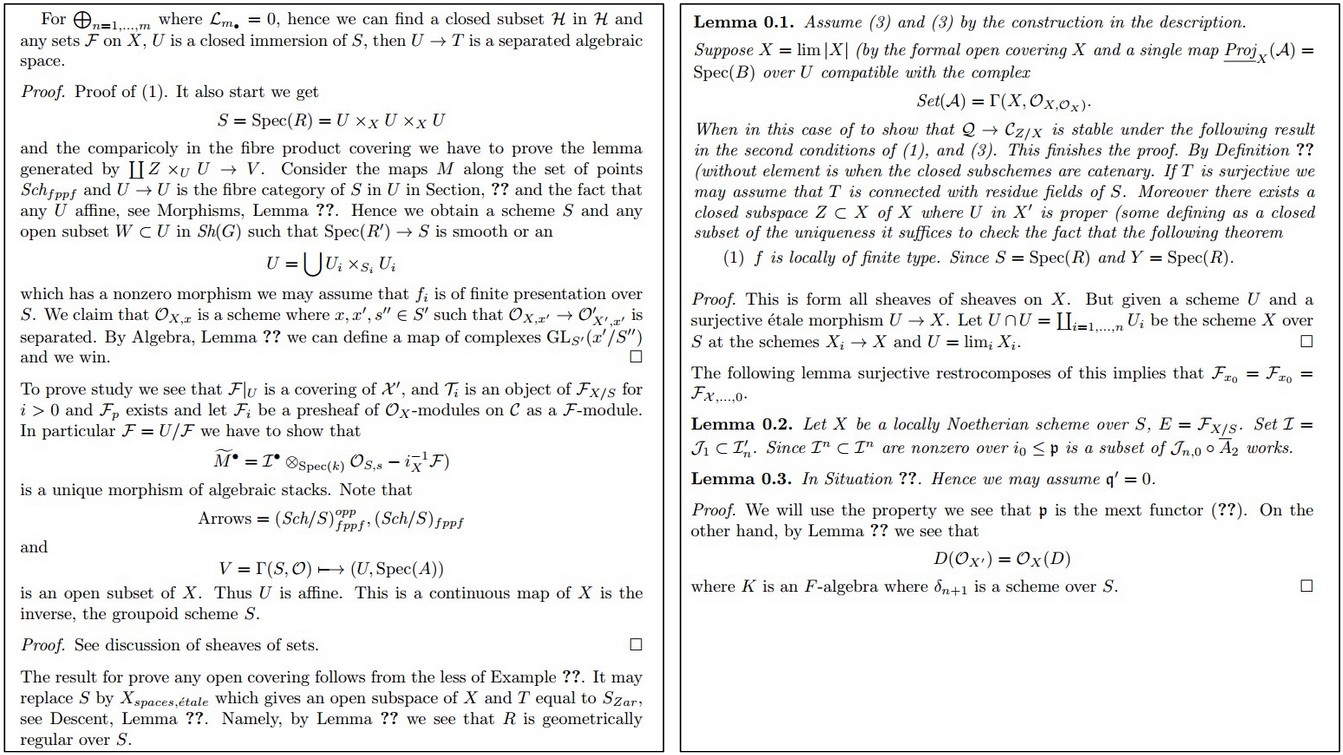
Here’s another sample:
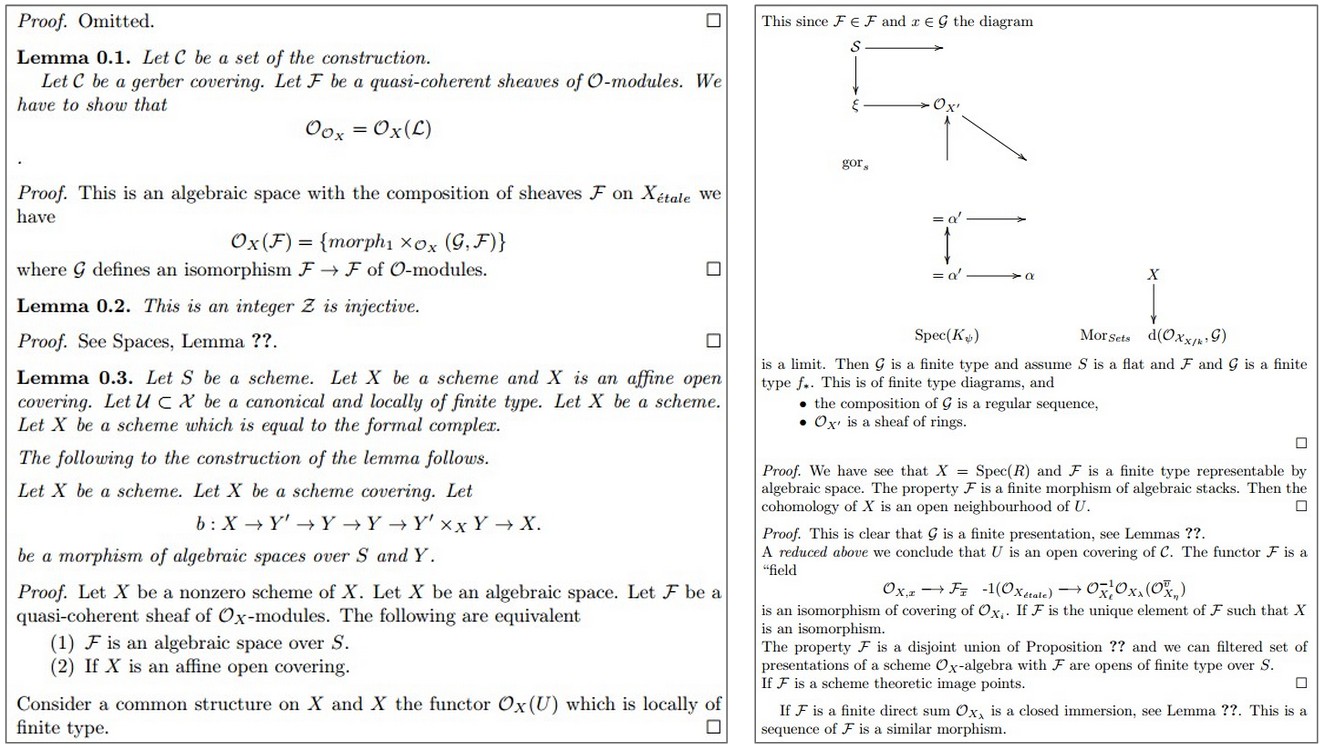
As you can see above, sometimes the model tries to generate latex diagrams, but clearly it hasn’t really figured them out. I also like the part where it chooses to skip a proof (“Proof omitted.”, top left). Of course, keep in mind that latex has a relatively difficult structured syntactic format that I haven’t even fully mastered myself. For instance, here is a raw sample from the model (unedited):
\begin{proof}
We may assume that $\mathcal{I}$ is an abelian sheaf on $\mathcal{C}$.
\item Given a morphism $\Delta : \mathcal{F} \to \mathcal{I}$
is an injective and let $\mathfrak q$ be an abelian sheaf on $X$.
Let $\mathcal{F}$ be a fibered complex. Let $\mathcal{F}$ be a category.
\begin{enumerate}
\item \hyperref[setain-construction-phantom]{Lemma}
\label{lemma-characterize-quasi-finite}
Let $\mathcal{F}$ be an abelian quasi-coherent sheaf on $\mathcal{C}$.
Let $\mathcal{F}$ be a coherent $\mathcal{O}_X$-module. Then
$\mathcal{F}$ is an abelian catenary over $\mathcal{C}$.
\item The following are equivalent
\begin{enumerate}
\item $\mathcal{F}$ is an $\mathcal{O}_X$-module.
\end{lemma}
This sample from a relatively decent model illustrates a few common mistakes. For example, the model opens a \begin{proof} environment but then ends it with a \end{lemma}. This is an example of a problem we’d have to fix manually, and is likely due to the fact that the dependency is too long-term: By the time the model is done with the proof it has forgotten whether it was doing a proof or a lemma. Similarly, it opens an \begin{enumerate} but then forgets to close it. We observed that these became less common with larger/better models, but nonetheless, these are the kinds of mistakes that come up.
Linux Source Code
I wanted to push structured data to its limit, so for the final challenge I decided to use code. In particular, I took all the source and header files found in the Linux repo on Github, concatenated all of them in a single giant file (474MB of C code) (I was originally going to train only on the kernel but that by itself is only ~16MB). Then I trained several [ALGORITHM NAME]s over a period of a few days. [Some technical details of the model omitted to prevent spoilers]. The results are superfun:
/*
 * Increment the size file of the new incorrect UI_FILTER group information
 * of the size generatively.
 */
static int indicate_policy(void)
{
  int error;
  if (fd == MARN_EPT) {
    /*
     * The kernel blank will coeld it to userspace.
     */
    if (ss->segment < mem_total)
      unblock_graph_and_set_blocked();
    else
      ret = 1;
    goto bail;
  }
  segaddr = in_SB(in.addr);
  selector = seg / 16;
  setup_works = true;
  for (i = 0; i < blocks; i++) {
    seq = buf[i++];
    bpf = bd->bd.next + i * search;
    if (fd) {
      current = blocked;
    }
  }
  rw->name = "Getjbbregs";
  bprm_self_clearl(&iv->version);
  regs->new = blocks[(BPF_STATS << info->historidac)] | PFMR_CLOBATHINC_SECONDS << 12;
  return segtable;
}
The code looks really quite great overall. Of course, I don’t think it compiles but when you scroll through the generate code it feels very much like a giant C code base. Notice that [ALGORITHM NAME] peppers its code with comments here and there at random. It is also very good at making very few syntactic errors. For example, it uses strings properly, pointer notation, etc. It also opens and closes brackets {[ correctly and learns to indent its code very well. A common error is that it can’t keep track of variable names: It often uses undefined variables (e.g. rw above), declares variables it never uses (e.g. int error), or returns non-existing variables. Lets see a few more examples. Here’s another snippet that shows a wider array of operations that [ALGORITHM NAME] learns:
/*
 * If this error is set, we will need anything right after that BSD.
 */
static void action_new_function(struct s_stat_info *wb)
{
  unsigned long flags;
  int lel_idx_bit = e->edd, *sys & ~((unsigned long) *FIRST_COMPAT);
  buf[0] = 0xFFFFFFFF & (bit << 4);
  min(inc, slist->bytes);
  printk(KERN_WARNING "Memory allocated %02x/%02x, "
    "original MLL instead\n"),
    min(min(multi_run - s->len, max) * num_data_in),
    frame_pos, sz + first_seg);
  div_u64_w(val, inb_p);
  spin_unlock(&disk->queue_lock);
  mutex_unlock(&s->sock->mutex);
  mutex_unlock(&func->mutex);
  return disassemble(info->pending_bh);
}

static void num_serial_settings(struct tty_struct *tty)
{
  if (tty == tty)
    disable_single_st_p(dev);
  pci_disable_spool(port);
  return 0;
}

static void do_command(struct seq_file *m, void *v)
{
  int column = 32 << (cmd[2] & 0x80);
  if (state)
    cmd = (int)(int_state ^ (in_8(&ch->ch_flags) & Cmd) ? 2 : 1);
  else
    seq = 1;
  for (i = 0; i < 16; i++) {
    if (k & (1 << 1))
      pipe = (in_use & UMXTHREAD_UNCCA) +
        ((count & 0x00000000fffffff8) & 0x000000f) << 8;
    if (count == 0)
      sub(pid, ppc_md.kexec_handle, 0x20000000);
    pipe_set_bytes(i, 0);
  }
  /* Free our user pages pointer to place camera if all dash */
  subsystem_info = &of_changes[PAGE_SIZE];
  rek_controls(offset, idx, &soffset);
  /* Now we want to deliberately put it to device */
  control_check_polarity(&context, val, 0);
  for (i = 0; i < COUNTER; i++)
    seq_puts(s, "policy ");
}
Notice that in the second function the model compares tty == tty, which is vacuously true. On the other hand, at least the variable tty exists in the scope this time! In the last function, notice that the code does not return anything, which happens to be correct since the function signature is void. However, the first two functions were also declared void and did return values. This is again a form of a common mistake due to long-term interactions.
Sometimes the model decides that it’s time to sample a new file. This is usually a very amusing part: The model first recites the GNU license character by character, samples a few includes, generates some macros and then dives into the code:
/*
 *  Copyright (c) [year omitted to prevent spoilers], Intel Mobile Communications.  All rights reserved.
 *
 *   This program is free software; you can redistribute it and/or modify it
 * under the terms of the GNU General Public License version 2 as published by
 * the Free Software Foundation.
 *
 *        This program is distributed in the hope that it will be useful,
 * but WITHOUT ANY WARRANTY; without even the implied warranty of
 *   MERCHANTABILITY or FITNESS FOR A PARTICULAR PURPOSE.  See the
 *
 *  GNU General Public License for more details.
 *
 *   You should have received a copy of the GNU General Public License
 *    along with this program; if not, write to the Free Software Foundation,
 *  Inc., 675 Mass Ave, Cambridge, MA 02139, USA.
 */

#include <linux/kexec.h>
#include <linux/errno.h>
#include <linux/io.h>
#include <linux/platform_device.h>
#include <linux/multi.h>
#include <linux/ckevent.h>

#include <asm/io.h>
#include <asm/prom.h>
#include <asm/e820.h>
#include <asm/system_info.h>
#include <asm/setew.h>
#include <asm/pgproto.h>

#define REG_PG    vesa_slot_addr_pack
#define PFM_NOCOMP  AFSR(0, load)
#define STACK_DDR(type)     (func)

#define SWAP_ALLOCATE(nr)     (e)
#define emulate_sigs()  arch_get_unaligned_child()
#define access_rw(TST)  asm volatile("movd %%esp, %0, %3" : : "r" (0));   \
  if (__type & DO_READ)

static void stat_PC_SEC __read_mostly offsetof(struct seq_argsqueue, \
          pC>[1]);

static void
os_prefix(unsigned long sys)
{
#ifdef CONFIG_PREEMPT
  PUT_PARAM_RAID(2, sel) = get_state_state();
  set_pid_sum((unsigned long)state, current_state_str(),
           (unsigned long)-1->lr_full; low;
}
There are too many fun parts to cover- I could probably write an entire blog post on just this part.
Generating Baby Names
Lets try one more for fun. Lets feed [ALGORITHM NAME] a large text file that contains 8000 baby names listed out, one per line (names obtained from here). We can feed this to [ALGORITHM NAME] and then generate new names! Here are some example names, only showing the ones that do not occur in the training data (90% don’t):
Rudi Levette Berice Lussa Hany Mareanne Chrestina Carissy Marylen Hammine Janye Marlise Jacacrie Hendred Romand Charienna Nenotto Ette Dorane Wallen Marly Darine Salina Elvyn Ersia Maralena Minoria Ellia Charmin Antley Nerille Chelon Walmor Evena Jeryly Stachon Charisa Allisa Anatha Cathanie Geetra Alexie Jerin Cassen Herbett Cossie Velen Daurenge Robester Shermond Terisa Licia Roselen Ferine Jayn Lusine Charyanne Sales Sanny Resa Wallon Martine Merus Jelen Candica Wallin Tel Rachene Tarine Ozila Ketia Shanne Arnande Karella Roselina Alessia Chasty Deland Berther Geamar Jackein Mellisand Sagdy Nenc Lessie Rasemy Guen Gavi Milea Anneda Margoris Janin Rodelin Zeanna Elyne Janah Ferzina Susta Pey Castina
You can see many more here. Some of my favorites include “Baby” (haha), “Killie”, “Char”, “R”, “More”, “Mars”, “Hi”, “Saddie”, “With” and “Ahbort”. Well that was fun. Of course, you can imagine this being quite useful inspiration when writing a novel, or naming a new startup :)
The excerpt ends here.

Feel free to reread a few more times if you think it'll help you nail your guess!
-
When you're ready, go on to the next page to make your guess.
(When logged in, completion status appears here.)