Module 04.1: Code as Data, Evaluating Expressions
For the first few weeks of CS 131, Haskell has been our vehicle for learning a collection of ideas: functions as values, higher-order functions, pattern matching, recursion, and recursive data structures.
Now those pieces start coming together around one of the central ideas of the course:
Code is data.
A program can take numbers, lists, coordinates, or text as input. But a program can also take another program as input. Once we represent code as ordinary structured data, the tools you already know for processing recursive data become tools for processing programs.
This module builds that bridge. We will distinguish expressions from statements, syntax from semantics, and concrete syntax from abstract syntax. Then we will represent arithmetic expressions as recursive Haskell data and write functions that pretty-print and evaluate those expressions.
This is also closely connected to HW3: the stack-machine representation gives you one way to treat an arithmetic expression as data. Here we step back and make the general idea explicit.
By the end of this module, you should be able to:
- explain what it means to say code is data,
- distinguish expressions, statements, and side effects,
- distinguish syntax from semantics,
- distinguish concrete syntax from abstract syntax,
- explain what an abstract syntax tree (AST) keeps and what it deliberately throws away,
- represent a small expression language using recursive Haskell data types,
- explain why some seemingly plausible representations of syntax are better than others,
- recursively traverse an AST,
- write and understand a simple pretty printer,
- write and understand a simple evaluator, and
- explain why evaluating variables requires some representation of their bindings.
How to use this module
When you see a box labeled Gradescope question, answer that question in the Module 4.1 Completion assignment on Gradescope.
Other boxes labeled Pause and think, Try it, or Practice are there to help you understand the material. There is nothing to submit for those unless the box explicitly says Gradescope question.
Where We Have Been, and Where We Are Going
It is worth locating this module in the larger arc of the course.
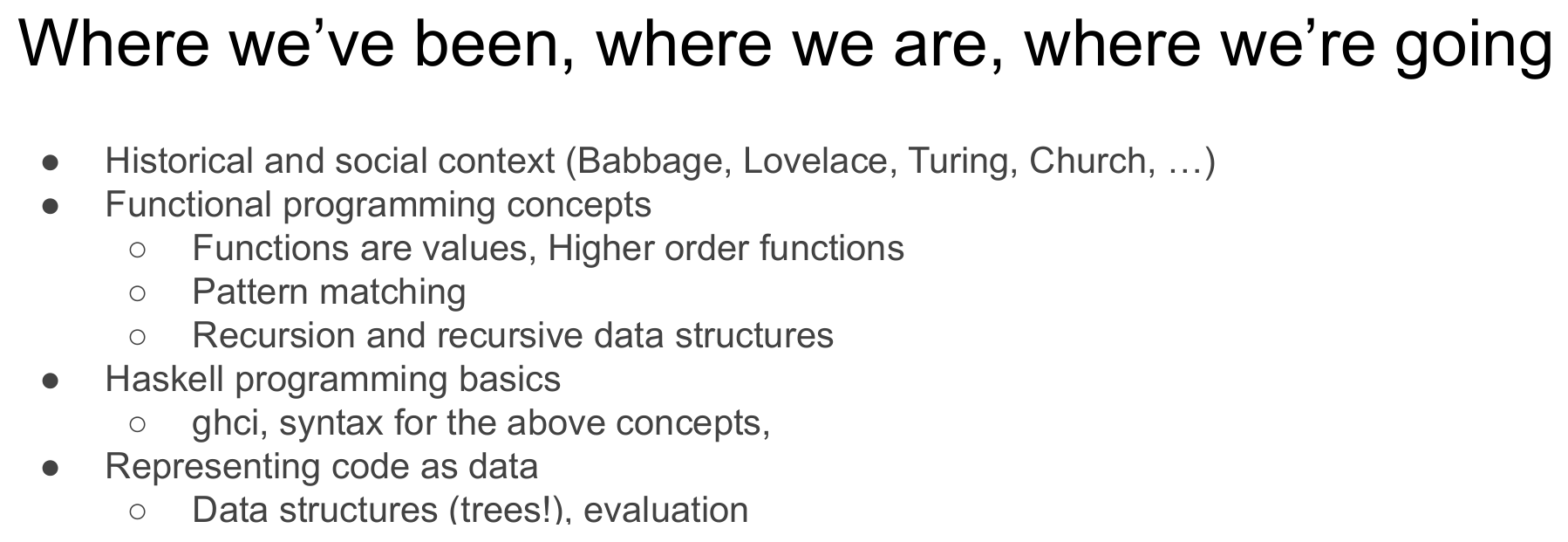
We started with some historical and social context for programming and computation: Babbage, Lovelace, Turing, Church, and different ways of thinking about what computation is.
Then we developed functional-programming ideas:
- functions are values,
- higher-order functions,
- pattern matching,
- recursion,
- recursive data structures.
At the same time, we learned enough Haskell to make those ideas concrete.
Now we turn toward programming languages themselves as things that programs can operate on.
The key transition is:
recursive data structures
        ↓
trees
        ↓
programs represented as trees
        ↓
recursive functions that operate on programs
The machinery is not entirely new. What is new is what the data represents.
Programs That Operate on Programs
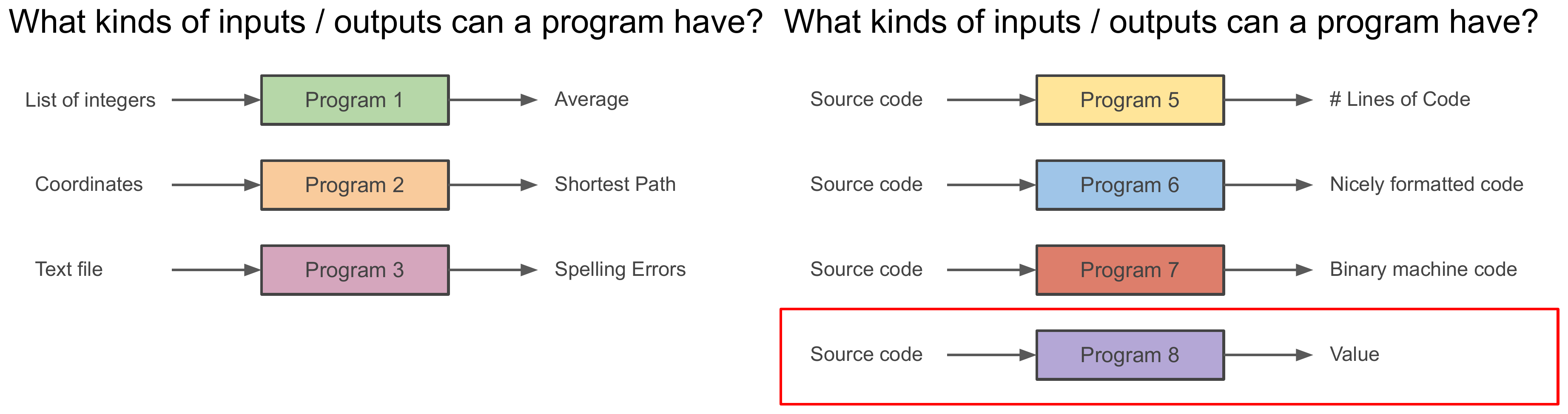
We often picture a program as a box with an input and an output:
list of integers -> program -> average

coordinates      -> program -> shortest path

text file        -> program -> spelling errors
But the input can itself be source code.
For example:
source code -> program -> number of lines

source code -> program -> nicely formatted source code

source code -> program -> machine code

source code -> program -> value
Those middle programs include tools you already know:
- a formatter takes source code and produces reformatted source code,
- a compiler takes source code and produces lower-level code,
- an interpreter takes a representation of code and evaluates it.
This motivates the central idea:
If we can represent source code as data, then programs can inspect it, transform it, translate it, format it, analyze it, or execute it.
But saying "code is data" leaves an important design question:
What data structure should represent the code?
Before answering that, we need some vocabulary.
Gradescope question: Representing arithmetic expressions
Submit this response on Gradescope.
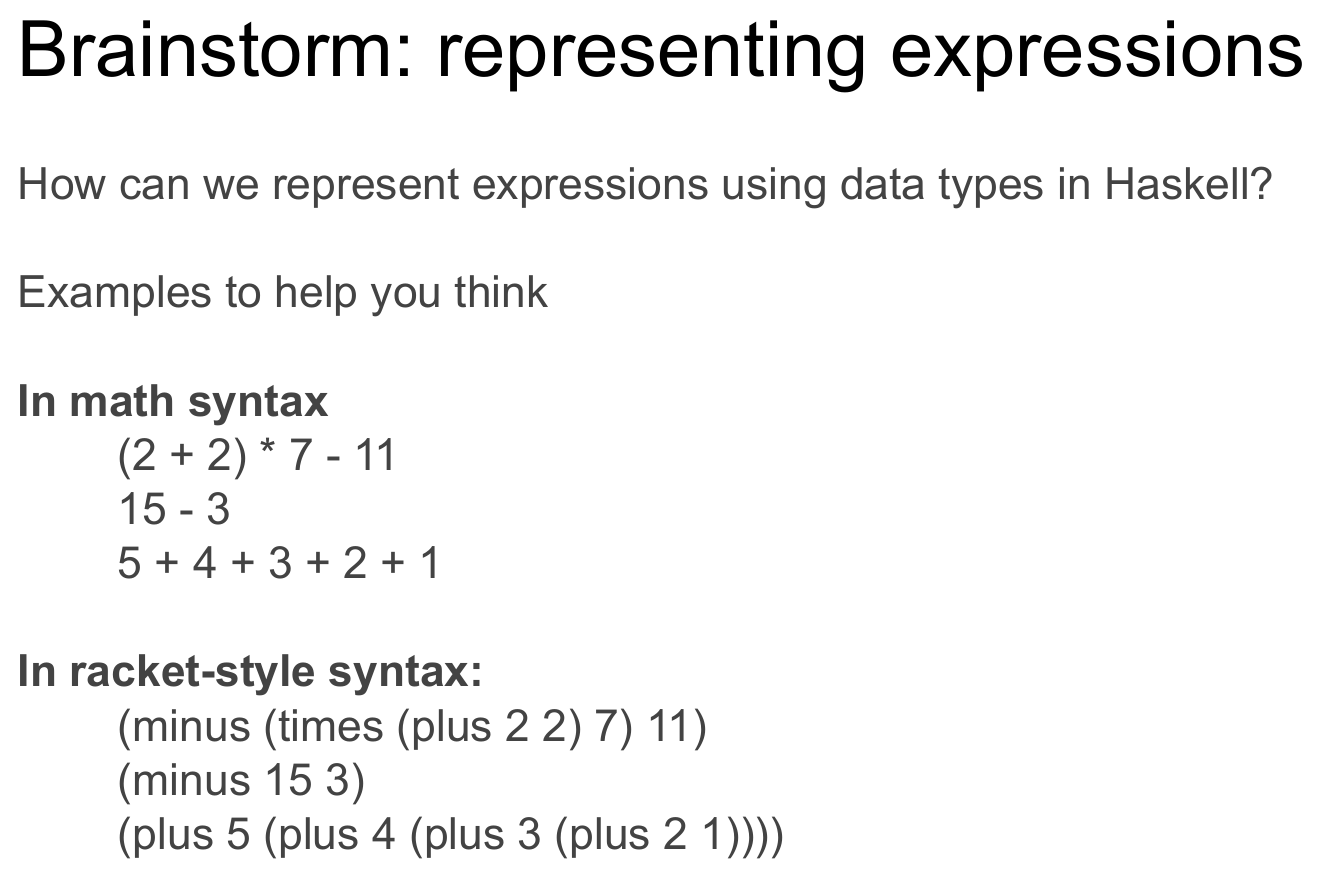
How can you represent arithmetic expressions using Haskell data types?
You do not need to have the final representation yet. Brainstorm a plausible design based on what you learned about Haskell data types in Module 03.2.
Here are some expressions to keep in mind while you think:
(2 + 2) * 7 - 11
15 - 3
5 + 4 + 3 + 2 + 1
Or, in a prefix / Racket-style notation:
(minus (times (plus 2 2) 7) 11)
(minus 15 3)
(plus 5 (plus 4 (plus 3 (plus 2 1))))
Do not worry yet about whether your proposed representation is ideal. We will build one carefully later.
Expressions, Statements, and Side Effects
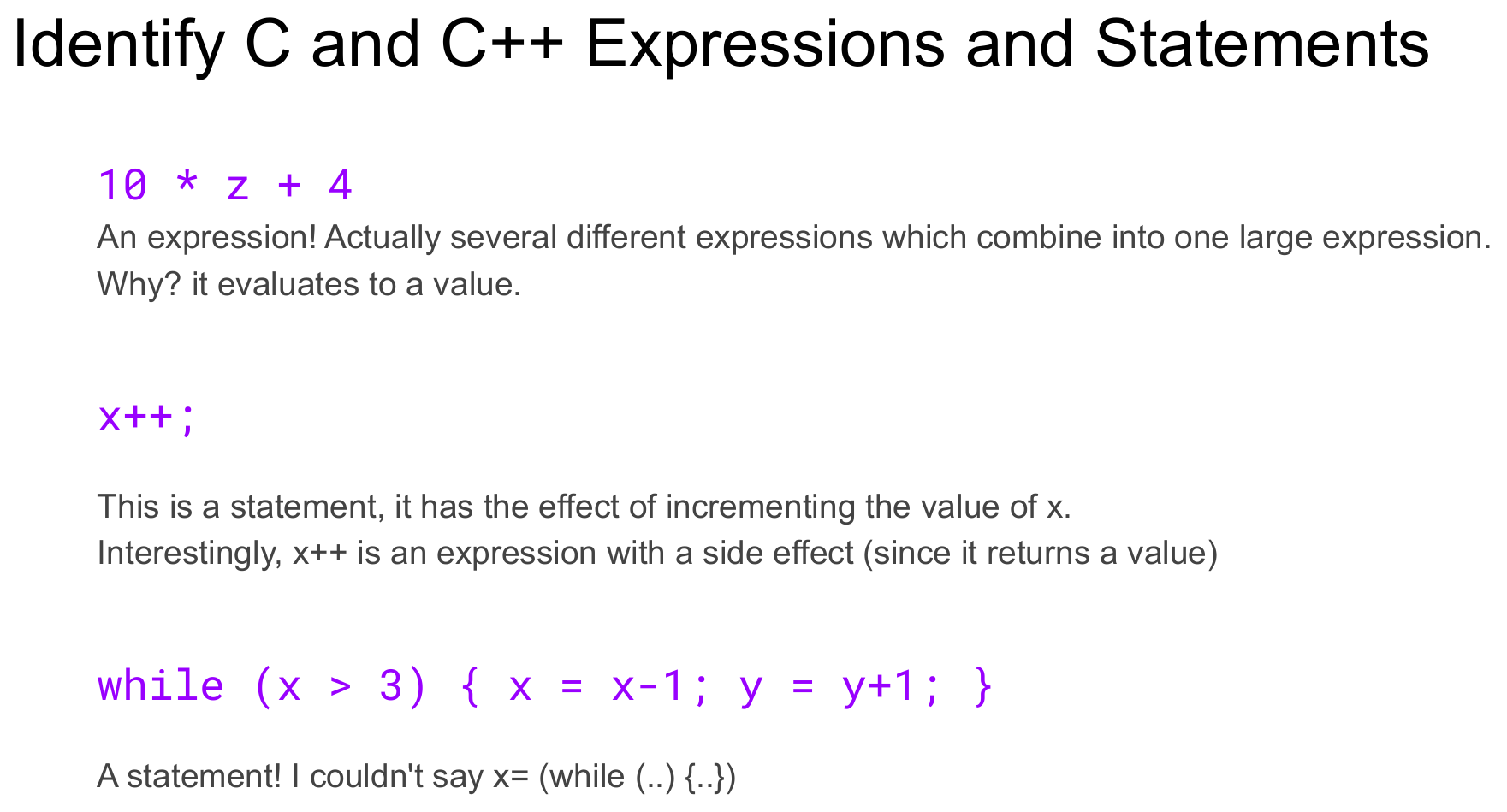
When we talk about evaluating code, the word expression matters.
Expression
An expression is a computation that calculates a value.
For example:
10 * z + 4
is an expression. So are its pieces:
10
z
4
10 * z
Each one can be evaluated to produce a value.
In functional programming, computation is largely described as evaluating expressions.
Statement
A statement is a computation performed primarily for its effect on the state of the program.
For example:
while (x > 3) {
    x = x - 1;
    y = y + 1;
}
changes program state. The loop is something we execute, but the loop itself is not a value that can be inserted into a larger arithmetic expression.
In an imperative language, computation is often described as executing a sequence of statements.
Side effect
A side effect is something a computation does besides producing its value, such as modifying mutable state or performing input/output.
For our purposes in this part of the course, the important contrast is:
functional style:   evaluate expressions to values

imperative style:   execute statements that change state
A small Haskell precision
We have been working almost entirely with pure Haskell functions, where evaluating the same expression does not secretly mutate ordinary program state.
Haskell can still perform input/output and other effects, but it represents and controls those effects explicitly rather than allowing arbitrary hidden side effects inside ordinary pure functions. We will not need the machinery for that distinction here.
Sometimes the line blurs
C and C++ give us an instructive example:
x++;
It certainly has an effect: it changes x.
But the expression x++ also has a value. For post-increment, that value is the old value of x, before the increment.
So the same piece of code can be both:
- an expression, because it has a value, and
- used as a statement, because we may execute it just for its effect.
That is a useful reminder that "expression" and "statement" describe language constructs and their roles, not simply two visual shapes of code.
Gradescope question: Expression or statement?
Submit this response on Gradescope.
In C++, is the code
int x = 100;
an expression, a statement, or both?
- A. Expression
- B. Statement
- C. Both
After you answer
In C++, this is a declaration statement. It creates and initializes a variable, but the declaration itself does not evaluate to a value that can be used as a subexpression.
Syntax and Semantics
Two of the most important words in programming languages are syntax and semantics.
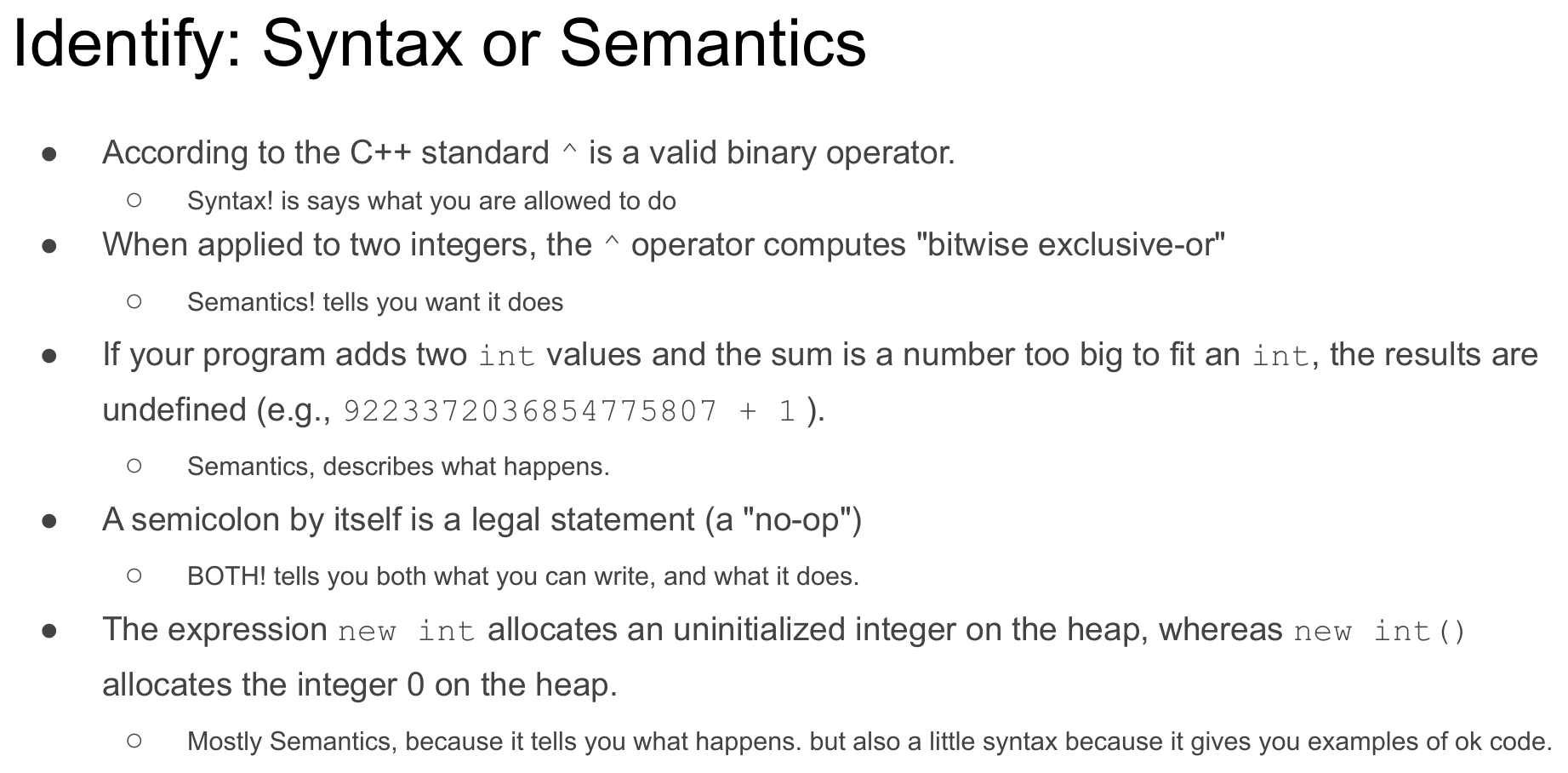
Syntax
Syntax describes what a programmer is allowed to write and how those written pieces may be arranged.
For example:
According to the C++ grammar, `^` is a valid binary operator.
This is a claim about syntax. It tells us that a certain symbol may occur in a certain grammatical position.
Syntax answers questions such as:
- Which tokens and keywords exist?
- Where may they appear?
- Which strings count as valid programs?
- How are pieces grouped?
Semantics
Semantics describes what valid code means or does.
For example:
When applied to two integers in C++, `^` computes bitwise exclusive-or.
That is a semantic claim. The character ^ could have been assigned a different meaning. The language gives that syntax this semantics.
Another semantic fact might say what happens if an integer computation overflows, or what storage is allocated by a particular construct.
A programming language therefore needs both:
syntax      what can I write?
semantics   what does it mean?
Gradescope question: Syntax, semantics, or both?
Submit this response on Gradescope.
Is this statement about syntax, semantics, or both?
A semicolon by itself is a legal statement, a "no-op" which performs no computation.
- A. Syntax
- B. Semantics
- C. Both
After you answer
It is both.
"A semicolon by itself is a legal statement" tells us something about what may be written: syntax.
"It performs no computation" tells us what that construct does: semantics.
Gradescope question: Syntax, semantics, or both?
Submit this response on Gradescope.
Is this statement about syntax, semantics, or both?
The expression
new intallocates an uninitialized integer on the heap, whereasnew int()allocates the integer0on the heap.
- A. Syntax
- B. Semantics
- C. Both
After you answer
The important information here is semantic: the statement is primarily telling us what the two constructs do.
It necessarily also shows us two pieces of valid concrete syntax, but the distinction being explained is a difference in behavior.
A few more examples classified the same way:
Attaching meaning to symbols
The syntax/semantics distinction is not peculiar to programming.
A symbol is not the same thing as what it denotes. The character sequence:
+
is only a mark until a language assigns it a role and meaning.
This connects programming-language semantics to questions in:
- linguistics,
- semiotics,
- philosophy of language,
- philosophy of mind,
- artificial intelligence,
- aesthetics and representation.
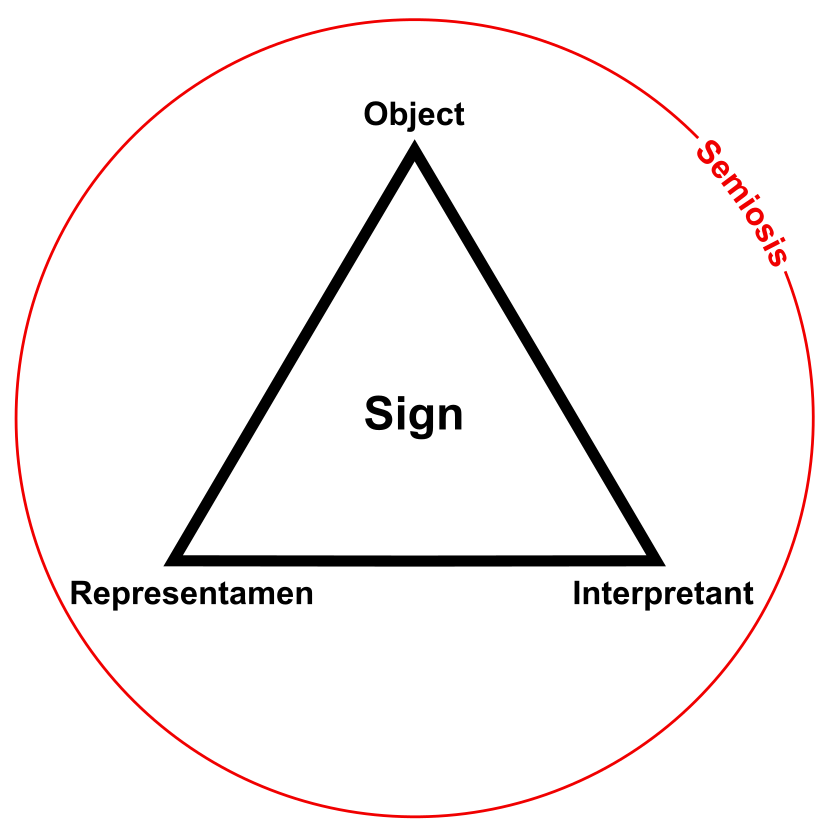
This connects to René Magritte's The Treachery of Images ("This is not a pipe"), the semiotic triangle, the symbol grounding problem, and the physical symbol system hypothesis.
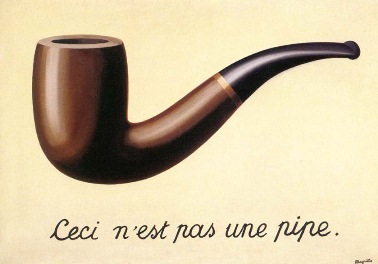
René Magritte, The Treachery of Images (1929). © the artist's estate; reproduced here at low resolution for educational commentary.
You do not need those philosophical ideas in order to implement an interpreter. But they make the underlying distinction vivid:
The representation is not the thing represented, and syntax is not semantics.
Concrete Syntax and Abstract Syntax
"Syntax" itself has two useful levels.
Concrete syntax
Concrete syntax is what the programmer actually writes.
It includes things such as:
- characters and tokens,
- keywords,
- punctuation,
- legal identifiers,
- parentheses,
- operator precedence,
- rules for resolving ambiguity.
For example:
(4 + 2) * 7
is concrete syntax.
A grammar describes which concrete strings are legal and how they are structured.
Abstract syntax
Abstract syntax keeps the essential structural information while discarding concrete details that are no longer needed.
We can represent the same expression as a tree:
        *
       / \
      +   7
     / \
    4   2
The tree already tells us that 4 + 2 happens as one subexpression before it is multiplied by 7.
We no longer need parentheses to communicate grouping. The shape of the tree records it.
That tree is an abstract syntax tree, usually abbreviated AST.
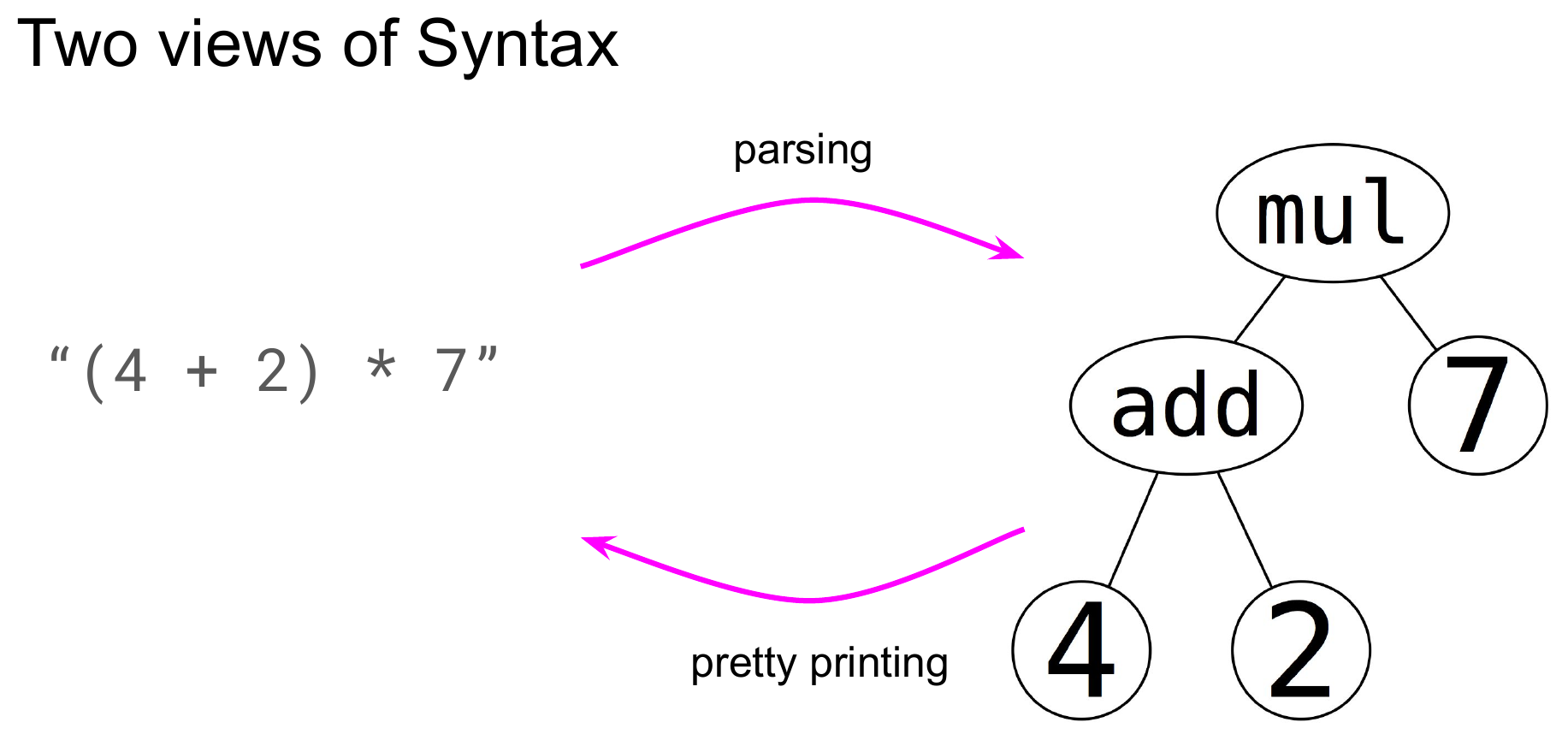
Different concrete syntax can describe the same abstract structure
Different languages can express the very same underlying logic with entirely different concrete syntax:
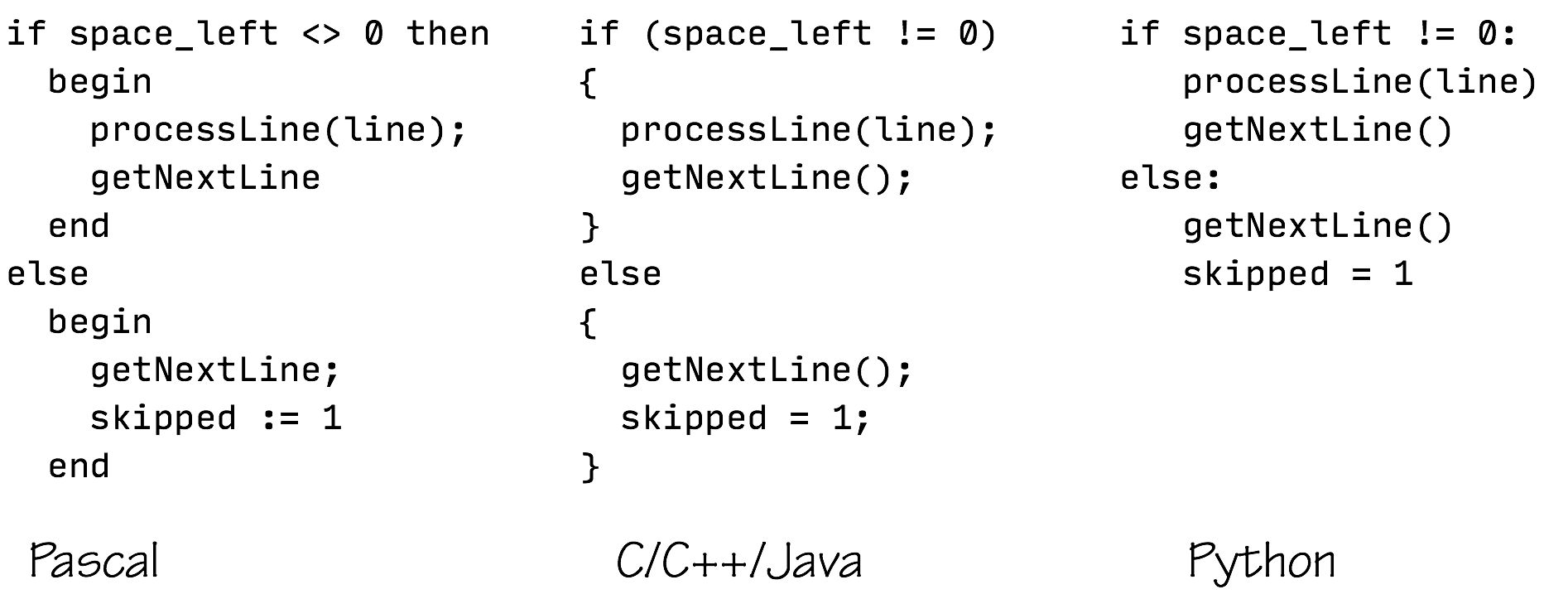
The keywords, punctuation, and layout differ across all three. But the underlying structure — an if/else with the same two branches — is identical.
This is why an interpreter or compiler usually does not want to manipulate raw strings forever. A tree gives us a representation where the relevant structure is explicit.
One Tree, Many Concrete Representations
Here is a more substantial abstract syntax tree.
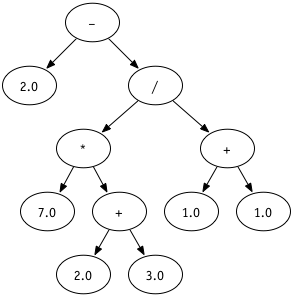
Gradescope question: Write concrete syntax for an AST
Submit this response on Gradescope.
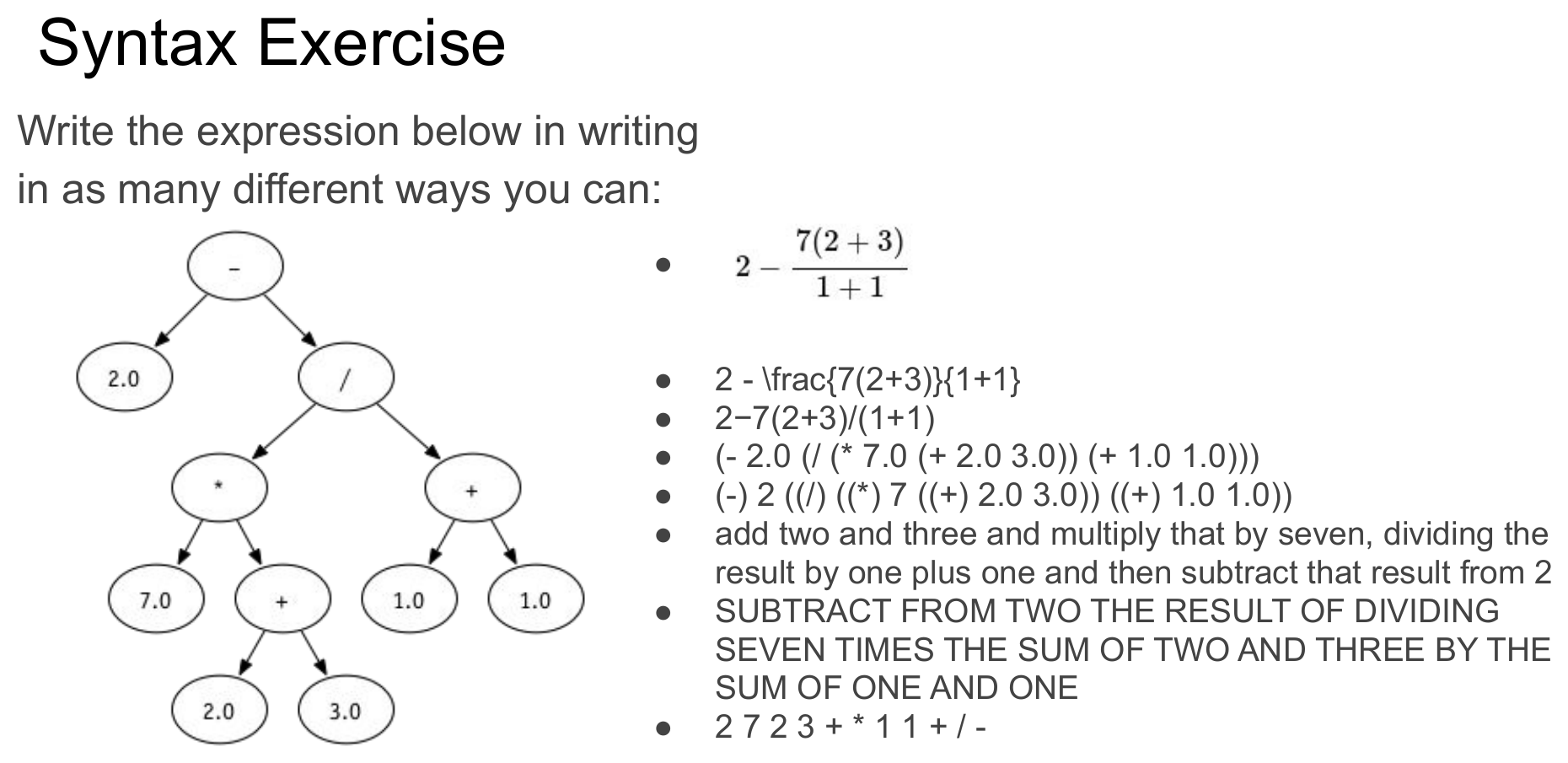
Write concrete syntax for the abstract syntax tree shown above in as many different ways as you can.
There is no single required notation. Possible representations include ordinary mathematical notation, programming-language notation, prefix notation, postfix notation, or even carefully written English.
For example, the same tree can be written as:
2 - 7(2 + 3) / (1 + 1)
or in an S-expression-style prefix form:
(- 2.0
   (/ (* 7.0 (+ 2.0 3.0))
      (+ 1.0 1.0)))
or in postfix notation:
2 7 2 3 + * 1 1 + / -
or in English:
subtract from two the result of dividing seven times the sum of two and three by the sum of one and one
The surface forms differ dramatically. The underlying tree is the same.
A fuller reveal, once you've tried it yourself
Parsing and Pretty Printing
The "Two views of Syntax" diagram above gives us two directions between concrete and abstract syntax:
source string  ---- parsing ---->  abstract syntax tree

source string  <--- formatting --- abstract syntax tree
More precisely:
- parsing turns concrete syntax into structured abstract syntax,
- formatting or pretty printing turns abstract syntax into readable concrete syntax.
We will study parsing in much more detail later. For now, the important point is that these transformations are not equally difficult.
Why parsing is harder
If you already have an AST, its structure is explicit. A formatter can recursively walk the tree and choose how to print each constructor.
A parser begins with a linear sequence of characters or tokens and has to reconstruct that hidden structure.
It may have to answer questions such as:
- Which operator binds more tightly?
- Is an identifier a variable, function name, type name, or something else?
- Where does one subexpression end?
- Are parentheses required here, or merely optional?
- Is the input syntactically valid at all?
- If there are several possible parses, which one is intended?
That is much more information to recover.
Gradescope question: Why is parsing harder?
Submit this response on Gradescope.
Can you think of some reasons why parsing is harder than formatting?
Are parsing and formatting inverses?
This question has an important asymmetry.
Suppose:
parse   :: String -> AST
format  :: AST -> String
Should we expect:
format (parse inputString) == inputString
and:
parse (format ast) == ast
?
Gradescope question: Should parsing and formatting be inverses?
Submit this response on Gradescope.
Do you think formatting and parsing should be inverses?
Remember:
- parsing takes a string and gives back an abstract syntax tree,
- formatting takes an abstract syntax tree and gives back a string.
So should it be the case that:
format(parse(input_string)) == input_string
and:
parse(format(abstract_syntax_tree)) == abstract_syntax_tree
?
After you answer: the two directions are different
We often do want:
parse (format ast) == ast
because formatting an AST and parsing the result should ideally recover the same abstract structure.
But we usually should not expect:
format (parse source) == source
character-for-character.
Parsing intentionally discards concrete details. These may include whitespace, redundant parentheses, comments, or stylistic choices. The formatter may then choose one canonical way to print the same structure.
For example, both:
(4+2)*7
and:
( 4 + 2 ) * 7
might parse to the same AST. A formatter cannot reconstruct which spacing the programmer originally used if that information was deliberately discarded.
This distinction is another consequence of abstract syntax being abstract: it forgets some concrete information on purpose.
How Should We Represent an AST in Haskell?
Now we are ready to return to the question from the beginning:
How can we represent arithmetic expressions as Haskell data?
We will use the data-type design skills from Module 03.2.
There are several plausible answers. Comparing them is useful because the representation determines how easy later functions will be to write.
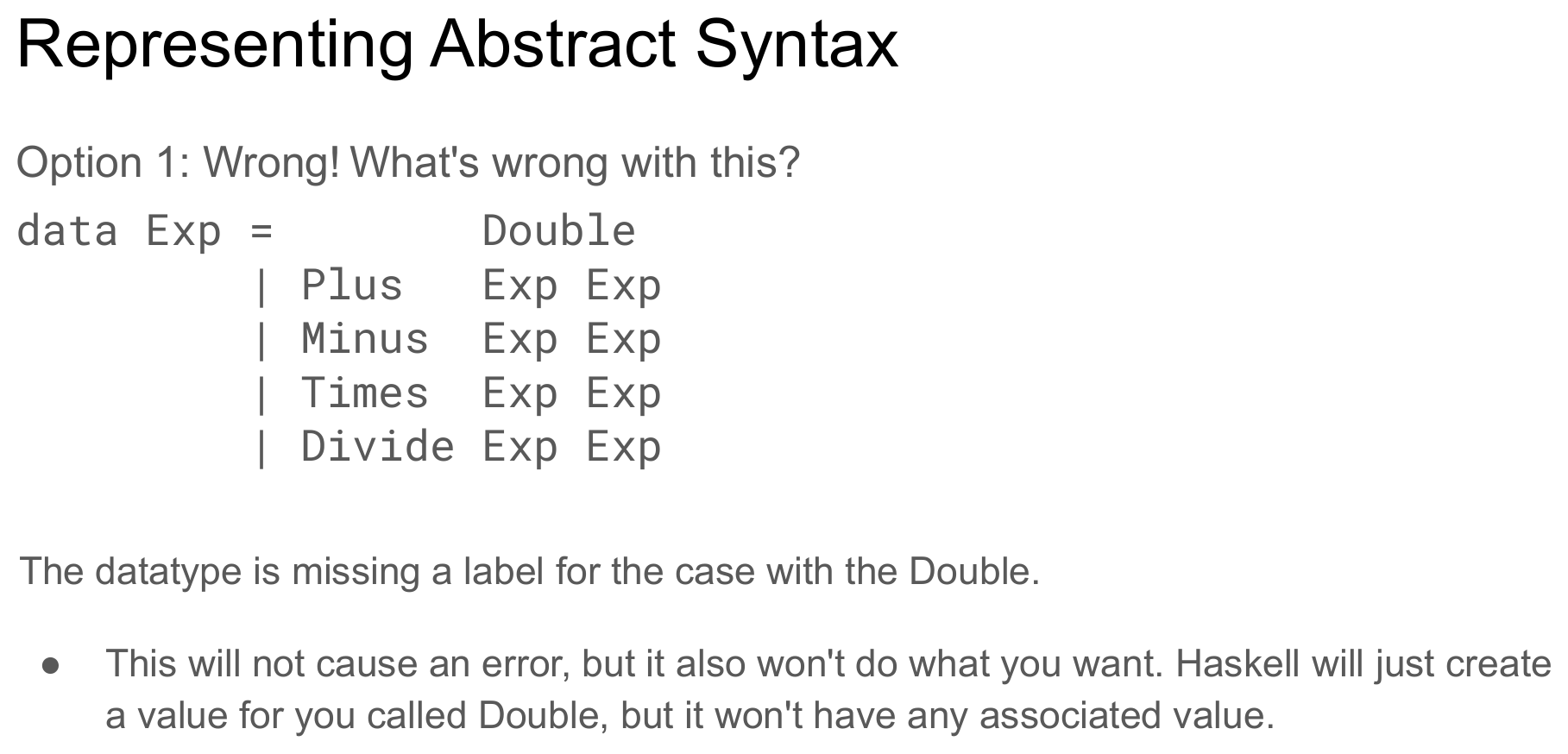
Attempt 1: A Constructor Named Double
Here is a tempting first attempt:
data Exp
  = Double
  | Plus   Exp Exp
  | Minus  Exp Exp
  | Times  Exp Exp
  | Divide Exp Exp
This is valid Haskell, but it does not mean what we want.
The name Double here is just a constructor name. It carries no associated value.
So we could construct:
Double
but not a particular numeric literal such as 3.14.
This is exactly the constructor/value distinction from Module 03.2.
Attempt 2: One Constructor per Arithmetic Operator
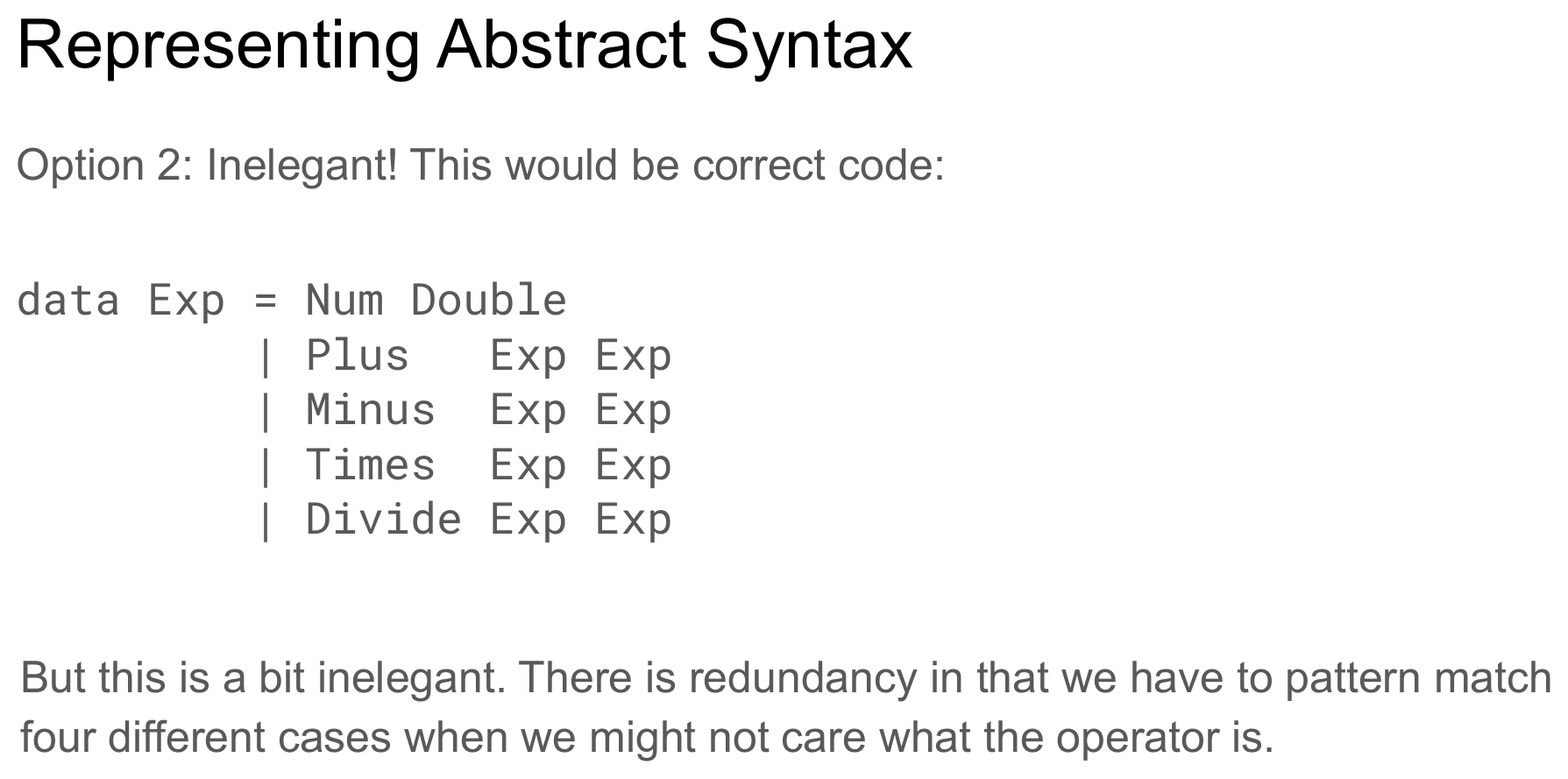
We can fix the number case:
data Exp
  = Num    Double
  | Plus   Exp Exp
  | Minus  Exp Exp
  | Times  Exp Exp
  | Divide Exp Exp
This representation works.
For example:
Times
  (Plus (Num 4) (Num 2))
  (Num 7)
can represent:
(4 + 2) * 7
So why not stop here?
Because the four binary-operation constructors have exactly the same structural shape:
Exp -> Exp -> Exp
If we later write some function that treats all binary operations similarly, we may have to repeat nearly identical cases four times.
This is not incorrect. It is a representation with some redundancy.
Attempt 3: Separate Operators from Expression Structure
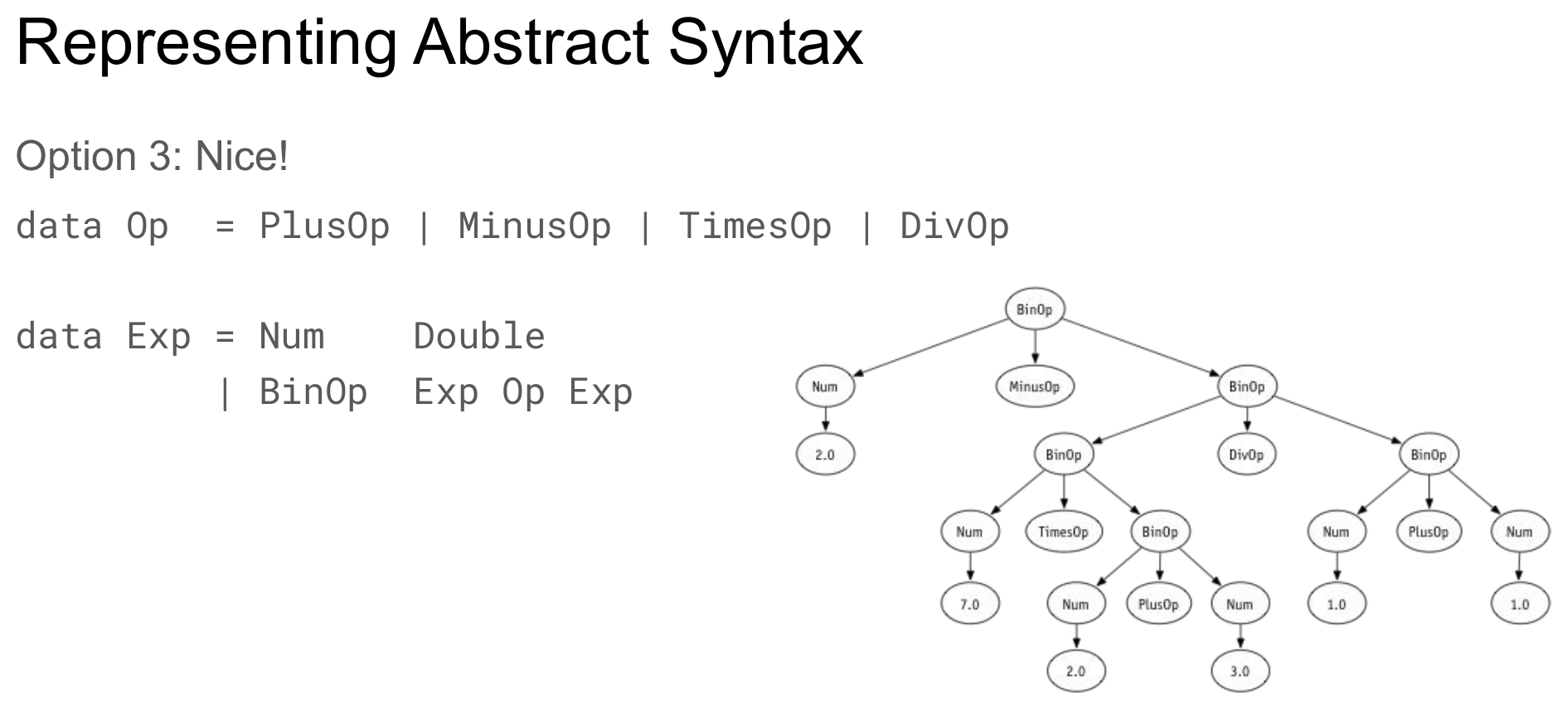
We can factor out what varies:
data Op
  = PlusOp
  | MinusOp
  | TimesOp
  | DivOp
  deriving (Show, Eq)

data Exp
  = Num Double
  | BinOp Exp Op Exp
  deriving (Show, Eq)
Now every binary arithmetic expression has the same outer shape:
BinOp left operator right
and the particular operator is itself a piece of data.
For example:
BinOp
  (BinOp (Num 4) PlusOp (Num 2))
  TimesOp
  (Num 7)
represents:
(4 + 2) * 7
This version is concise, recursive, and easy to traverse.
It is the representation we will use.
Attempt 4: Why Not Store the Operator as a String?
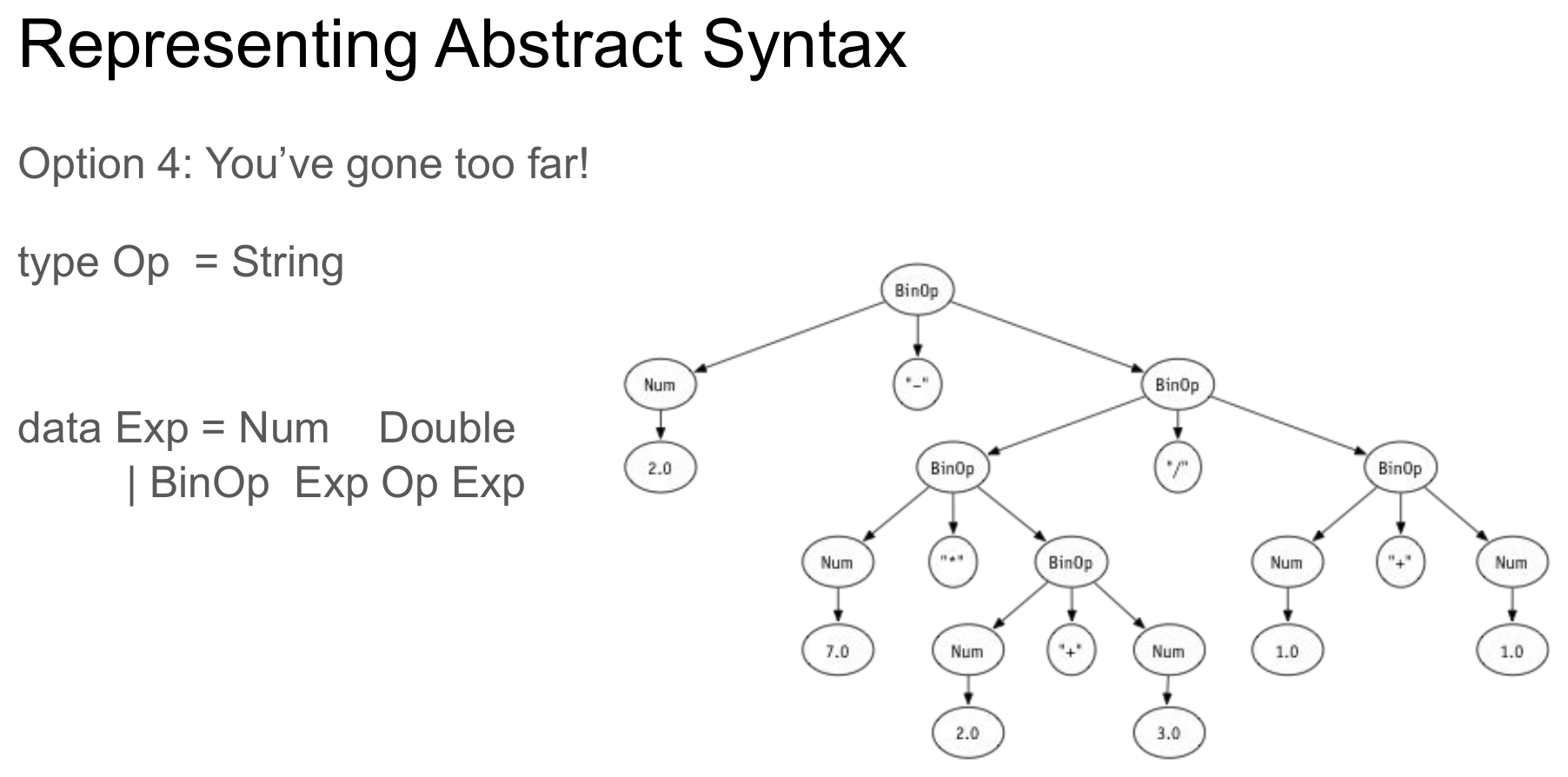
What about:
type Op = String

data Exp
  = Num Double
  | BinOp Exp Op Exp
This looks even simpler.
But it makes invalid states easy to construct:
BinOp (Num 1) "banana" (Num 2)
or:
BinOp (Num 1) "please explode" (Num 2)
A separate Op datatype limits the possible operator values to the ones our language actually supports.
Compare:
data Op = PlusOp | MinusOp | TimesOp | DivOp
Now every Op value is a valid operator by construction.
This is a useful design principle:
If a data type can rule out impossible or meaningless values, let it.
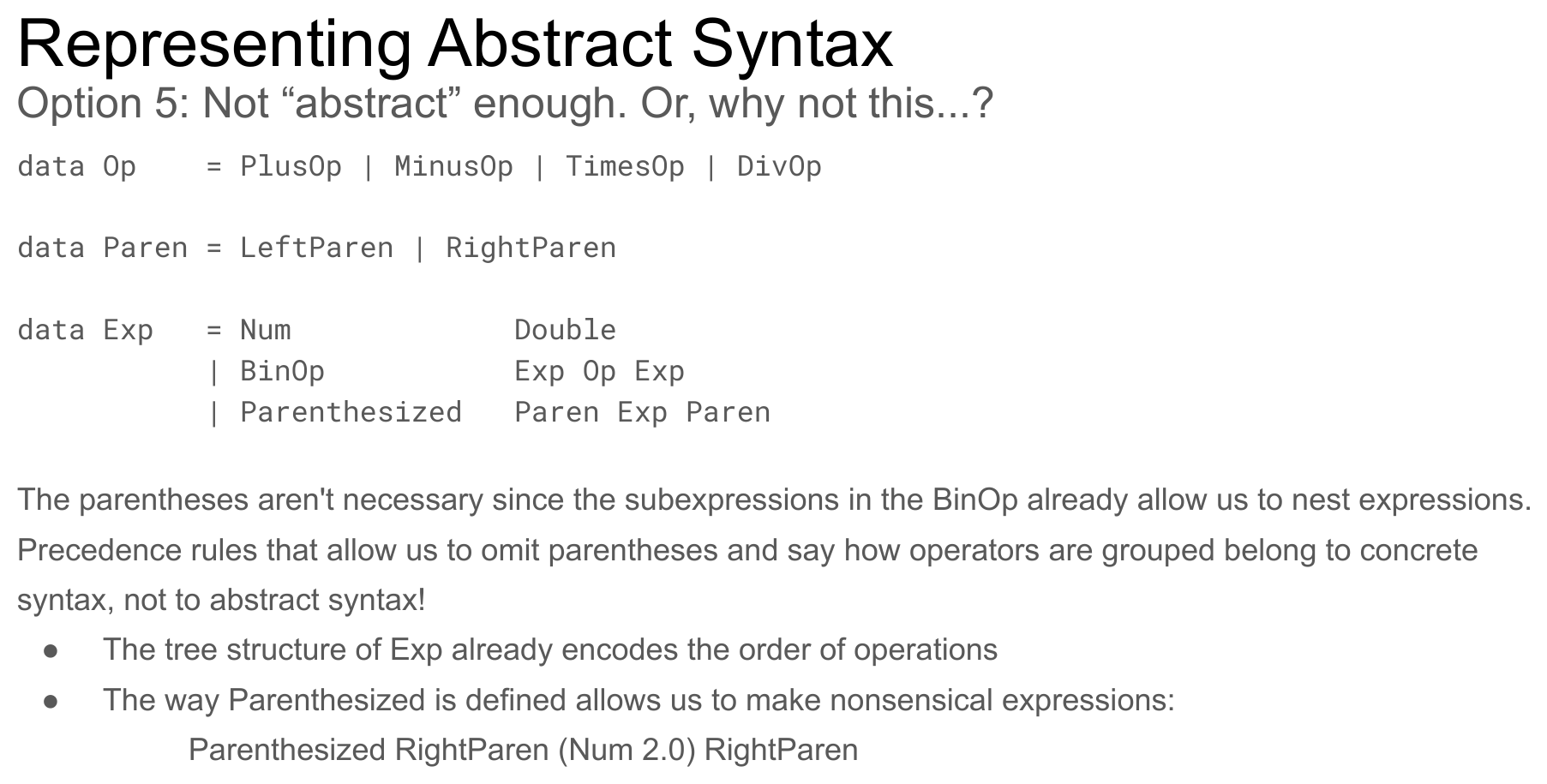
Attempt 5: Should Parentheses Be in the AST?
One more possibility:
data Op
  = PlusOp
  | MinusOp
  | TimesOp
  | DivOp

data Paren
  = LeftParen
  | RightParen

data Exp
  = Num Double
  | BinOp Exp Op Exp
  | Parenthesized Paren Exp Paren
This seems faithful to the source code.
But that is exactly the problem: it is faithful to concrete syntax, not abstract syntax.
Parentheses are used in concrete syntax to tell us how things group. Once we have already built the tree, grouping is encoded structurally.
For example, these two ASTs are different:
BinOp
  (BinOp (Num 4) PlusOp (Num 2))
  TimesOp
  (Num 7)
BinOp
  (Num 4)
  PlusOp
  (BinOp (Num 2) TimesOp (Num 7))
No parentheses are needed. The tree tells us whether we mean:
(4 + 2) * 7
or:
4 + (2 * 7)
The proposed Parenthesized constructor also permits nonsense such as:
Parenthesized RightParen (Num 2.0) RightParen
Abstract syntax should ideally retain what matters and discard what does not.
The Representation We Will Use
Our little arithmetic language is therefore:
data Op
  = PlusOp
  | MinusOp
  | TimesOp
  | DivOp
  deriving (Show, Eq)

data Exp
  = Num Double
  | BinOp Exp Op Exp
  deriving (Show, Eq)
The type Exp is recursive:
BinOp :: Exp -> Op -> Exp -> Exp
A binary expression contains two smaller expressions.
That means functions over Exp will naturally be recursive, just like functions over lists and trees.
This should feel familiar:
List:
    []            base case
    x : xs        recursive case

Exp:
    Num x         base case
    BinOp l op r  recursive case
The structure of the data tells us the structure of the function.
How Would Another Language Represent the Tree?
Before writing our Haskell traversal, it is useful to connect this representation to languages you already know.
Gradescope question: Representing and traversing an AST outside Haskell
Submit this response on Gradescope.
Can you describe in words what code would look like in C++, Java, or Python to represent an abstract syntax tree and then traverse it?
You might imagine, for example:
- a base
Expressionclass, - subclasses such as
NumberandBinaryOperation, - fields for child expressions,
- perhaps an enum for the operator,
- a recursive method or function that visits child nodes.
The details vary, but the core data structure is still a tree.
Haskell's algebraic data types and pattern matching simply give us a particularly direct way to describe and traverse that tree.
Pretty Printing: AST to Concrete Syntax
Once code is represented as a tree, we can write ordinary functions over it.
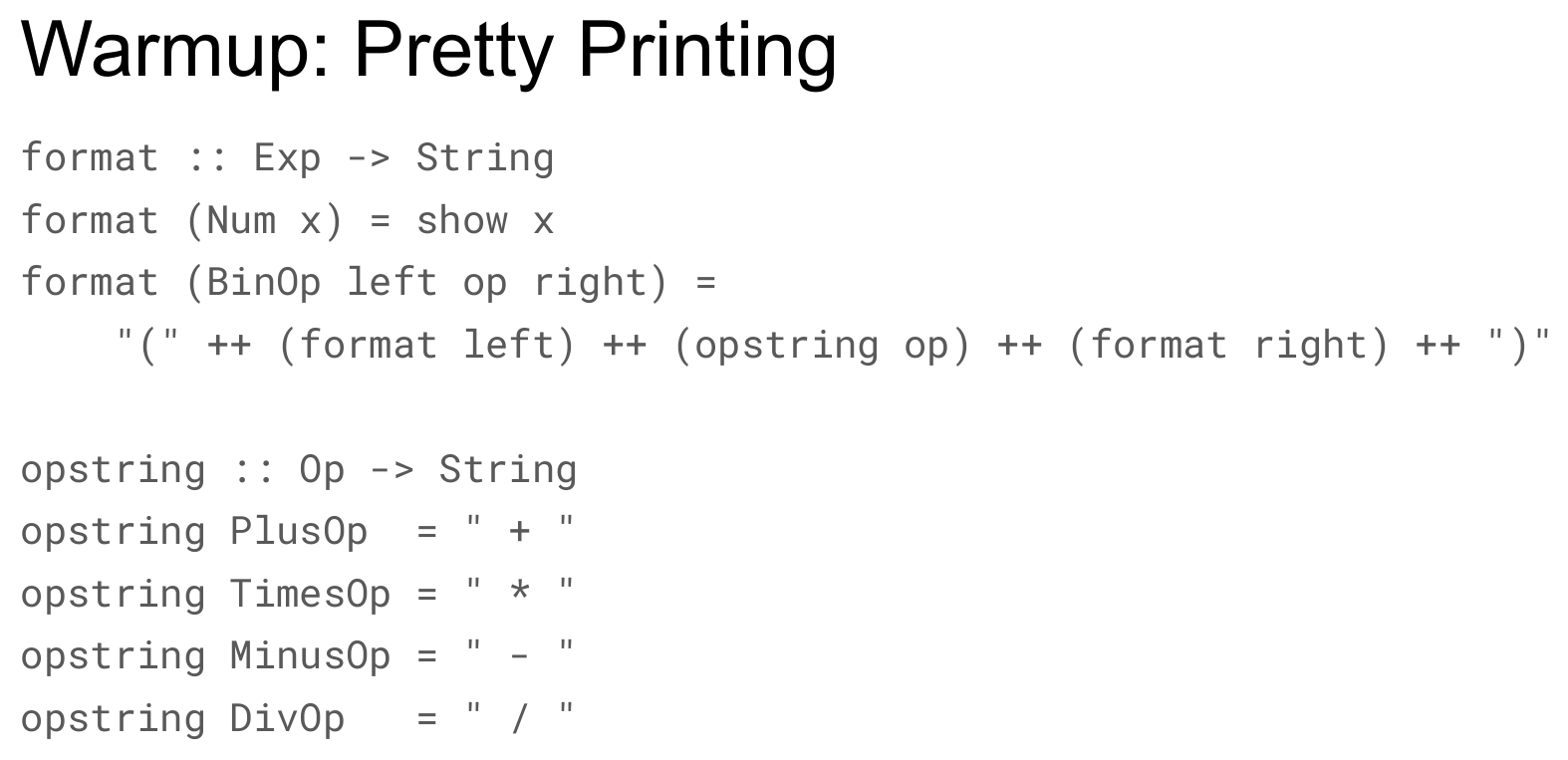
One useful function turns our Exp back into a string:
format :: Exp -> String
This is a formatter or pretty printer.
Start with the base case:
format (Num x) = show x
A numeric leaf just becomes its textual representation.
For a binary operation:
format (BinOp left op right) =
  "(" ++ format left ++ opString op ++ format right ++ ")"
and:
opString :: Op -> String
opString PlusOp  = " + "
opString MinusOp = " - "
opString TimesOp = " * "
opString DivOp   = " / "
Notice the recursion:
format this expression
    =
format the left subtree
    +
format the operator
    +
format the right subtree
The data is recursive, so the formatter is recursive.
Example
Suppose:
e =
  BinOp
    (BinOp (Num 4) PlusOp (Num 2))
    TimesOp
    (Num 7)
Then:
format e
produces something like:
"((4.0 + 2.0) * 7.0)"
Our simple formatter uses parentheses generously. That is okay. Its job is to produce an unambiguous readable representation, not necessarily the shortest one.
Evaluation: Giving the Syntax Meaning
Now we get to semantics.
The Exp value:
BinOp
  (BinOp (Num 4) PlusOp (Num 2))
  TimesOp
  (Num 7)
is just structured data.
To make it mean arithmetic, we write an evaluator:
eval :: Exp -> Double
For a number:
eval (Num x) = x
A numeric literal evaluates to its numeric value.
For binary operations:
eval (BinOp left PlusOp right) =
  eval left + eval right

eval (BinOp left MinusOp right) =
  eval left - eval right

eval (BinOp left TimesOp right) =
  eval left * eval right

eval (BinOp left DivOp right) =
  eval left / eval right
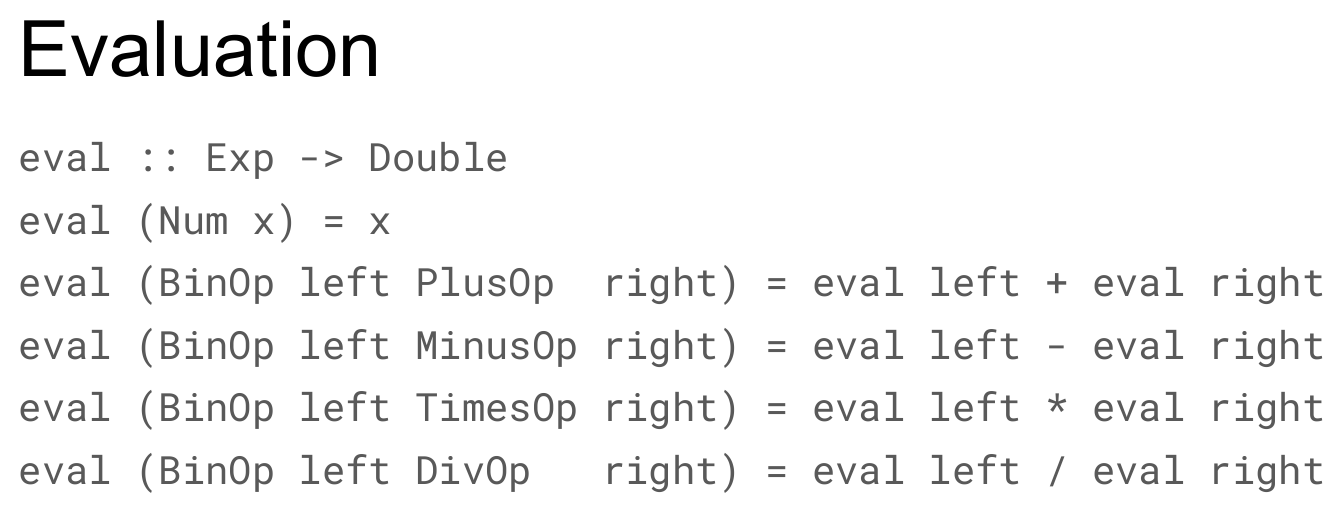
This tiny function is an interpreter for our tiny arithmetic language.
That is worth pausing over.
The constructors:
Num
BinOp
PlusOp
MinusOp
TimesOp
DivOp
define the abstract syntax of our language.
The function:
eval
assigns a meaning to that syntax.
So we now have a concrete version of the earlier distinction:
syntax:
    what expressions can be represented?

semantics:
    what value does each expression mean?
The tree tells the evaluator what to do
Consider:
e =
  BinOp
    (BinOp (Num 4) PlusOp (Num 2))
    TimesOp
    (Num 7)
Evaluation proceeds recursively:
eval ((4 + 2) * 7)

= eval (4 + 2) * eval 7
= (eval 4 + eval 2) * 7
= (4 + 2) * 7
= 6 * 7
= 42
We do not need explicit parentheses stored in the AST. The tree already tells eval which subexpressions belong together.
Two Traversals, Same Tree
Compare:
format :: Exp -> String
with:
eval :: Exp -> Double
Both recursively traverse exactly the same tree.
But they interpret that structure differently.
format turns:
Num 4
into:
"4.0"
while eval turns it into:
4.0
For a BinOp, both functions recursively process the children and then combine the results:
format: combine Strings

eval:   combine Doubles
This is the same recursive-programming pattern you have already seen with lists and trees.
The major conceptual shift is that the tree now represents code.
A larger example
Let:
bigExp :: Exp
bigExp =
  BinOp
    (BinOp
      (BinOp (Num 2.0) PlusOp (Num 3.0))
      TimesOp
      (BinOp (Num 5.0) MinusOp (Num 8.0)))
    MinusOp
    (Num 0.5)
The tree represents:
((2 + 3) * (5 - 8)) - 0.5
format bigExp walks the entire tree and reconstructs readable concrete syntax.
eval bigExp walks the same tree:
2 + 3    ->   5
5 - 8    ->  -3
5 * -3   -> -15
-15 - .5 -> -15.5
No matter how deeply nested the expression becomes, we do not add new cases to eval. The same recursive definition handles every depth.
That is the payoff of choosing a recursive representation.
Adding Variables
Arithmetic consisting entirely of literal numbers is useful, but real programs contain names.
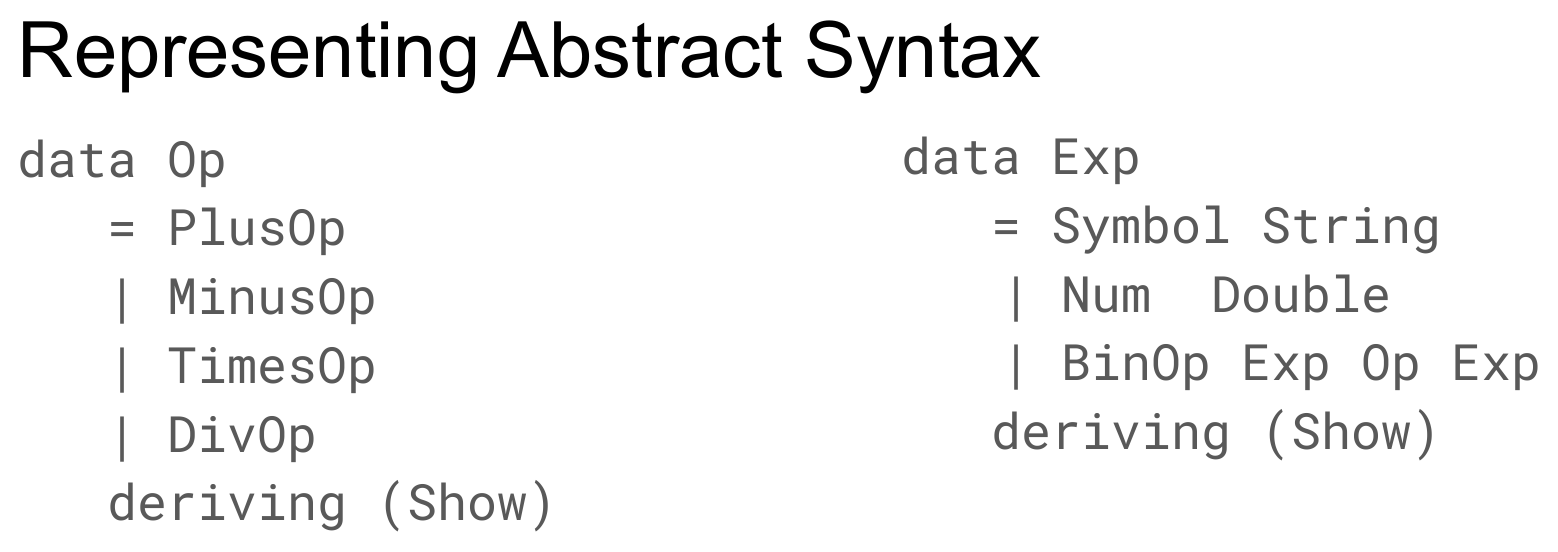
Let's extend the syntax:
data Exp
  = Symbol String
  | Num Double
  | BinOp Exp Op Exp
  deriving (Show, Eq)
Now we can represent:
x + 5
as:
BinOp (Symbol "x") PlusOp (Num 5)
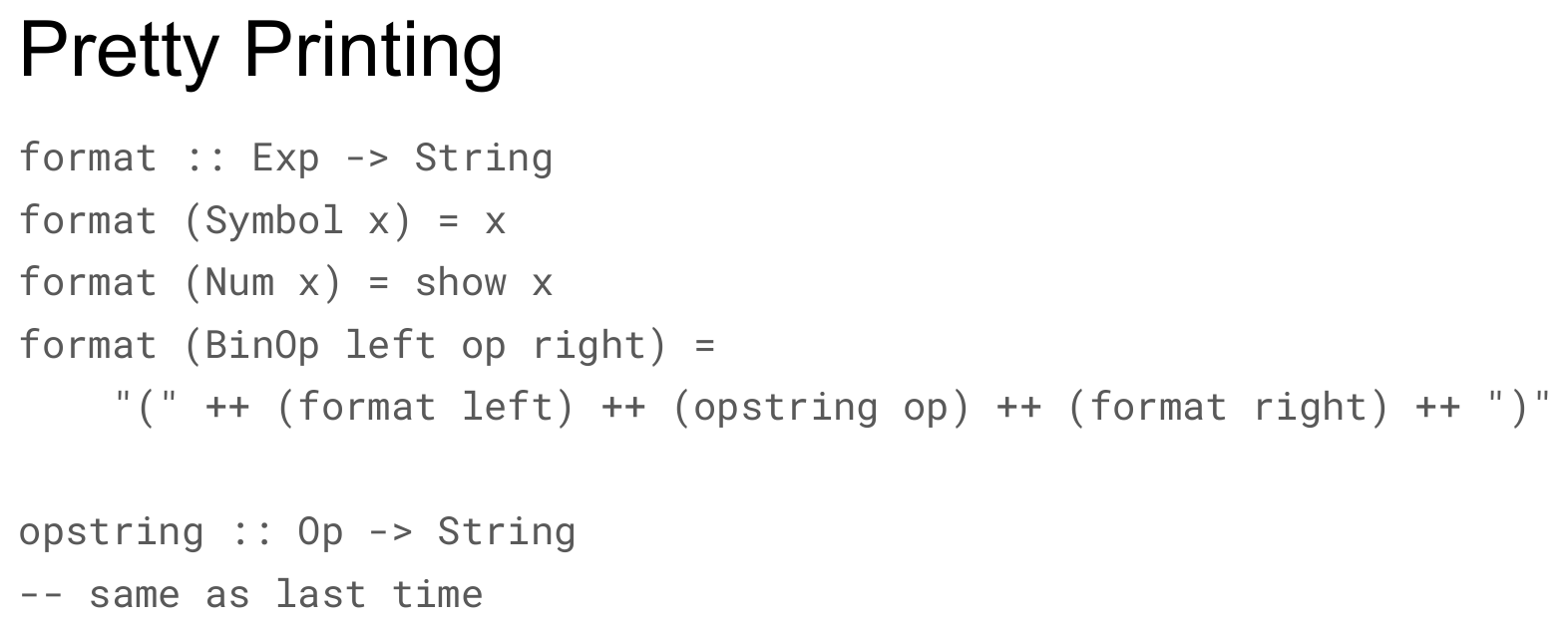
Pretty printing is easy to extend:
format :: Exp -> String
format (Symbol x) = x
format (Num x) = show x
format (BinOp left op right) =
  "(" ++ format left ++ opString op ++ format right ++ ")"
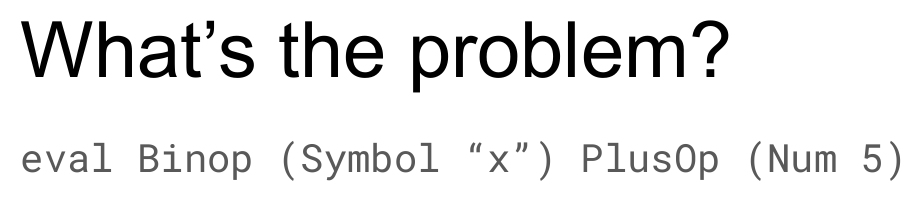
But evaluation has a new problem.
What is the value of:
Symbol "x"
?
The syntax alone does not tell us.
A Dictionary of Bindings
To evaluate a variable, we need some additional information that tells us what the name refers to.
The original module calls this a symbol dictionary:
type SymbolDictionary = [(Exp, Exp)]
For example, conceptually:
x -> 10
y -> x + 2
might be represented using pairs of expressions.
We can search the dictionary recursively:
symbolLookup :: Exp -> SymbolDictionary -> Exp
symbolLookup _ [] = undefined

symbolLookup symb ((key, val) : rest) =
  if symb == key
    then val
    else symbolLookup symb rest
Because we compare Exp values using ==, our Op and Exp definitions above derive Eq as well as Show.
![A slide titled "Evaluation with a symbol lookup" defining type SymbolDictionary = [(Exp, Exp)] and symbolLookup :: Exp -> SymbolDictionary -> Exp, with base case symbolLookup symb [] = undefined and recursive case symbolLookup symb ((key, val) : rest) = if symb == key then val else symbolLookup symb rest.](../img/04.1/symbol-dictionary-lookup.png)
This lookup function is just another recursive list function:
empty dictionary:
    not found

(key, value) : rest:
    if this key matches, return the value
    otherwise search the rest
Nothing about that recursion is special to interpreters. We are reusing the same structural reasoning from Module 03.1.
Evaluation with Variables
Our evaluator now needs both:
- the expression to evaluate,
- the dictionary telling us what symbols mean.
So its type becomes:
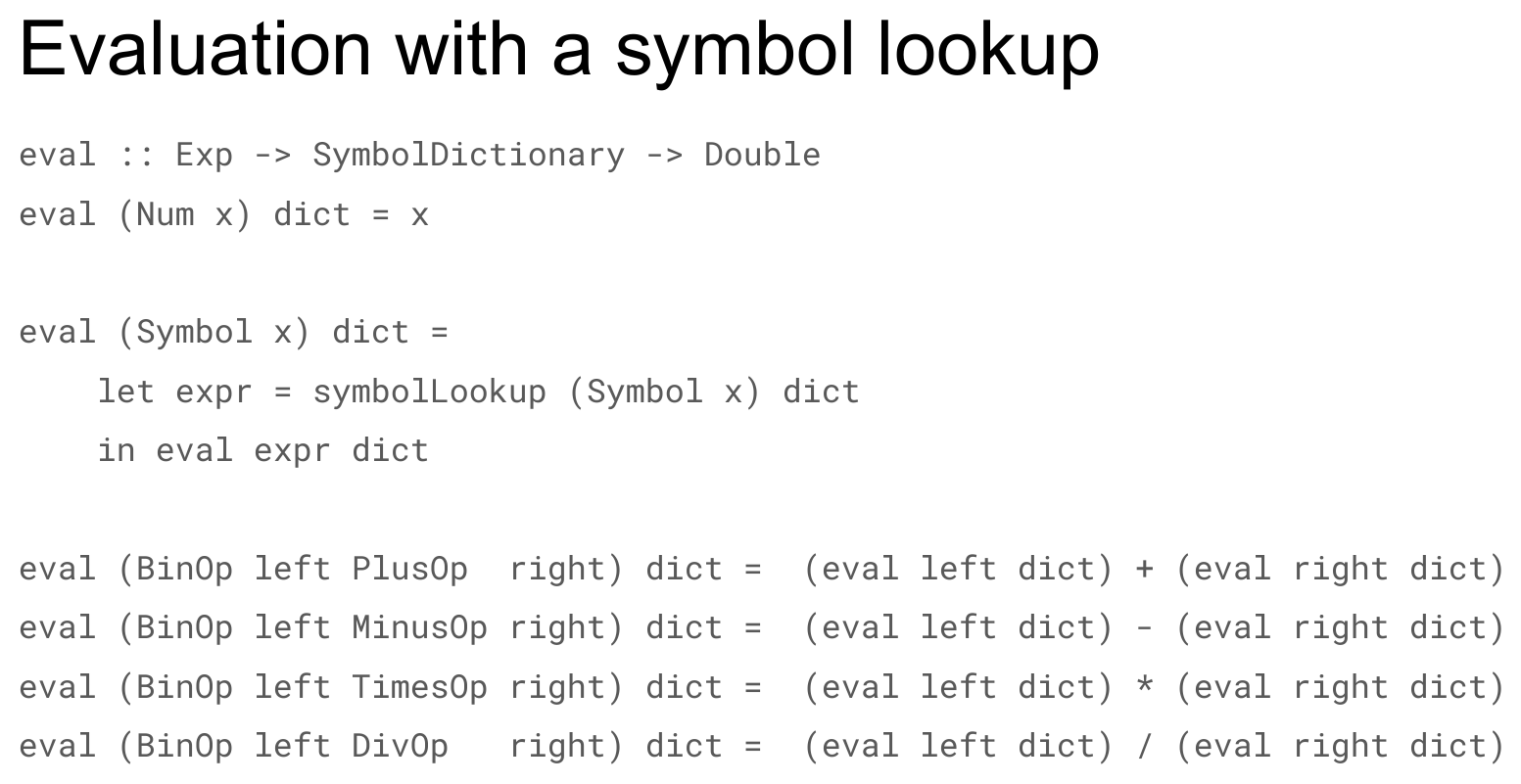
eval :: Exp -> SymbolDictionary -> Double
Numbers ignore the dictionary:
eval (Num x) _ = x
A symbol performs a lookup and then evaluates whatever expression it finds:
eval (Symbol x) dict =
  eval (symbolLookup (Symbol x) dict) dict
Binary operations recursively evaluate both children using the same dictionary:
eval (BinOp left PlusOp right) dict =
  eval left dict + eval right dict

eval (BinOp left MinusOp right) dict =
  eval left dict - eval right dict

eval (BinOp left TimesOp right) dict =
  eval left dict * eval right dict

eval (BinOp left DivOp right) dict =
  eval left dict / eval right dict
Notice an important new idea:
Evaluation now depends not only on the syntax tree, but also on some context telling us what names mean.
For now that context is just a list of key/value pairs.
Later, this idea becomes much more important. Interpreters need ways to keep track of bindings, scope, and environments. This little dictionary is our first version of that machinery.
One subtle but powerful detail
Suppose the dictionary says:
x -> y + 1
y -> 10
When eval encounters x, it does not merely expect the dictionary to contain a final Double.
It retrieves another expression:
y + 1
and recursively evaluates that expression using the same dictionary.
So code can refer to names whose meanings are themselves represented as code.
The boundary between "program" and "data structure" is disappearing quickly, which is exactly the point of the module.
Pulling the Main Ideas Together
There is a chain of ideas here that is worth seeing as one story.
1. Code can be input to a program
Formatters, compilers, interpreters, static analyzers, and many other tools operate on programs.
2. To manipulate code, we need a representation
A raw source string contains the program, but its important structure is not explicit.
3. Parsing exposes that structure
Parsing turns concrete syntax into an abstract syntax tree.
"(4 + 2) * 7"
       ↓ parsing
      AST
4. The AST is ordinary recursive data
In Haskell:
data Exp
  = Num Double
  | BinOp Exp Op Exp
looks structurally like every other recursive data type we have studied.
5. Ordinary recursive functions can process it
format :: Exp -> String
eval   :: Exp -> Double
Both are tree traversals.
6. An evaluator gives syntax semantics
The AST tells us what program we have.
eval tells us what that program means.
7. Variables require context
Once expressions contain names, evaluation needs some representation of what those names mean.
That leads us toward symbol tables, environments, scope, closures, and eventually richer interpreters.
A Compact Mental Model
Here is a useful picture to carry forward:
             concrete syntax
                  String
                    |
                 parse
                    v
              abstract syntax
                    Exp
                 /      \
             format      eval
               |           |
               v           v
             String      Double
Once variables appear:
              Exp + bindings
                    |
                   eval
                    v
                  value
The central move is the one in the middle:
Represent the program as structured data.
Once we do that, the skills you already have with data types, pattern matching, and recursion become programming-language tools.
Where This Leaves Us
You should now be comfortable distinguishing:
expression       statement
syntax           semantics
concrete syntax  abstract syntax
parsing          pretty printing
syntax tree      evaluation
And you should be able to explain the role of:
data Op
data Exp
format
eval
Symbol
SymbolDictionary
symbolLookup
The especially important connection is not a new piece of Haskell syntax. It is this:
A program can be represented as a recursive data structure, and an interpreter can be an ordinary recursive function over that structure.
The next modules build on exactly this foundation. As the language grows, the abstract syntax tree grows, and the evaluator grows with it. Variables will lead us toward bindings and environments; functions will force us to think carefully about scope and closures; and parsing will eventually let us turn source text into these data structures automatically.
Finish the Module 04.1 Completion
The existing Module 4.1 materials identify the following required completion questions, all of which appeared at their relevant points above:
- How can you represent arithmetic expressions using Haskell data types?
- In C++, is
int x = 100;an expression, a statement, or both? - Is the semicolon/no-op statement about syntax, semantics, or both?
- Is the
new int/new int()statement about syntax, semantics, or both? - Write concrete syntax for the provided abstract syntax tree in as many different ways as you can.
- Describe how C++, Java, or Python code might represent and traverse an abstract syntax tree.
- Why is parsing harder than formatting?
- Should parsing and formatting be inverses?
Make sure you have submitted your responses to the Module 4.1 Completion assignment on Gradescope.