HW 3: Lists, Datatypes, and a Stack Machine
This assignment has three parts, each building on the last: more practice with lists and higher-order functions, a first datatype of your own, and — the main event — implementing a stack machine that evaluates arithmetic expressions. That last part is your first real taste of representing programs themselves as data, the idea Module 03.2 was building toward.
How you'll get materials and submit this assignment
Getting the starter code and turning in your work follows the same process as every homework this semester — see The Homework Workflow for the full walkthrough. In short: from the hw3 template repo, make your own private copy, clone it to the course server, and submit your test output and code on Gradescope. The rest of this page covers what the assignment actually asks of you.
What You'll Do
- Get more practice writing, running, and debugging Haskell code.
- Deepen your understanding of higher-order functions and currying.
- Apply what you know about lists, tuples, pattern matching, and data types.
- Use all of the above to implement a different model of computation: a stack machine.
Checklist
- Get the assignment materials (see The Homework Workflow)
- Review good Haskell programming practices
- Implement list functions
evens,odds,evenodds,riffle - Test your list functions
- Implement higher-order functions
myCurry,myUncurry - Test your higher-order functions
- Implement the
TreeOfIntdatatype and itsleastfunction - Implement
evalRPN - Implement
toRPN - Implement
toRPNopt - Write
depth3anddepth4example expressions - Test your stack machine functions
- Turn in the assignment (see The Homework Workflow)
Collaboration
You can work with a partner on this assignment. If you do, follow the pair-programming rules from the syllabus at all times — even when writing text or math — and make sure both partners contribute to and understand every part of the work you submit together.
Functions on Lists
evens (5 points)
Define:
evens :: [a] -> [a]
which returns every other element of a list, starting with the first (the zero-th).
Example
ghci> :l HW3.hs
*HW3> evens [0,1,2,3,4]
[0,2,4].
odds (5 points)
Define:
odds :: [a] -> [a]
which returns every other element starting with the second (the one-th).
Example
*HW3> odds [0,1,2,3,4]
[1,3].
evenodds (5 points)
Define:
evenodds :: [a] -> ([a],[a])
such that evenodds l is the same as (evens l, odds l). Write evenodds as its own recursive function, with no calls to evens or odds as helpers — you'll want let and pattern matching to name the two lists produced by your recursive call.
Example
*HW3> evenodds [0,1,2,3,4]
([0,2,4],[1,3]).
riffle (5 points)
Define:
riffle :: ([a],[a]) -> [a]
which undoes evenodds, so that for any list l, riffle (evenodds l) returns l. In practice, riffle interleaves the elements of the two given lists into one. Document what your function does when the two lists have different lengths.
Example
*HW3> riffle ([0,2,4],[1,3])
[0,1,2,3,4].
Testing Your List Functions
ghci test/ListsSpec.hs
*ListsSpec> main, and when you're done, *ListsSpec> :quit. As always: passing the provided tests is a good sign, not a guarantee — think up a few of your own too.
Higher-Order Functions: Currying and Uncurrying
Recall that a higher-order function takes another function as input, produces one as output, or both. You've also seen that a two-argument function can be written two ways: arguments supplied together as a pair, or supplied one at a time (curried). riffle above takes its two lists as a pair:
riffle :: ([a], [a]) -> [a]
but we could imagine a curried version that takes them one at a time instead:
riffle2 :: [a] -> [a] -> [a]
Depending on the situation, one interface or the other might be more convenient — and conveniently, we can convert between them automatically.
Your task: define
myCurry   :: ((a, b) -> c) -> (a -> b -> c)
myUncurry :: (a -> b -> c) -> ((a, b) -> c)
myCurry (10 points)
If g = myCurry f, then g x y and f (x, y) should agree for all x and y. (In particular, riffle2 is myCurry riffle.)
Example
*HW3> add (a, b) = a + b
*HW3> g = myCurry add
*HW3> g 1 2
3.
myUncurry (10 points)
If h = myUncurry k, then h (x, y) and k x y should agree for all x and y. (In particular, riffle is myUncurry riffle2.)
Example
*HW3> add a b = a + b
*HW3> g = myUncurry add
*HW3> g (1,2)
3.
Each of these functions can be written in a single short line — in fact, there's really only one piece of code with the right type for each, so if you can read the type signature, you can very likely write the code.
Testing Your Higher-Order Functions
ghci test/HOFSpec.hs
*HOFSpec> main, and *HOFSpec> :quit when done.
Haskell Datatypes: Warming Up
This part isn't test-graded — it's graded on compiling successfully and completion, just to get you comfortable with datatypes before the main event.
TreeOfInt (15 points)
Define a datatype TreeOfInt representing a binary search tree of Ints, with two kinds of values: Empty (an empty tree), and Branch, storing three associated values — an Int, a left subtree, and a right subtree, in that order.
least (10 points)
Write a recursive function least that returns the minimum element of a TreeOfInt (or undefined if the tree is empty). You can assume the tree is a valid binary search tree.
The names and types here matter — the datatype must be named TreeOfInt, with constructors and field types exactly as described, since later grading depends on it.
Evaluating Arithmetic Expressions Using a Stack Machine
Background: Representation and Evaluation
To reduce an expression like 1+2+3 to a value like 6, we need two things: a representation — a data structure holding the expression — and an evaluator, an algorithm that turns that representation into a result. We'll focus on stack machines: evaluating an expression using a stack, one instruction at a time.
One way to represent an arithmetic expression is as a tree, with operations at interior nodes and numbers at the leaves:
data Expr = Num   Double
          | BinOp Expr Op Expr
  deriving (Show, Eq)

data Op = PlusOp | MinusOp | TimesOp | DivOp
  deriving (Show, Eq)
(2+3)*7 becomes:
BinOp (BinOp (Num 2) PlusOp (Num 3)) TimesOp (Num 7)
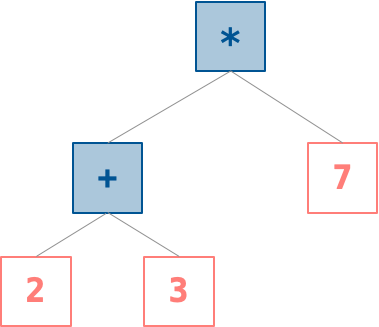
A tree-based encoding of (2+3)*7.
Certain calculators and languages (PostScript and BibTeX among them) instead evaluate expressions using a stack — a flat list of instructions to execute in order:
data StackInstr = Push Double
                | DoOp Op
                | Swap
  deriving (Show, Eq)

A list-based (stack-instruction) encoding of the same expression.
Push r pushes r onto the stack. DoOp PlusOp replaces the top two numbers with their sum (and similarly for the other operators). Swap swaps the top two numbers. In table form, with the top of the stack shown on the left:
| Stack looks like | Operation | Stack afterwards |
|---|---|---|
… |
Push r |
r … |
a b … |
DoOp PlusOp |
(b+a) … |
a b … |
DoOp MinusOp |
(b-a) … |
a b … |
DoOp TimesOp |
(b*a) … |
a b … |
DoOp DivOp |
(b/a) … |
a b … |
Swap |
b a … |
(2+3)*7 as a stack program:
[Push 2, Push 3, DoOp PlusOp, Push 7, DoOp TimesOp]
evalRPN (15 points)
We'll represent the stack itself as a list of floating-point numbers, with the head as the top:
type StackValue = Double
type Stack = [StackValue]
("RPN" stands for Reverse Polish Notation, named for Polish logician Jan Łukasiewicz, who invented the notation.)
Your task: write a recursive function
evalRPN :: [StackInstr] -> Stack -> StackValue
that runs a list of stack instructions against a starting stack, in order, and returns the number left at the top.
![Six stack states side by side, showing the stack growing and shrinking as [Push 2, Push 3, DoOp PlusOp, Push 7, DoOp TimesOp] executes, ending at 35.](../img/hw03/stack-example.png)
The stack's progression while evaluating (2+3)*7, instruction by instruction.
Be careful with the order of operands for MinusOp and DivOp — per the table above, evalRPN [Push 2.0, Push 1.0, DoOp MinusOp] [] should return 1.0, not -1.0.
Example
ghci> :l HW3.hs
*HW3> evalRPN [Push 8.0, Push 2.0, DoOp DivOp] []
4.0.
For this and the remaining problems, don't worry about inefficiency from repeated ++, and you don't need to handle stack underflow or other runtime errors.
toRPN (24 points)
Write:
toRPN :: Expr -> [StackInstr]
which converts a tree-based expression into a list of stack instructions computing the same value — one DoOp PlusOp for every PlusOp in the input, and so on. (Evaluating the expression down to a number r and returning [Push r] doesn't count — the point is to translate the structure, not shortcut it.) Pattern matching on the input, with recursion on subexpressions, is the way to go here.
Example
*HW3> toRPN (Num 1.0)
[Push 1.0].
Minimizing Stack Depth
This part is worth thinking through on paper before you start coding.
The same expression can be evaluated multiple ways: for each subexpression, you can evaluate the left side first or the right side first (using Swap to fix up order when it matters, since subtraction and division aren't commutative). For example, 1.0 - (2.0 + 3.0) can become either
[Push 1.0, Push 2.0, Push 3.0, DoOp PlusOp, DoOp MinusOp]
or
[Push 2.0, Push 3.0, DoOp PlusOp, Push 1.0, Swap, DoOp MinusOp]
The first needs a stack that holds 3 numbers at once; the second never needs more than 2:
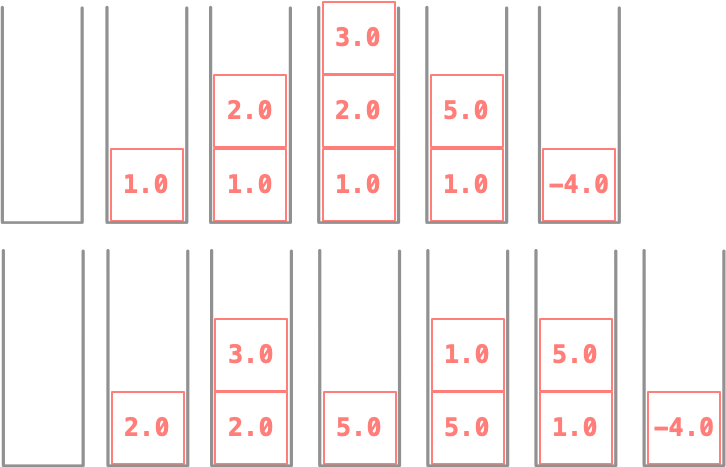
Same result, different peak stack depth, depending on evaluation order.
(We're only considering left-first-vs-right-first here, not reassociation like computing (a+b)+(c+d) as a+(b+(c+d)) — floating-point arithmetic isn't associative in general, so reassociating could change the answer.)
toRPNopt (14 points)
Define:
toRPNopt :: Expr -> ([StackInstr], Integer)
returning a pair: an optimal instruction sequence for the given expression, and the maximum number of values simultaneously on the stack while running it. "Optimal" means smallest possible peak stack size.
A few implementation notes:
- This can be computed inductively — using the optimal sequence (and required stack size) for each operand.
- You can decide which side to evaluate first just by comparing the stack depth each side requires, without looking at the actual operations. Don't write a separate helper purely for computing stack depths.
let ... inwith pattern matching is handy for naming the two values a recursive call returns.
Example Expressions (3 points each)
Define two expressions:
depth3 :: Expr
depth4 :: Expr
that require a maximum stack depth of 3 and 4, respectively — even under optimal left/right evaluation order. In other words, a correct toRPNopt should report exactly 3 and 4 for these two.
Testing Your Stack Machine
ghci test/StackSpec.hs
*StackSpec> main, and *StackSpec> :quit when done. As always, more tests of your own are welcome and encouraged.
Turning It In
Submit on Gradescope, under HW 03: Lists, Datatypes, and a Stack Machine:
- Run the full test suite one last time:
runhaskell -itest test/Spec.hs. - Copy the entire terminal output and paste it into the HW3 text box.
- Upload your
HW3.hsto the same assignment (for our records).
The Homework Workflow covers the submission step in context.
Make sure your final code is committed and pushed to your repo as well.
Where to Go From Here
This assignment's central idea — representing a program as structured data, then writing functions that operate over that structure — is one of the biggest ideas in this course, and you'll see it again and again. A couple of directions to keep exploring on your own:
- What would it take to add "memory" to the stack evaluator — commands that store and recall a computed value? How would
StackInstrneed to change? How about the evaluator itself? - Could you write a
fromRPNfunction that converts a list of stack instructions back into the corresponding tree-shaped expression?
If you'd like to see these ideas taken even further, the esoteric language Piet represents a stack-machine program as an abstract painting made of colored blocks, rather than as text at all.
The stack machine you just built is a tiny example of a much bigger idea: stack-oriented programming, where the stack isn't just an implementation detail — it is the language. Forth, PostScript (the language your printer probably speaks), and countless calculators and virtual machines (including the JVM and Python's own bytecode interpreter) are all built this way. It's not just a practical trick, either — it's theoretically rich territory: the language Joy treats stack-based programs as literal compositions of functions, with a clean underlying algebra (no variables, no substitution — just functions built out of other functions). Worth a rabbit hole if stack machines caught your interest.