
Intelligent Music Software
Interactive Learning for Improvisation
Our Impro-Visor software now includes various learning models, including grammar learning and deep learning. It also includes interaction capabilities, such as having human player trade melodies with the computer in real-time. The focus of this REU will attempt to combine interaction and learning, so that Impro-Visor becomes more of a musical companion, listening to the user and learning from him or her. Some possible variations on this theme are the user as instructor with the program as student, or the program as instructor and the user as student.
The ideal participant will have experience with machine learning, and human-computer interfaces, as well as software development using Java. Knowledge of how improvisation works is useful, but not totally essential. Experience with AI programming in Lisp, Prolog, or Python is a plus.
References
- Kondak, Z., Konst, M., Lessard, C., Siah, D., and Keller, R. Active Trading with Impro-Visor, MUME 2016–The Fourth International Workshop on Musical Metacreation ISBN #978-0-86491-397-5.
- Keller, R. Real-Time Input and Trading with Impro-Visor (video).
- Bickerman, G., Bosley, S., Swire, P., Keller, R., Learning to create jazz melodies using deep belief nets. In: Proc. First International Conference On Computational Creativity, Lisbon, Portugal. (2010).
- Keller, R., Impro-Visor: Jazz Improvisation Advisor, https://www.cs.hmc.edu/~keller/jazz/improvisor/
- Keller, R., Machine Learning Applied to Musical Improvisation, Constructive Machine Learning Workshop NIPS 2013.
Mentor: Professor Robert Keller
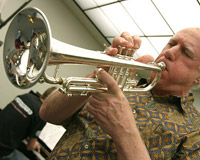 Professor Keller has been on the faculty of Harvey Mudd College since 1991, having previously held faculty positions with Princeton University, the University of Utah, and the University of California, Davis, as well as having worked in the software industry and with various government laboratories. He has broad interests in computer science, and teaches in areas such as computability and logic, software development, and neural networks. He is an active jazz musician and plays the piano and trumpet in bands in southern California. He also teaches a course in jazz improvisation at the Claremont Colleges.
