Harvey Mudd College
Spring 2009
Computer Science 81
Computability
and Logic
What this course is about
First we’ll look at logic, both propositional and predicate forms, with
an emphasis on the distinction between validity (truth) and proofs. We’ll gain
some experience in doing proofs in a style known as “natural deduction”, both
for propositional and predicate logic. This will be helpful as a way of
outlining proofs for the rest of your careers. We will also look at several
more mechanical methods of assessing the validity of a formula. We’ll also
examine the relationships between logical formulas and program correctness.
We will next review finite-state automata and their relationship to
languages and regular expressions. We’ll look at the
applications and limitations of these machines, then move on to the
more powerful pushdown automata. We will show how pushdown automata exactly
characterize the larger family of languages known as context-free languages.
These are the languages generated by grammars of the type you studied in CS 60.
We’ll look at the applications of these automata, and also show their
limitations.
Next we’ll look at Turing machines, which are even more computationally
powerful. We’ll discover what kind of grammars are equivalent to Turing
machines as well as some specialized Turing machine models. We will also
discuss the lambda calculus, an alternate basis for computability and the basis
for modern functional programming languages, as well as the partial recursive
function formulation.
As with other families of machines, Turing machines have their imitations.
We will show how to prove that certain problems cannot be solved algorithmically,
even ones not apparently related to Turing machines.
We will close by examining the connections between logic and computability
in more depth, and conclude with a look at Godel’s famous Incompleteness
Theorem.
Instructor
Bob
Keller, 1253 Olin (office hours 4:15-5:30 MTW, or whenever I'm in),
keller A T cs.hmc.edu, x 18483, AIM: MuddProf
Grutors
Denis Aleshin
Richard Bowen
Josh Ehrlich
Kaylin Spitz
Grutor Consulting Hours
Sat, 1-3 pm, Platt Campus Center Living Room (ground floor), Josh Ehrlich, joshua_ehrlich A T hmc.edu

Sat. 3-5 pm, Platt Campus Center Living Room, Kaylin Spitz, Kaylin_M_Spitz A T hmc.edu

Sun. 6-8 pm, Beckman Hall, CS Terminal Room (underground),  Denis Aleshin, daleshin A T hmc.edu

Sun. 8-10 pm, Linde Activities Center (LAC), Computer Lab (2nd floor) Richard Bowen, rsbowen A T gmail.com
Catalog Description
An introduction to some of the mathematical foundations of computer
science, particularly logic, automata, and
computability theory. Develops skill in constructing and writing
proofs, and demonstrates the applications of the aforementioned areas to
problems of practical significance. Prerequisites: Math 55, Computer Science
60. 3 credit hours. (Both semesters.)
Requirements and Grading
- 50% Homework
- 40% Exams
(1 midterm, 1 final)
- 10% Attendance
& participation
Textbooks
·
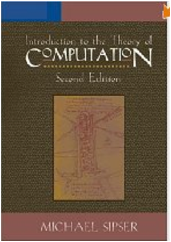
Michael
Sipser, Introduction to the Theory of Computation, Second Edition (Hardcover),
Course Technology (February 15, 2005), ISBN-10: 0534950973, ISBN-13:
978-0534950972
·
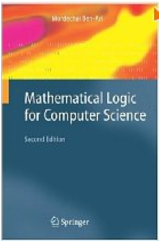
Mordechai
Ben-Ari, Mathematical Logic for Computer Science, Second Revised edition
(Paperback), Springer (February 2003), ISBN-10: 1852333197, ISBN-13:
978-1852333195
This Outline is being revised to
conform to texts.
Lecture Slides and Assignments (will be posted as each is given)
- 01 Introduction
- Assignment 1 (due Monday 26 January 2009) (solutions)
- 02 Natural Deduction
- Natural Deduction Rule Summary
- JAPE Website
- JAPE Natural Deduction Manual (pdf, see Chapter 2 for mouse gestures)
- Assignment 2 (due Monday 2 February 2009) (solutions)
- DeMorgan's Laws (WP)
- 03 Tableau Proofs
- 04 Predicate Logic
- Assignment 3 (due Monday 9 February 2009) (solutions)
- 05 Predicate Tableaux
- Assignment 4 (due Monday 16 February 2009) (solutions)
- 06 Propositional Soundness and Completeness
- "Living Proof" of Propositional Completeness for Natural Deduction (Prolog program)
- 07 Sequent Calculus
- Sequent Calculus in Natural Deduction Style (research paper)
- Assignment 5 (due Monday 23 February 2009) (solutions)
- 08 Resolution
- Assignment 6 (due Monday 2 March 2009) (solutions)
- 09 Resolution 2
- Resolution Principle (MathWorld)
- Notes on Conversion to Clausal Form
- Otter 3.3 (command-line)
- Original Otter manual
- Otter examples
- Inference Rules Used in Otter
- Prover9
- Prover9 Manual
- Otter-λ (web, and other)
- Modus Ponens Example | Transitivity Example
- Monoid Example 1 | Monoid Example 2 | Monoid Example 3
- Group Example 1
- Equivalence Relation Example 1
- Universally-valid Example 1 | Universally-valid Example 2 | Universally-valid Example 3 | Universally-valid Example 4
- Missile Example
- Mushrooms Example
- Grandfather Example (answer predicate)
- Pegs puzzle
- Son of BirdBrain II (More theorem proving examples)
- Assignment 7 (due Monday 9 March 2009) (solutions)
- Commutativity of Addition (for Otter)
- 10 Program Logic
- 11 Structural Induction
- Outline of Sipser book
- Notes on Minimization and Myhill-Nerode Theorem
- Notes on the Myhill-Nerode Theorem
- grep, egrep, and automata
- Assignment 8 (due Monday 6 April 2009)(solutions)
- Assignment 9 (due Monday 13 April 2009)(solutions)
- NFA simulator and convertor (in Prolog)
- Assignment 10 (due Monday 20 April 2009)(solutions)
- JFLAP Tutorial
- Notes on Grammars
- CYK Algorithm
- Rice's Theorem
- Link to Slides for Chapters 4 and 5 (by Michael Soltys)
- Slides on Post's Correspondence Problem (by Mark Greenstreet)
- Wang Tiles